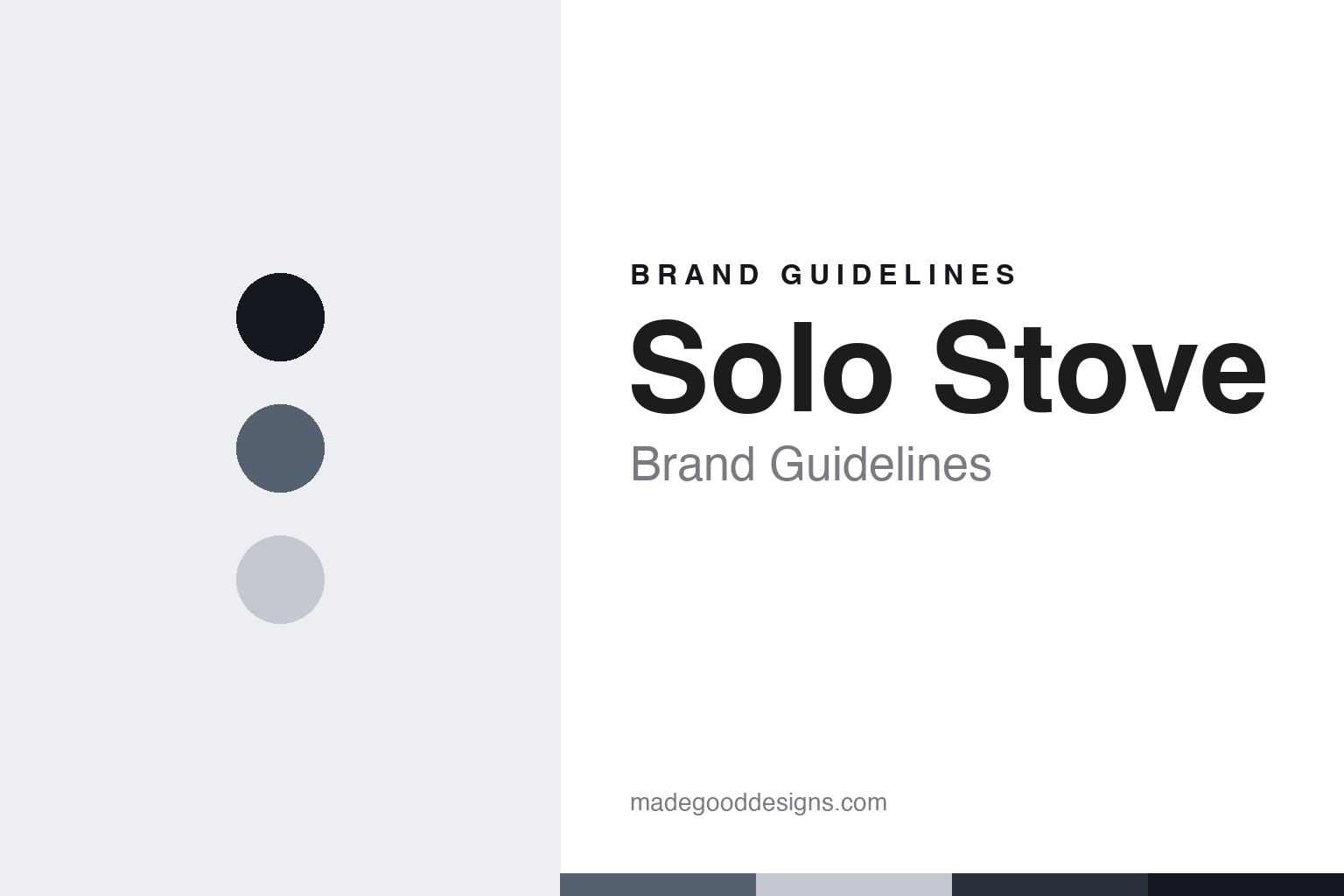
Solo Stove Brand Guidelines
The viral fire pit that went public.
Aa
Two constants: a smokeless-steel palette and an outdoor-sans register. Abstract homage — not a Solo Stove product or mark; no fire pit, oven or logo is reproduced.
The viral fire pit that went public
Solo Stove is the smokeless-fire-pit brand whose backyard virality took its parent public at ~$2B, then off the NYSE to over-the-counter trading by 2026.
Solo Stove brings the pizza-oven round its outdoor-lifestyle node — a fire-pit brand first, a pizza-oven maker second, and a cautionary public-company story throughout. It was founded in 2011 by brothers Jeff and Spencer Jan in the Dallas–Fort Worth area, starting with a twig-burning backpacking stove. Solo Stove makes and sells the outdoor gear, and its answer to a round about where products are made and who owns them now includes a hard public-market chapter: designed in Texas, made in Asia, and the flagship of a company that went from a two-billion-dollar listing to over-the-counter trading.
Its identity is the viral fire pit that went public. The smokeless fire pits, the pizza-oven extension and the public-company rise and fall are the story here. A brand, viral. The viral fire pit that went public.
(Honest notes, because the corporate story must be told plainly and in the present tense. Solo Stove sells outdoor gear as its heroes — its smokeless stainless-steel fire pits, the Bonfire, Ranger and Yukon, and its Pi and Pi Prime outdoor pizza ovens — and we report its performance language as the brand’s own. On the founders: it was founded by brothers Jeff and Spencer Jan; the executive who scaled it and took it public was a later chief executive, not a founder, so we do not credit a wrong founding name. On ownership, the point that carries the node: Solo Stove is the flagship of Solo Brands, a roll-up that also owns apparel and paddle-sport labels; it listed on the New York Stock Exchange in 2021 at roughly a two-billion-dollar valuation, then declined sharply, issued going-concern warnings, and in April 2026 was delisted from the exchange to over-the-counter trading, with bankruptcy risk disclosed — so we describe it as an over-the-counter, distressed company, not a healthy blue chip. On where it is made: designed in Texas and manufactured in Asia, principally China. Its designs and the Solo Stove, Bonfire and Pi names are IP we describe but do not reproduce; there is no official brand hex; these tones are an unofficial interpretation.)
Colour
Solo Stove lives in a smokeless steel. Click a swatch to copy the hex.
Solo Stove’s identity is outdoor, viral and strained — a smokeless steel, an ink, a pale iron, a deep graphite, and a paper. The palette leans smokeless steel and pale iron: a cool, muted register that suits a stainless fire pit and a sober corporate chapter rather than a loud logo colour. It signals the viral fire pit that went public — outdoor, popular and now financially strained. The honest caveat: with no published brand hex, these values are an original, unofficial interpretation, not first-party colours.
The lesson is a smokeless steel signals an outdoor, sober identity. Solo Stove’s world is a stainless fire pit that burns clean, and a company that burned hot and cooled. For designers, it is a reminder that a cool smokeless steel and a soft pale iron can carry a maker brand — a muted tone held as colour, not a product shot. Because these tones can fail as small text, keep type dark and let the colour live in the accents, palette and band. The takeaways: date it to 2011; credit the Jan brothers; describe the public-company arc in the present tense; state the designed-US, made-Asia reality; and treat any single hex as unofficial.
Typography
The register is an outdoor sans — outdoor, popular, sober.
Solo Stove’s identity carries an outdoor, popular, sober spirit — a viral lifestyle brand with a chastened corporate story. An outdoor sans captures the mood: clean, plain and direct, the register of a mass outdoor product told honestly. Set in a smokeless-steel palette, the outdoor sans feels outdoor and sober — exactly the personality Solo Stove carries now. It behaves like a made, functional thing rather than a loud logo, mirroring double-wall steel and a clean flame. (Solo Stove’s real fire pits, ovens and the Bonfire name are things we describe but do not reproduce, and the exact typeface is not ours to use.) Because it is not ours to use, the honest description is “an outdoor-sans brand,” shown here in a stand-in. The type behaves like the brand: outdoor, popular and sober.
Aa
An outdoor-sans brand — outdoor and sober. (Specimen set in Archivo, an outdoor-sans STAND-IN; NOT the Solo Stove logo or any fire pit.)
The pizza oven
Solo Stove stands for the viral fire pit that went public.
Solo Stove brings the round its outdoor-lifestyle node. A smokeless-steel palette, an outdoor sans and a 2011 founding make one thing — the viral fire pit that went public — the whole identity: outdoor, viral and strained. The smokeless fire pits are the pitch, and the public-company arc is the sober twist. The point is a brand that rode a viral moment to a big listing and then fell off it, in a round about who owns what and how honestly the story is told.
Put to work, the identity is the brand told straight, founders credited and the corporate arc kept current. A maker in this spirit would date it to 2011, credit the Jan brothers, and describe the public-company arc in the present tense. A reader in this spirit would keep the facts right: Solo Stove sells outdoor gear as its heroes, led by its smokeless fire pits and the Pi pizza ovens; it was founded in 2011 by brothers Jeff and Spencer Jan; it is the flagship of Solo Brands, which listed on the NYSE in 2021 at roughly two billion dollars and by April 2026 was delisted to over-the-counter trading with going-concern warnings; and it is designed in Texas and made in Asia. Solo Stove sits sixth in the round, after Witt. The honest editorial moves are to date it to 2011, to get the founders right, to describe the delisting in the present tense, and to state the manufacture.
For designers and brand-builders, Solo Stove continues the pizza oven: tell a public-company rise and fall honestly — and never dress a distressed company as a stable one. The lessons: recognise virality as a beginning, not a moat; get founders and executives distinct; describe a company’s real financial standing plainly; keep an extension product in the context of the core; and never reproduce a logo. It is also a reminder to stay precise: Solo Stove is the smokeless-fire-pit brand whose backyard virality took its parent public at roughly two billion dollars, then off the NYSE to over-the-counter trading by 2026 — with the palette here an unofficial interpretation. The hook is that arc: a backyard fire pit went so viral it took the company public at a roughly two-billion-dollar valuation in 2021, and by April 2026 that same company had been pushed off the New York Stock Exchange to the over-the-counter market, warning it might not survive as a going concern — while the “smokeless” fire pit at the centre of it all is really just clever double-wall airflow physics. Read that way, Solo Stove is less a fire pit than a market cautionary tale: outdoor, popular, sober. The lesson for a brand is that virality and honest reporting must travel together, and telling the standing straight keeps the story earned. Solo Stove made the-viral-fire-pit-that-went-public the identity — proof that an honest rise-and-fall carries a round.
Explore & save
Keep Solo Stove’s identity on hand — save it to a board in the Made Good inspiration library.
Solo Stove identity set
Pin the smokeless-steel palette and the outdoor-sans register to your own board.