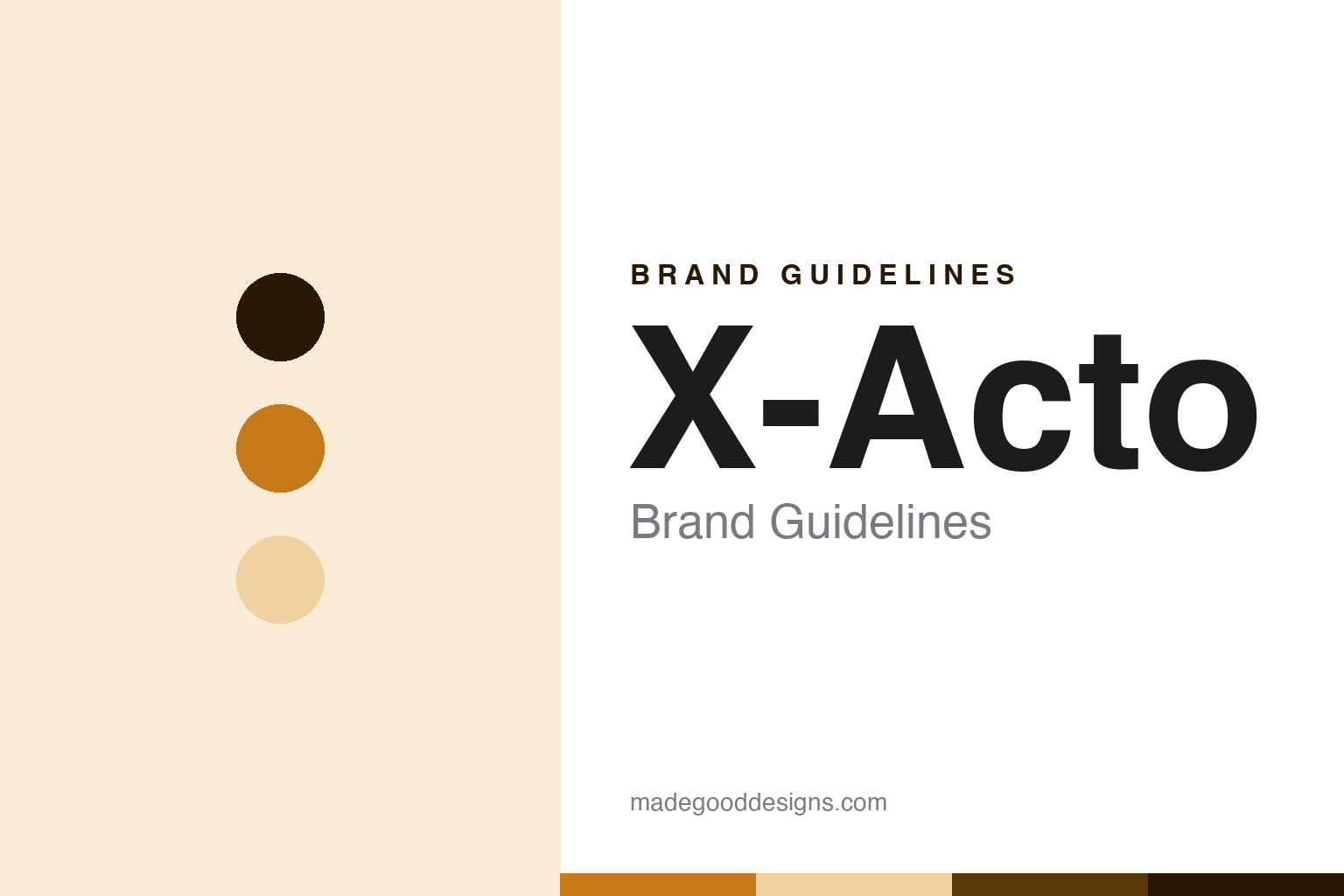
X-Acto Brand Guidelines
The craft knife owned by Newell Brands.
Aa
Two constants: an X-Acto-amber palette and a craft-heritage-sans register. Abstract homage — not an X-Acto product or mark; no knife, blade or logo is reproduced.
The craft knife owned by Newell Brands
X-Acto is the American precision hobby knife that grew from removable-blade surgical scalpels — now a Newell Brands stationery brand alongside Elmer’s.
X-Acto follows Martor as the round’s craft-heritage node — the knife on every art desk, born from a surgical scalpel and now one brand inside a stationery conglomerate. Its answer to a round about who owns and where-makes the cutter is a heritage name under a big parent: the craft knife owned by Newell Brands.
Its identity is the craft knife owned by Newell Brands. The scalpel origin, the number-one hobby knife and the Newell Brands ownership are the story here. The craft knife. The craft knife owned by Newell Brands.
(Honest notes, so the origin, the product, the ownership and the making are framed accurately, with dates hedged. X-Acto sells precision hobby knives as its heroes; we report its language as the brand’s own. On origin: X-Acto was invented by Sundel Doniger, an immigrant to the United States, in the 1930s, growing from a medical-supply background making scalpels with removable blades, then repurposed as a craft and art tool, with the exact dates treated as reported. On the product: its signature is the number-one precision hobby knife, a slim aluminium handle taking a fine-point replaceable blade, along with craft blades, pencil sharpeners and paper trimmers. On ownership, the key point: X-Acto is a brand of Newell Brands, sitting in Newell’s writing and stationery group alongside Elmer’s, which Newell acquired in 2015, so the accurate framing is that Newell owns both, with Newell publicly traded under the ticker NWL. On the making: not documented, which we hedge rather than claim made in the USA. Its designs and the X-Acto name are IP we describe but do not reproduce; there is no official brand hex; these tones are an unofficial interpretation. On a trap: X-Acto is a trademark, not the generic Exacto.)
Colour
X-Acto lives in an X-Acto amber. Click a swatch to copy the hex.
X-Acto’s identity is American, conglomerate-owned and craft-rooted — an X-Acto amber, an ink, a pale amber, a deep umber, and a paper. The palette leans X-Acto amber and deep umber: a warm, precise register that stands in for a craft-heritage brand rather than a loud logo colour. It signals the craft knife owned by Newell Brands — American, conglomerate-owned and craft-rooted. The honest caveat: with no official brand hex, these values are a practical, unofficial interpretation, not first-party colours. A further design lesson is that a heritage name can carry a conglomerate quietly, so an X-Acto amber can hold the art-desk story while the words name Newell Brands as the owner and keep the scalpel-origin dates honestly reported.
The lesson is an X-Acto amber signals an American, craft-rooted identity. X-Acto’s world is the art desk and the number-one knife. For designers, it is a reminder that a warm amber and a pale amber can carry an American, craft-rooted brand — a precise tone held as an accent, not a product shot. Because a warm hue can fail as small text, keep type dark and let the colour live in the accents, palette and band. The takeaways: tell the scalpel origin and name Sundel Doniger, with dates reported; center the number-one hobby knife; name Newell Brands as the owner alongside Elmer’s; and keep X-Acto as a trademark, not the generic Exacto.
Typography
The register is a craft-heritage sans — American, conglomerate-owned, craft-rooted.
X-Acto’s identity carries an American, craft-rooted spirit — a heritage tool inside a modern group. A craft-heritage sans captures the mood: clean, precise and practical, the register of an art-desk brand. Set in an X-Acto-amber palette, the craft-heritage sans feels dependable and current — exactly the personality X-Acto carries. It behaves like a made, pointed thing rather than a loud logo, mirroring a point-line and a guard-dot. (X-Acto’s real products and the name are things we describe but do not reproduce, and the exact typeface is not ours to use.) Because it is not ours to use, the honest description is “a craft-heritage-sans brand,” shown here in a stand-in. The type behaves like the brand: American, conglomerate-owned and craft-rooted.
Aa
A craft-heritage-sans brand — clean and precise. (Specimen set in Jost, a craft-heritage-sans STAND-IN; NOT the X-Acto logo or products.)
The cutter node
X-Acto stands for the craft knife owned by Newell Brands.
X-Acto sits fifth in the round as its craft-heritage node. An X-Acto-amber palette, a craft-heritage sans and a scalpel origin make one thing — the craft knife owned by Newell Brands — the whole identity: American, conglomerate-owned and craft-rooted. The scalpel origin is the frame, the number-one hobby knife is the substance, and the Newell Brands ownership is the twist. The point is the art-desk knife, born from a surgical tool and now one brand in a stationery conglomerate, in a round about who owns and where-makes the cutter.
Put to work, the identity is the brand told straight, the owner named and the origin reported. A brand in this spirit would tell the scalpel origin and name Sundel Doniger with dates reported, center the number-one hobby knife, name Newell Brands as the owner alongside Elmer’s, and keep X-Acto as a trademark. A reader in this spirit would keep the facts right: X-Acto makes precision hobby knives; it grew from surgical scalpels; Newell Brands owns it; and it is not the generic Exacto. X-Acto sits after Martor and before Slice. The honest editorial moves are to tell the origin, to center the product, to name the owner, and to keep the trademark.
For designers and brand-builders, X-Acto carries the cutter node: a craft heritage can live on inside a conglomerate. The lessons: a heritage tool can be conglomerate-owned, here X-Acto under Newell Brands; an origin is told, invented by Sundel Doniger in the 1930s from a background making removable-blade surgical scalpels, repurposed for craft, with dates reported; a product is centered, the number-one precision hobby knife, a slim aluminium handle and a fine-point blade, plus sharpeners and trimmers; an ownership is named, a Newell Brands brand in the writing group alongside Elmer’s, which Newell acquired in 2015, Newell listed as NWL; a making is hedged, not documented; and a trademark is kept, X-Acto not the generic Exacto. It is also a reminder to name a parent accurately: X-Acto and Elmer’s are both Newell Brands brands, rather than one owning the other — with the palette here an unofficial interpretation. The hook is that heritage-inside-a-group: X-Acto is the craft knife owned by Newell Brands, the American precision hobby knife that grew from removable-blade surgical scalpels, now a Newell Brands stationery brand alongside Elmer’s. Read that way, X-Acto is less a single cutter than the craft knife owned by Newell Brands: American, conglomerate-owned, craft-rooted. The lesson for a brand is that a craft heritage can live on inside a conglomerate, and naming the owner keeps it honest. X-Acto made the-craft-knife-owned-by-Newell-Brands the identity — proof that a craft heritage can carry a node.
Explore & save
Keep X-Acto’s identity on hand — save it to a board in the Made Good inspiration library.
X-Acto identity set
Pin the X-Acto-amber palette and the craft-heritage-sans register to your own board.


