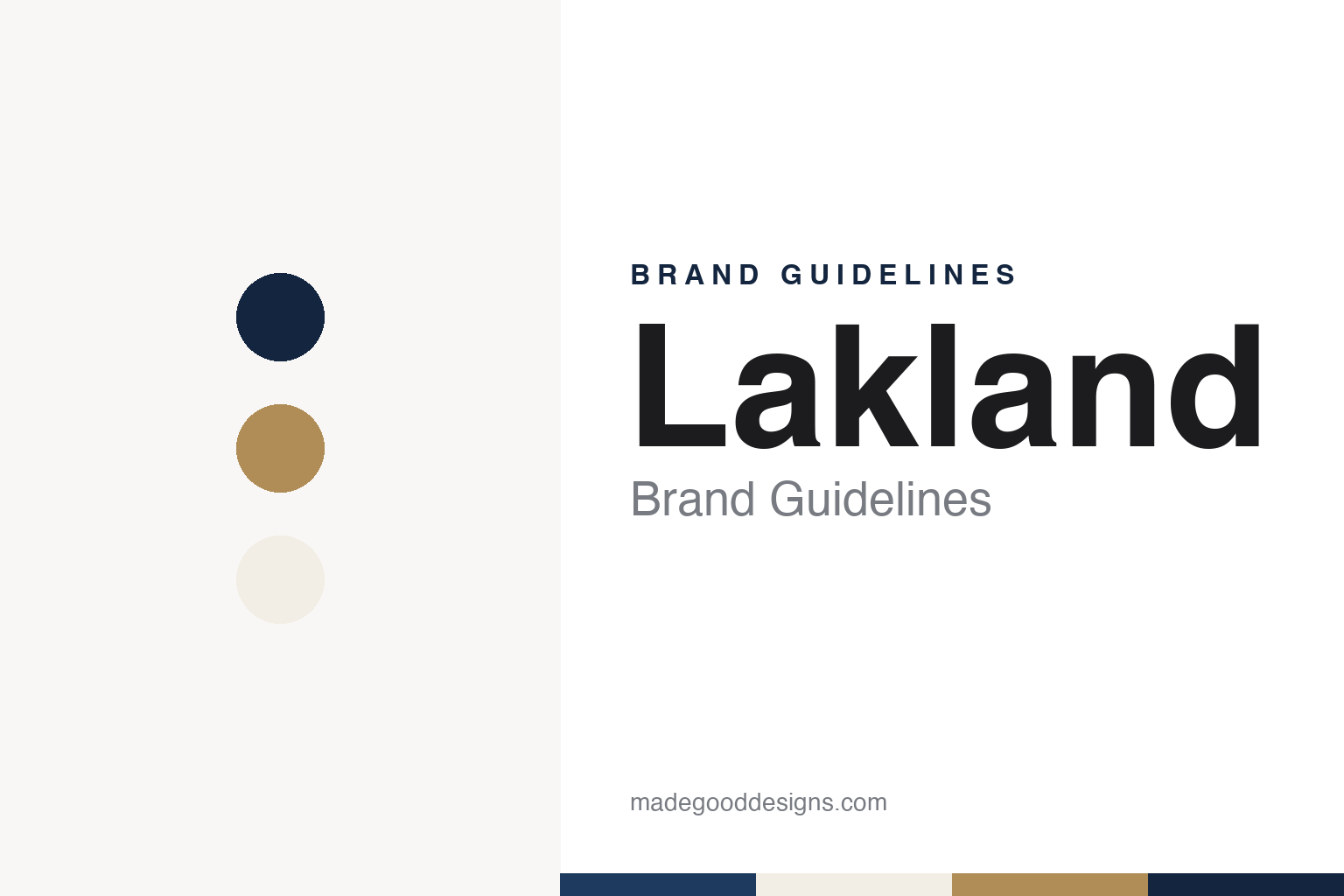
Lakland Brand Guidelines
The Chicago bass maker named after its two founders.
Aa
Two constants: a Lakland navy, amber and cream palette and a Grotesque sans register. Abstract homage — not a Lakland product or mark; no instrument, logo or headstock is reproduced.
Lakin plus McFarland
A bassist, a repairman and a home-equity loan.
Lakland began in Chicago in 1994. Its founders were the bassist Dan Lakin and Hugh McFarland, whom Forbes described in 2004 as a guitar repairman, and the name is a blend of their two surnames. The company says it is pronounced “Lake-land,” with a long first A, and its FAQ points to the mark over the A in its logo as the clue. Hanson Musical Instruments, announcing its purchase of the firm in April 2010, also gave the founding as 1994 with McFarland.
According to Jim Roberts’s book American Basses (Backbeat, 2003), as cited by English Wikipedia, the pair began the first prototype in January 1994 and showed it at the summer NAMM trade show that July. It mixed ideas from the Fender Jazz Bass and an early Music Man StingRay. Forbes reported in 2004 that Lakin launched the business with $20,000 from a home-equity loan, and that McFarland’s first design borrowed so closely from classic basses that it drew a cease-and-desist letter from Fender over trademark infringement, sending the pair back to the drawing board. Wikipedia, again citing Roberts, says the prototype’s electronics were prompted by a Bass Player review of the Warwick Dolphin, used Bartolini pickups and introduced the oval bridge plate that became a Lakland feature.
Money was the hard part. Production was slower than planned, Lakin told Forbes, and in 1996 Lakland became a unit of his family’s Chicago tyre-recycling business, A. Lakin & Sons; McFarland left a year later. By 2000 the company had spent more than it had taken in, and Lakin and friends raised fresh capital to keep it going. Sources differ on how far back the family firm goes — Forbes credits Lakin’s great-grandfather, Wikipedia his grandfather — so we leave the date aside.
Colour
Chicago assembly, Korean wood-shops and signature numbers.
The basses themselves were classic in outline and modern in detail. The first model, the 44-94, and the five-string 55-94 set the naming habit: the first two digits give the string count, the last two a year. In 1997 Lakin, a fan of the session bassist Joe Osborn, contacted him after reading about him in Bass Player; the vintage Jazz-style signature model that followed, developed with a team that included luthier Michael Tobias, was Lakland’s first, Wikipedia says citing Roberts. Signature basses with Donald “Duck” Dunn, Bob Glaub, Jerry Scheff, Darryl Jones and Geezer Butler followed, and the Decade, a two-pickup model, marked the tenth anniversary in 2004.
“Made in the USA” meant a particular thing. In 2004 Forbes reported that the necks were carved by workers in Montana and the bodies shaped and painted in California, with frets, electronics and hardware installed in Chicago. Endorsers then included Tony Garnier of Bob Dylan’s band, Adam Clayton of U2 and Darryl Jones of the Rolling Stones, who got instruments on favourable terms. The same article noted that the ad agency Leo Burnett had made Lakland’s print, TV and web creative for free, and had won four awards for it, including a Clio.
The turning point was the Skyline Series of 2001. Lakin teamed up with Westheimer Corp., an exporter-importer in Northbrook, Illinois, which held a stake in a factory in Seoul. North American wood was cut, painted and fretted in South Korea, and the electronics went in back in Chicago. In 2003, Forbes reported, Lakland sold about 1,000 Korean-made Skylines and 300 Chicago-made basses and broke even for the first time, on $1.2 million in revenue. Wikipedia says Skyline production moved to Indonesia in 2008, citing a forum post by a Lakland executive, so we treat that date as unconfirmed.
Typography
Design and documentation.
The basses in this guide come from small workshops, most started in the 1970s and 1980s by a luthier or a luthier-and-player partnership. Several are connected: English Wikipedia says Vinny Fodera was Spector’s first full-time employee, in 1977, and that he and Joey Lauricella started Fodera after working with Ken Smith Basses.
Three are in New York State. Fodera says it has been in Brooklyn since 1983 and is now a family business with Laura Fodera as partner and chief executive. Sadowsky, founded by Roger Sadowsky in 1979, gives an address in Long Island City, Queens; since 2019, under a licence with Germany’s Warwick, its MetroLine, MasterBuilt and Custom Shop basses have been made in Germany, Wikipedia and Warwick’s Sadowsky website say. Spector, founded by Stuart Spector in Brooklyn in 1976, was bought by Korg in 2019, Bass Magazine reported in 2021; it builds its US basses near Woodstock.
Lakland, founded in Chicago in 1994, was bought in 2010 by a group led by Hanson Musical Instruments, according to the announcement of the deal. It says its USA Series basses are built in Chicago.
Ken Smith Basses says every instrument is handmade at its shop in Perkasie, Pennsylvania. Dingwall, founded by Sheldon Dingwall in 1987, is based in Saskatoon, Canada; its own spec sheets list most models as made in Canada and a few lower-priced ones as built in China or Indonesia and finished in Canada. Alembic is run by the Wickersham family in Rohnert Park, California, the company says.
This guide sets out what can be checked about each brand — who founded it, who owns it, and what it says about where its products are made — and marks clearly what rests only on the company’s own word.
Aa
A sturdy grotesque — for a maker that named its basses with numbers. (Specimen set in Archivo, a sans STAND-IN; NOT the Lakland logo.)
Lakland
A Chicago brand under a Chicago owner.
Ownership changed in 2010. A press release dated 30 April 2010, carried by Music Gear Review, said a group led by Hanson Musical Instruments of Chicago, a maker of pickups and electric guitars, had bought Lakland Basses. John Pirruccello, who had spent 11 years at Lakland as global sales director and chief operating officer, became president of the new Lakland Guitars, LLC. Hanson had been Lakland’s main supplier of bass pickups and preamps since 2005, and its principals had been Lakland shareholders from 2000 to 2009. The brand name stayed, but the signature basses took numbers: the Glaub became the 44-64, the Dunn the 44-64 Custom and the Osborn the 44-60. English Wikipedia, citing Premier Guitar, says Hanson was founded in 2005 by John and Bo Pirruccello.
Today the website calls Lakland “family owned” and says its USA Series and USA Classic Series are built in its Chicago facility “one at a time, with a true custom shop approach,” with pickups hand-wound there; the Classic line trims options to lower the price. Skyline basses, it says, are “put together abroad to keep down costs,” without naming a country; we found none on the retailer pages we checked either. Wikipedia adds that a Shoreline series is made in Japan by ESP for the Japanese market.
For a design guide, Lakland shows how a small maker can build an identity from a pronunciation, a numbering system and a hometown. Compare Fender, whose Jazz and Precision basses Lakland reinterprets, and Warwick, whose Dolphin helped shape its first electronics. For this guide we use navy, amber and cream with a sans, an unofficial interpretation; no product or logo is reproduced.
Explore & save
Keep Lakland’s identity on hand — save it to a board in the Made Good inspiration library.
Lakland identity set
Pin the Lakland navy, amber and cream palette and the Grotesque sans register to your own board.