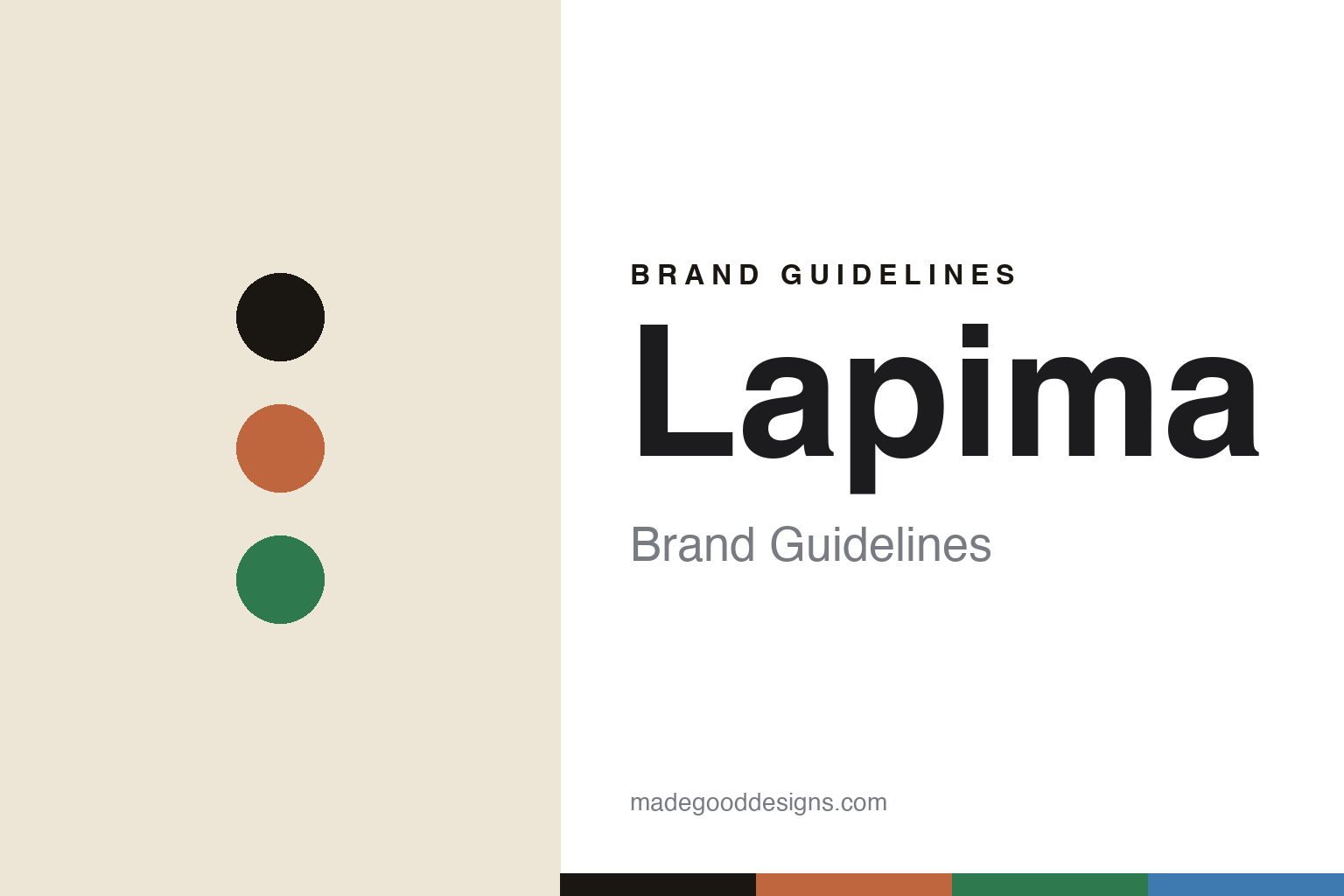
Lapima Brand Guidelines
Sculpted in Brazil.
Aa
Two constants: a terracotta-and-jungle palette and a modernist sans register. Abstract homage — not the Lapima identity.
Sculpted in Brazil
Lapima carves modernist frames in its own atelier.
Lapima is a lesson in craft and place as identity. Founded in 2016 in Brazil by married couple Gustavo and Gisela Assis — who say the brand was “built entirely by the two of us” — it is an independent, founder-owned house that produces entirely in its own atelier, with international luxury press to match.
Its identity is Brazilian modernism, sculpted by hand. Frames are made from thick Italian acetate (chosen because it can be sculpted), CNC-cut and hand-polished across more than thirty stages under one roof. The design language draws on Brazilian modernist architecture and the country’s biomes — sculptural curves, generous volumes, depth of colour. Models carry human first names (Julia, Nina, Lina, Otto, Cleo, Carlota), and the brand name comes from the Portuguese “lá em cima” (“up there”), as the founders’ young son once pronounced it.
(Honest notes: Lapima is independent and founder-owned (replacing our earlier Brazil consideration, which had been acquired). The first-name models are a naming convention with mixed, personal origins — not a confirmed architect-homage system, so we don’t overclaim one. The palette is drawn from Brazil’s landscape, and with no official brand hex these tones are a qualitative, unofficial interpretation.)
Colour
Lapima lives in a terracotta-and-jungle palette. Click a swatch to copy the hex.
Lapima’s identity is warm, sculptural and rooted — an ink, a terracotta, a jungle green, a sky blue, and a sand. The palette reads like Brazil — modernist terracotta, Atlantic-forest green and expansive blue — the register of a place-rooted, sculptural house. It signals craft and landscape rather than trend. The honest caveat: with no published brand hex, these tones are an original, unofficial interpretation, not first-party values.
The lesson is modernist terracotta with jungle green signals a place-rooted, sculptural house. Lapima’s world is Brazil’s architecture and biomes, carved into acetate. For designers, it is a reminder that a palette sourced from a real place reads as rich and rooted — right for a modernist, hand-made house. The takeaways: source the palette from the place (Brazil’s landscape); let the material be sculpted (thick acetate); keep the forms generous; and treat any single hex as unofficial.
Typography
The register is a modernist sans — sculptural, warm, rooted.
Lapima’s identity carries a sculptural, warm, rooted spirit — modernist form and Brazilian colour. A modernist sans captures the mood: it is clean and confident, the register of modernist architecture. Set in a terracotta-and-jungle palette, the modernist sans feels sculptural and warm — exactly the personality Lapima carries. It is rooted rather than trend-driven, mirroring generous, hand-carved volumes. (Lapima’s real frames are works we describe but do not reproduce, and the exact typeface is not ours to use.) Because it is not ours to use, the honest description is “a modernist sans spirit,” shown here in a stand-in. The type behaves like the brand: sculptural, warm and rooted.
Aa
A modernist sans spirit — sculptural and warm. (Specimen set in Gabarito, a modernist sans STAND-IN; NOT the Lapima identity.)
Place as identity
Lapima stands for Brazil, sculpted into acetate.
Lapima is a lesson in making place and craft the identity. A terracotta-and-jungle palette, a modernist sans and hand-carved frames make Brazilian modernism the whole brand — sculptural, warm, rooted. The place is the differentiator. The differentiator is a made-in-atelier, modernist identity.
For designers and brand-builders, Lapima offers a clear takeaway: root the brand in a real place and process. The lessons: make it yourself (the own atelier, thirty-plus stages); draw the language from home (Brazilian modernism, the biomes); sculpt a real material (thick Italian acetate); and name with warmth (first names, “lá em cima”). It is also a reminder to stay accurate: it’s a 2016 founder-owned couple’s house, the first-name models aren’t a confirmed architect system, and the palette here is an unofficial interpretation. Lapima made place the brand — proof that where and how it’s made can be the difference.
Explore & save
Keep Lapima’s identity on hand — save it to a board in the Made Good inspiration library.
Lapima identity set
Pin the terracotta-and-jungle palette and the modernist-sans register to your own board.