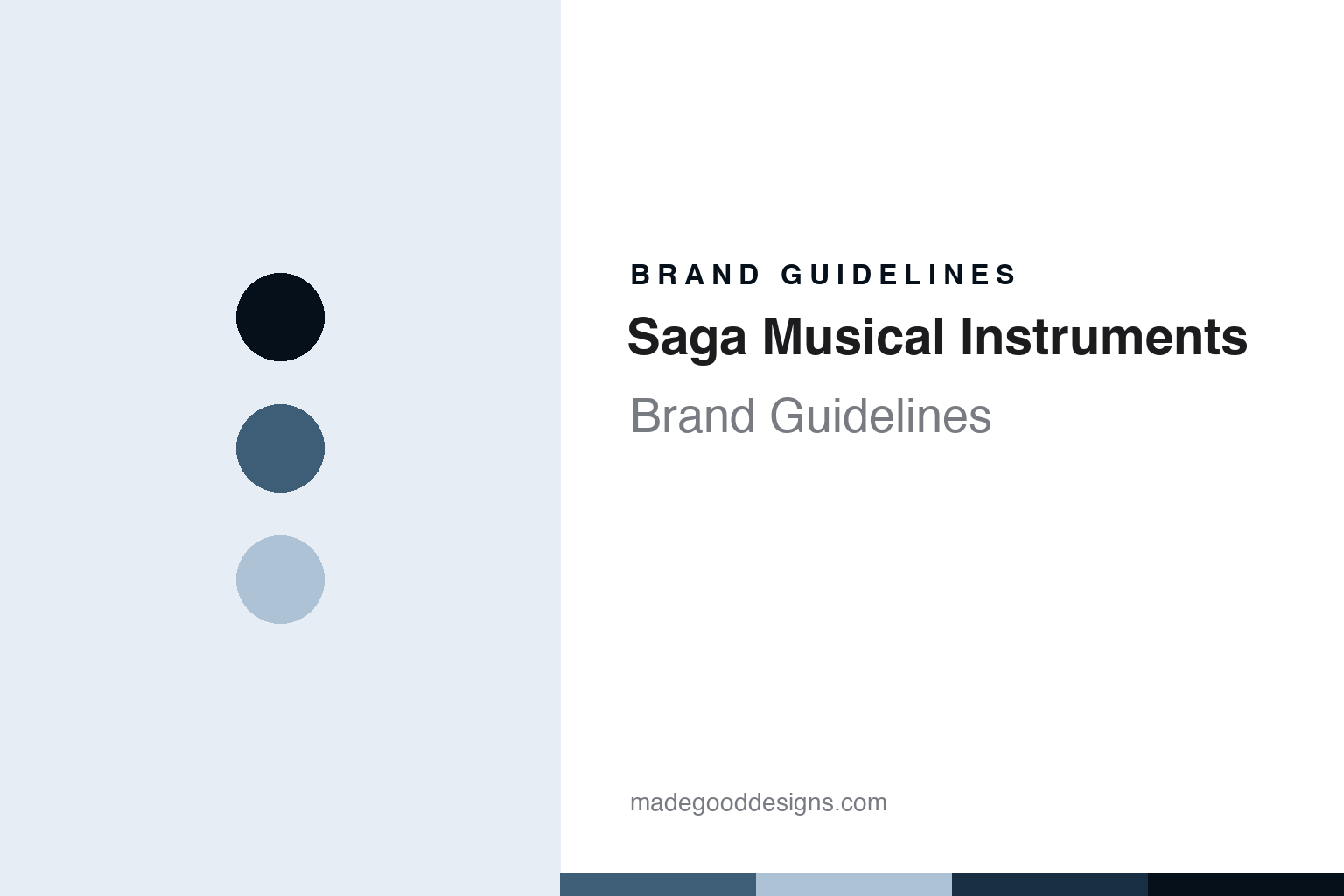
Saga Musical Instruments Brand Guidelines
The import house of many names.
Aa
Two constants: a merchant-slate palette and an import-house-sans register. Abstract homage — not a Saga product or mark; no instrument silhouette or logo is reproduced.
The import house of many names
Saga Musical Instruments is the California import house that designs and imports a whole stable of brand names, from Blueridge to Kentucky, without its own factory.
Saga Musical Instruments opens this fourth stringed-instrument round — the maker-or-merchant round — as its clearest merchant: the California import house that does not build instruments at all, but designs and imports a whole stable of brand names. Saga sells the instrument, and its answer to a round that asks maker or merchant is plainly merchant — one importer standing behind a shelf of names. A brand of brands.
Its identity is the import house of many names. The many brand names, the overseas manufacture and the no-own-factory model are the story here. A brand of brands. The import house of many names.
(Honest notes, so the model stays clear, and the names stay attributed. Saga Musical Instruments, based in South San Francisco, California, owns and distributes a large stable of brands — on its own site, among them Blueridge guitars, Kentucky mandolins, Cremona student violins, Gold Star banjos and Regal resonators, alongside Golden Gate, Bristol and Trinity College, with more claimed — around two dozen names in all. On what it makes, the star question of this round, it makes none itself: it specifies and designs to its own requirements and imports, with the instruments built in China and elsewhere in Asia, and no factory of its own. On its history, a founder and a founding year — a commonly-cited 1969 and a founder name — we could not verify, so we describe it as an importer of more than four decades. Two cautions: its Cremona brand, named for the Italian city, is unrelated to Kremona, the independent Bulgarian factory; and its brand names are trademarks we describe but do not reproduce. There is no official brand hex; these tones are an unofficial interpretation.)
Colour
Saga lives in a merchant slate. Click a swatch to copy the hex.
Saga’s identity is merchant, imported and many-named — a merchant slate, an ink, a pale harbor, a deep navy, and a paper. The palette leans merchant slate and pale harbor: a shipping register that nods to an import house rather than a loud logo colour. It signals a house of many names. The honest caveat: with no published brand hex, these values are an original, unofficial interpretation, not first-party colours.
The lesson is a merchant slate signals a merchant, imported identity. Saga’s world is a shelf of brand names. For designers, it is a reminder that a merchant slate and a soft pale harbor can carry a music brand — the tone of the importer. Because these tones can fail as small text, keep type dark and let the colour live in the accents, palette and band. The takeaways: name the brands honestly; say it imports and does not build; keep Cremona distinct from Kremona; and treat any single hex as unofficial.
Typography
The register is an import-house sans — merchant, plain, many-named.
Saga’s identity carries a merchant, plain, many-named spirit — an import house, not a graphics label. An import-house sans captures the mood: clean, organised and confident, the register of a distributor’s catalogue. Set in a merchant-slate palette, the import-house sans feels merchant and many-named — exactly the personality Saga carries. It is a stable of names rather than a logo, mirroring the catalogue. (Saga’s real brand names are things we describe but do not reproduce, and the exact typeface is not ours to use.) Because it is not ours to use, the honest description is “an import-house-sans distributor,” shown here in a stand-in. The type behaves like the brand: merchant, plain and many-named.
Aa
An import-house-sans distributor — merchant and many-named. (Specimen set in Space Grotesk, an import-house-sans STAND-IN; NOT the Saga logo or any brand mark.)
Maker or merchant
Saga Musical Instruments stands for the import house of many names.
Saga opens the maker-or-merchant round as its clearest merchant. A merchant-slate palette, an import-house sans and a California base make one thing — the import house of many names — the whole identity: merchant, imported and many-named. The stable of brands is the pitch, and the no-own-factory model is the point. The point is one importer behind a shelf of names, opening a round that asks whether a brand builds or buys.
Put to work, the identity is the importer told straight, model and all — with the brands named and the manufacture placed abroad. A maker in this spirit — or here, a merchant — would name the brands honestly, say it imports rather than builds, and keep Cremona distinct from Kremona. A reader in this spirit would keep the facts right: Saga Musical Instruments, in South San Francisco, owns and distributes a large stable — Blueridge, Kentucky, Cremona, Gold Star, Regal, Golden Gate, Bristol, Trinity College and more, around two dozen; it makes none itself, specifying and importing instruments built in China and elsewhere in Asia, with no factory of its own; and its founder and founding year are unverified, so it is described as an importer of more than four decades. Saga anchors the round’s merchant end, before the honest-import makers and the genuine workshops. The honest editorial moves are to name the brands, to say it imports and does not build, to hold the founding open, and to keep Cremona and Kremona distinct.
For designers and brand-builders, Saga opens maker or merchant: say it imports and does not build — and name the brands honestly. The lessons: describe an import house as an import house; name the stable of brands it stands behind; place the manufacture abroad plainly; keep a same-city-name collision distinct; and never reproduce a brand mark. It is also a reminder to stay precise: Saga Musical Instruments is the California import house that designs and imports a whole stable of brand names, from Blueridge to Kentucky, without its own factory — with the palette here an unofficial interpretation. Read that way, Saga is less an instrument than a merchant model: imported, many-named, factory-less. The lesson for a brand is that naming the model and the brands honestly reinforce each other, and saying it imports keeps the story earned. Saga made the-import-house-of-many-names the identity — proof that a merchant can open a round, its clearest case.
Explore & save
Keep Saga Musical Instruments’s identity on hand — save it to a board in the Made Good inspiration library.
Saga identity set
Pin the merchant-slate palette and the import-house-sans register to your own board.