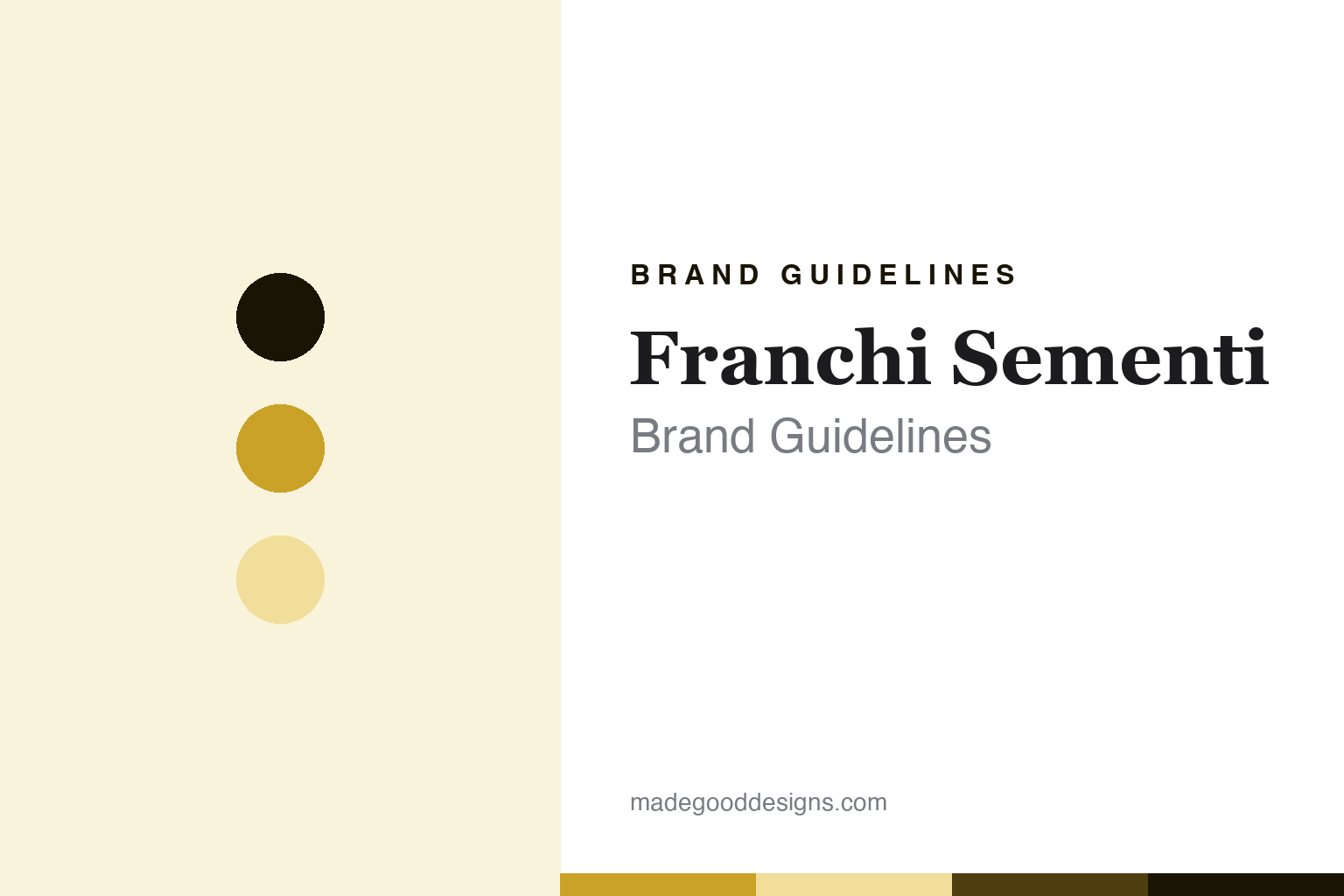
Franchi Sementi Brand Guidelines
The Italian family seed house.
Aa
Two constants: a Tuscan-saffron palette and an old-house-serif register. Abstract homage — not a Franchi Sementi product or mark; no seed-packet artwork or logo is reproduced.
The Italian family seed house
Franchi Sementi is the Italian family seed house near Bergamo, which says it has traded since 1783 and offers over a thousand varieties.
Franchi Sementi brings the atlas round its Italian house — Franchi Sementi S.p.A., in English simply Franchi Seeds, the family seed company near Bergamo that offers more than thirteen hundred varieties, many of them regional Italian vegetables, and that describes itself as one of the oldest family-run seed houses in the world. Franchi keeps and sells the seed, and its answer to a round that maps seed houses by country is an Italian address and a very long claimed history. A brand, Italian.
Its identity is the Italian family seed house. The Italian base, the regional-vegetable catalogue and the family ownership are the story here. A brand, Italian. The Italian family seed house.
(Honest notes, so a heritage claim stays hedged, and the catalogue stays honest. Franchi Sementi sells seed as its heroes — more than thirteen hundred varieties, including regional Italian vegetables — and we report its performance language as the brand’s own. On where it is, the star theme of this round, its operational base is Grassobbio, in the province of Bergamo, with a registered office in Milan, Italy. On who owns it, it is a family-run joint-stock company, an S.p.A., founded by Giovanni Franchi; the generation count is its own account, which we do not tally independently. On its age, the point that needs the most care: its “since 1783” heritage is self-reported, with no independent documentation we could reach — so we say the company says it has traded since 1783, rather than treat it as established fact. Two more honest limits: it also sells hybrid lines, so we do not label it non-hybrid, open-pollinated, heirloom or non-GMO as a blanket; and “Seeds of Italy” is a separate United Kingdom importer and distributor of the Franchi brand, not a confirmed common owner. Its designs are IP we describe but do not reproduce; there is no official brand hex; these tones are an unofficial interpretation.)
Colour
Franchi lives in a Tuscan saffron. Click a swatch to copy the hex.
Franchi’s identity is Italian, family and long-claimed — a Tuscan saffron, an ink, a pale wheat, a deep ochre, and a paper. The palette leans Tuscan saffron and pale wheat: a warm register that nods to an Italian field rather than a loud logo colour, and it stays a colour rather than borrowing a national flag. It signals an Italian family seed house. The honest caveat: with no published brand hex, these values are an original, unofficial interpretation, not first-party colours.
The lesson is a Tuscan saffron signals an Italian, family identity. Franchi’s world is a regional-Italian catalogue of seed. For designers, it is a reminder that a Tuscan saffron and a soft pale wheat can carry a garden brand — the tone of the Italian field, held as colour not as a flag. Because these tones can fail as small text, keep type dark and let the colour live in the accents, palette and band. The takeaways: hedge the 1783 claim; do not over-label the catalogue; keep Seeds of Italy as a separate distributor; and treat any single hex as unofficial.
Typography
The register is an old-house serif — Italian, editorial, long-standing.
Franchi’s identity carries an Italian, editorial, long-standing spirit — a family seed house, not a graphics label. An old-house serif captures the mood: refined, warm and confident, the register of a very old Italian catalogue. Set in a Tuscan-saffron palette, the old-house serif feels Italian and long-standing — exactly the personality Franchi carries, with the age itself held as a claim. It is a kept seed rather than a logo, mirroring seed-packet paper. (Franchi’s real catalogue and designs are things we describe but do not reproduce, and the exact typeface is not ours to use.) Because it is not ours to use, the honest description is “an old-house-serif company,” shown here in a stand-in. The type behaves like the brand: Italian, editorial and long-standing.
Aa
An old-house-serif company — Italian and long-standing. (Specimen set in Cormorant Garamond, an old-house-serif STAND-IN; NOT the Franchi logo or any packet art.)
The atlas
Franchi Sementi stands for the Italian family seed house.
Franchi Sementi brings the atlas round its Italian house. A Tuscan-saffron palette, an old-house serif and a claimed 1783 origin make one thing — the Italian family seed house — the whole identity: Italian, family and long-claimed. The Italian base is the pitch, and the regional-vegetable catalogue is the proof. The point is an Italian address and a very long claimed history, held honestly as a claim, in a round that maps seed houses by where they are.
Put to work, the identity is the Italian house told straight, age and all — the 1783 date framed as the company’s own claim and the catalogue owned honestly. A steward in this spirit would hedge the 1783 claim, refuse to over-label the catalogue, and keep Seeds of Italy as a separate distributor. A reader in this spirit would keep the facts right: Franchi Sementi — Franchi Sementi S.p.A., or Franchi Seeds — sells seed as its heroes, more than thirteen hundred varieties including regional Italian vegetables; its operational base is Grassobbio, in the province of Bergamo, with a registered office in Milan, Italy; it is a family-run S.p.A. founded by Giovanni Franchi; its “since 1783” heritage is self-reported and unverified, so it is reported as a claim, not a fact; it also sells hybrid lines, so it is not labelled open-pollinated, heirloom or non-GMO as a blanket; and “Seeds of Italy” is a separate UK importer, not a confirmed common owner. Franchi opens the round’s continental-European group, before Baumaux and Sativa Rheinau. The honest editorial moves are to keep the country Italian, to frame the 1783 date as a claim, to own the hybrid mix, and to keep Seeds of Italy distinct.
For designers and brand-builders, Franchi continues the atlas: frame a heritage date as a claim — and do not over-label the catalogue. The lessons: let an Italian family history carry a seed brand; report an undocumented “since” date as the company’s claim; refuse to blanket-label a mixed catalogue; keep a distributor separate from the maker; and never reproduce a mark or a flag. It is also a reminder to stay precise: Franchi Sementi is the Italian family seed house near Bergamo, which says it has traded since 1783 and offers over a thousand varieties — with the palette here an unofficial interpretation. Read that way, Franchi is less a packet than a very old Italian catalogue: Italian, family, long-claimed. The lesson for a brand is that a heritage claim and honest hedging reinforce each other, and framing the date keeps the story earned. Franchi made the-Italian-family-seed-house the identity — proof that where-it-is carries the round.
Explore & save
Keep Franchi Sementi’s identity on hand — save it to a board in the Made Good inspiration library.
Franchi Sementi identity set
Pin the Tuscan-saffron palette and the old-house-serif register to your own board.