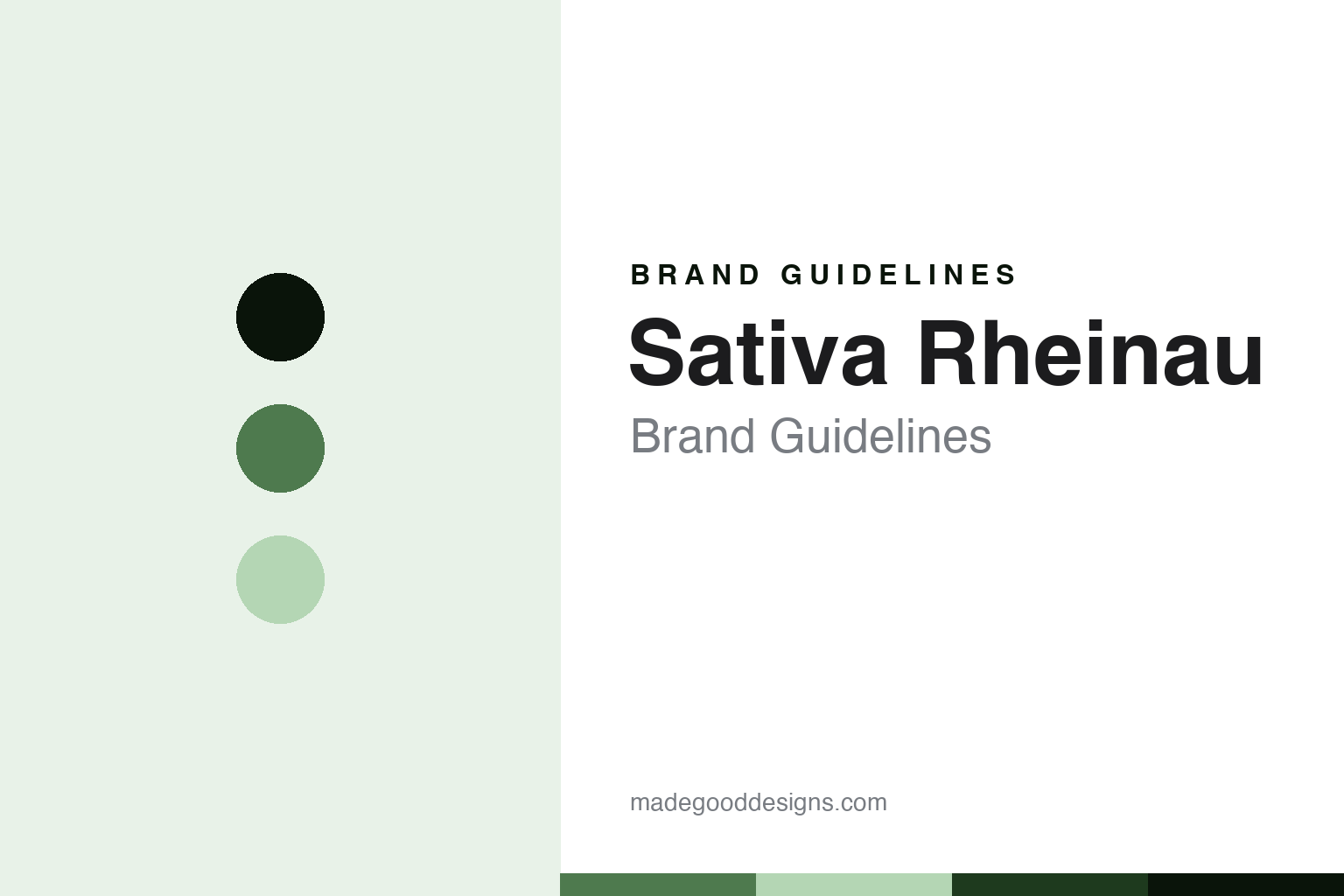
Sativa Rheinau Brand Guidelines
The Swiss biodynamic seed house.
Aa
Two constants: a biodynamic-green palette and a biodynamic-sans register. Abstract homage — not a Sativa Rheinau product or mark; no seed-packet artwork, logo or cannabis motif is reproduced.
The Swiss biodynamic seed house
Sativa Rheinau is the Swiss biodynamic seed house at Rheinau, a foundation-affiliated stock company certified Demeter and Bio Suisse.
Sativa Rheinau closes the atlas round, and the three-round seed-house arc, as its Swiss house — Sativa Rheinau AG, the organic and biodynamic seed company at Rheinau, whose motto holds that organic begins with the seed. Sativa keeps and sells the seed, and its answer to a round that maps seed houses by country is a Swiss address and an unusual, deliberately-distributed ownership. A brand, biodynamic.
Its identity is the Swiss biodynamic seed house. The Swiss base, the biodynamic certification and the foundation-affiliated, distributed ownership are the story here. A brand, biodynamic. The Swiss biodynamic seed house.
(Honest notes, so the ownership stays hedged, and a name stays disambiguated. Sativa Rheinau AG sells seed and plants as its heroes — organic and biodynamic vegetable, herb and flower varieties, for gardeners, professionals and farmers — and we report its performance language as the brand’s own. On where it is, the star theme of this round, it is in Rheinau, in the canton of Zürich, Switzerland. On who owns it, a point that needs care: it became a stock company, an AG, in 2005, after beginning as a cooperative in 1992 and a limited company in 1999; the 2005 conversion deliberately distributed shares among propagators, customers, employees and various foundations, with the foundation anchor being Stiftung Fintan, based at a former Benedictine monastery in Rheinau, and Sativa is one of the Fintan group’s enterprises. Because the exact shareholding is not published, we say it is foundation-affiliated with distributed shareholding, not that any foundation owns or controls it. Its certifications include Demeter, Bio Suisse and Bioverita, and its breeding roots trace to pioneers Ilmar Randuja and Peter Kunz. Because “sativa” is a botanical epithet, and to prevent confusion, we note plainly that this is a vegetable, herb and flower seed house with no cannabis connection, and we use no cannabis motif. Its designs are IP we describe but do not reproduce; there is no official brand hex; these tones are an unofficial interpretation.)
Colour
Sativa Rheinau lives in a biodynamic green. Click a swatch to copy the hex.
Sativa Rheinau’s identity is biodynamic, Swiss and distributed — a biodynamic green, an ink, a pale sprout, a deep field, and a paper. The palette leans biodynamic green and pale sprout: an organic register that nods to a Swiss biodynamic field rather than a loud logo colour, and it is a plain plant green with no cannabis association. It signals a Swiss biodynamic seed house. The honest caveat: with no published brand hex, these values are an original, unofficial interpretation, not first-party colours.
The lesson is a biodynamic green signals a biodynamic, Swiss identity. Sativa Rheinau’s world is a certified biodynamic seed programme. For designers, it is a reminder that a biodynamic green and a soft pale sprout can carry a garden brand — the tone of the organic field, and a green that is emphatically not a cannabis leaf. Because these tones can fail as small text, keep type dark and let the colour live in the accents, palette and band. The takeaways: say foundation-affiliated, not foundation-owned; keep the certifications named; note the no-cannabis point plainly; and treat any single hex as unofficial.
Typography
The register is a biodynamic sans — biodynamic, plain, distributed.
Sativa Rheinau’s identity carries a biodynamic, plain, distributed spirit — a seed house, not a graphics label. A biodynamic sans captures the mood: clean, grounded and confident, the register of a certified biodynamic programme. Set in a biodynamic-green palette, the biodynamic sans feels biodynamic and distributed — exactly the personality Sativa Rheinau carries. It is a kept seed rather than a logo, mirroring a sprout. (Sativa Rheinau’s real designs are things we describe but do not reproduce, and the exact typeface is not ours to use.) Because it is not ours to use, the honest description is “a biodynamic-sans house,” shown here in a stand-in. The type behaves like the brand: biodynamic, plain and distributed.
Aa
A biodynamic-sans house — biodynamic and distributed. (Specimen set in Archivo, a biodynamic-sans STAND-IN; NOT the Sativa Rheinau logo, and no cannabis motif.)
The atlas
Sativa Rheinau stands for the Swiss biodynamic seed house.
Sativa Rheinau closes the atlas round, and the seed-house arc, as its Swiss house. A biodynamic-green palette, a biodynamic sans and a 2005 conversion to a stock company make one thing — the Swiss biodynamic seed house — the whole identity: biodynamic, Swiss and distributed. The Swiss base is the pitch, and the foundation-affiliated distributed ownership is the proof. The point is a Swiss address and a deliberately-shared ownership, closing a round that maps seed houses by where they are.
Put to work, the identity is the Swiss house told straight, ownership hedged and name disambiguated — the shareholding described as distributed and the cannabis confusion headed off. A steward in this spirit would say foundation-affiliated rather than foundation-owned, keep the certifications named, and note the no-cannabis point plainly. A reader in this spirit would keep the facts right: Sativa Rheinau AG sells seed and plants as its heroes — organic and biodynamic vegetable, herb and flower varieties; it is in Rheinau, canton Zürich, Switzerland; it became an AG in 2005, after a cooperative in 1992 and a limited company in 1999, with the 2005 conversion distributing shares among propagators, customers, employees and various foundations, the anchor being Stiftung Fintan, and Sativa one of the Fintan group’s enterprises; because the exact shareholding is not published, it is described as foundation-affiliated, not foundation-owned; its certifications include Demeter, Bio Suisse and Bioverita; its breeding roots trace to Ilmar Randuja and Peter Kunz; and, because “sativa” is a botanical epithet, it is stated plainly to have no cannabis connection, with no cannabis motif used. Sativa Rheinau closes the round beside Franchi and Baumaux in the continental group, and closes the arc that began with Baker Creek. The honest editorial moves are to hedge the ownership as distributed, to name the certifications, to disambiguate the name from cannabis, and to keep the Swiss base right.
For designers and brand-builders, Sativa Rheinau closes the atlas: say foundation-affiliated, not foundation-owned — and head off the confusable name. The lessons: let a biodynamic certification carry a seed brand; describe a distributed, foundation-affiliated ownership without over-claiming control; head off a botanical-name collision plainly; use a plant green that is not a cannabis leaf; and never reproduce a mark. It is also a reminder to stay precise: Sativa Rheinau is the Swiss biodynamic seed house at Rheinau, a foundation-affiliated stock company certified Demeter and Bio Suisse — with the palette here an unofficial interpretation. Read that way, Sativa Rheinau is less a packet than a biodynamic programme: Swiss, certified, distributed. The lesson for a brand is that a biodynamic mission and a carefully-hedged ownership reinforce each other, and saying foundation-affiliated keeps the story earned. Sativa Rheinau made the-Swiss-biodynamic-seed-house the identity — proof that where-it-is closes the round, and the arc.
Explore & save
Keep Sativa Rheinau’s identity on hand — save it to a board in the Made Good inspiration library.
Sativa Rheinau identity set
Pin the biodynamic-green palette and the biodynamic-sans register to your own board.