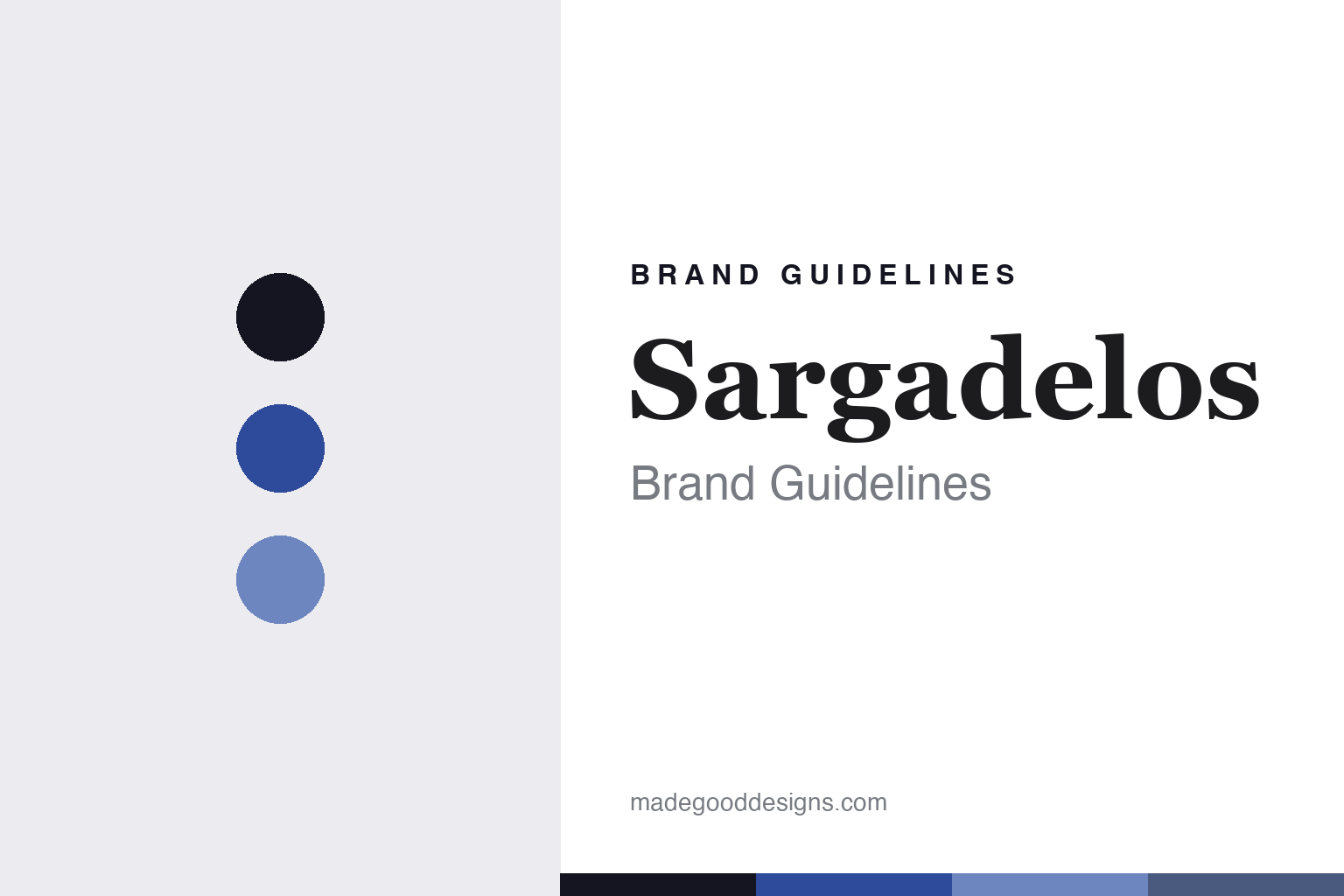
Sargadelos Brand Guidelines
The cobalt geometry.
Aa
Two constants: a cobalt-and-sky palette and a folk slab register. Abstract homage — not the Sargadelos ceramics, motifs or packaging.
The cobalt geometry
Sargadelos makes a blue geometry the identity.
Sargadelos is a lesson in a graphic language as identity. Its name reaches back to the original Real Fábrica founded in 1806 by Antonio Raimundo Ibáñez in Cervo, in Galicia, Spain — a fine-earthenware works that closed in 1875. But today’s Sargadelos is really the work of a 20th-century revival led by Isaac Díaz Pardo and Luís Seoane, out of the Laboratorio de Formas, with the modern factory reopening around 1969.
Its identity is cobalt-blue geometry. The revival gave Sargadelos its instantly-recognisable look: bold, hand-decorated geometric Galician-folk motifs in cobalt blue on white, hand-painted in Galicia — a modern-folk graphic language across tableware, figurines and jewellery. The blue and the geometry are the brand.
(Honest notes: keep the two histories distinct — the 1806 Ibáñez works (earthenware, closed 1875) is a different entity from the Díaz Pardo / Seoane revival that created the cobalt-geometric Sargadelos; the specific motif names (spirals, concentric circles) are widely described but we keep them general. There’s no official brand hex, so these tones are an unofficial interpretation. This is design commentary and does not promote any product.)
Colour
Sargadelos lives in a cobalt-and-sky palette. Click a swatch to copy the hex.
Sargadelos’ identity is graphic, folk and Galician — a cobalt, an ink, a sky, a slate blue, and a chalk. The palette pairs a cobalt with a sky — the register of blue-on-white hand-painting. It signals graphic identity and craft rather than novelty. The honest caveat: with no published brand hex, these tones are an original, unofficial interpretation, not first-party values.
The lesson is a cobalt with a sky signals a blue-geometric ceramics house. Sargadelos’ world is a white piece patterned in bold blue geometry. For designers, it is a reminder that a single colour plus a strong graphic language can define a whole ceramics identity — right for modern-folk ware. Because a mid cobalt can fail as small text, keep type dark and let the blue live in the accents, palette and band. The takeaways: own one colour (cobalt); build a graphic motif language; hand-paint it; and treat any single hex as unofficial.
Typography
The register is a folk slab — graphic, bold, Galician.
Sargadelos’ identity carries a graphic, bold, Galician spirit — a blue geometric motif. A sturdy slab serif captures the mood: it is solid and characterful, the register of a modern-folk poster. Set in a cobalt-and-sky palette, the folk slab feels graphic and bold — exactly the personality Sargadelos carries. It is confident rather than delicate, mirroring bold blue geometry. (Sargadelos’ real ceramics, motifs and wordmark are works we describe but do not reproduce, and the exact typeface is not ours to use.) Because it is not ours to use, the honest description is “a folk slab spirit,” shown here in a stand-in. The type behaves like the brand: graphic, bold and Galician.
Aa
A folk slab spirit — graphic and bold. (Specimen set in Bitter, a sturdy slab serif STAND-IN; NOT the Sargadelos packaging or motifs.)
A graphic language as identity
Sargadelos stands for cobalt-blue geometry.
Sargadelos is a lesson in making a graphic language the identity. A cobalt-and-sky palette, a folk slab and a blue geometric motif make a graphic language the whole brand — graphic, bold, Galician. The language is the differentiator. The differentiator is hand-painted cobalt geometry.
For designers and brand-builders, Sargadelos offers a clear takeaway: own one colour and a motif system. The lessons: commit to a colour (cobalt); build a recognisable geometry; keep it hand-painted in place; and be honest about the history. It is also a reminder to stay accurate: the 1806 original is distinct from the 20th-century revival that made the cobalt look, it’s hand-painted in Galicia, and the palette here is an unofficial interpretation. Sargadelos made a graphic language the brand — proof that colour and geometry can be the difference.
Explore & save
Keep Sargadelos’s identity on hand — save it to a board in the Made Good inspiration library.
Sargadelos identity set
Pin the cobalt-and-sky palette and the folk-slab register to your own board.