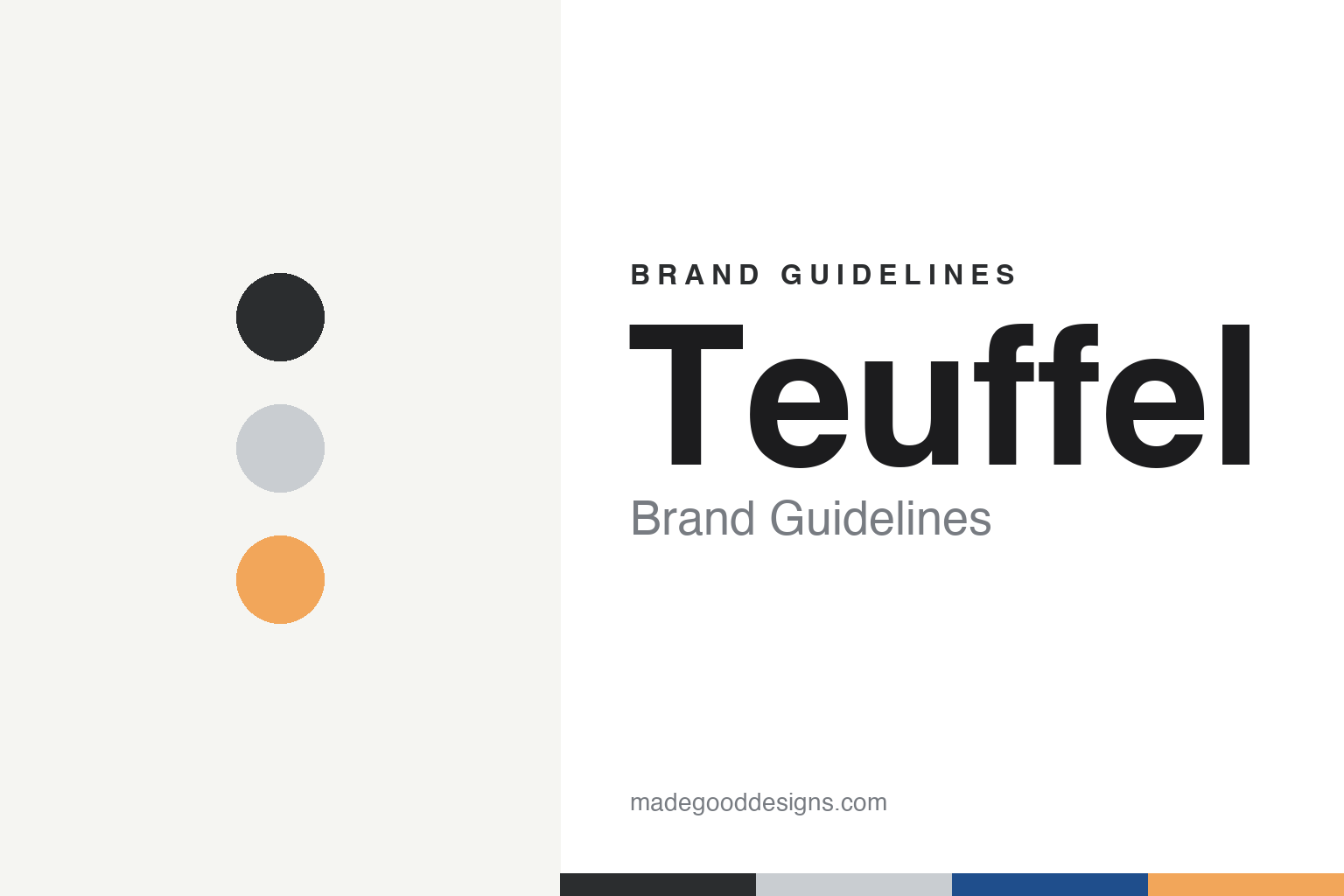
Teuffel Brand Guidelines
Ulrich Teuffel’s modular aluminium guitars, built by one man in Neu-Ulm.
Aa
Two constants: a Teuffel charcoal, chrome and sapphire palette and an industrial sans register. Abstract homage — not a Teuffel product or mark; no instrument, logo or nameplate is reproduced.
A metalworker turned designer
Mercedes-Benz, Dr. Mabuse and design school.
Teuffel is the workshop of one man, Ulrich Teuffel, and his website is written in the first person. He says he trained first in metalwork and construction in an extended apprenticeship at Mercedes-Benz, where he learned that “exact” means a tenth of a millimetre or less, and that he built his first proper acoustic guitar as a homage to the American luthier Steve Klein, working from photographs in a book by Donald Brosnac. He founded his company on 1 June 1988, he says, and spent the next years making electric guitars and basses in a traditional way: the “Dr. Mabuse” guitar series and the “JFK” bass line, with glued-in mahogany necks, figured maple, gloss finishes and bought-in pickups and hardware.
The turn came when he studied industrial design from 1992 to 1996, which he calls the most formative experience of his career. Looking at guitars “from the distance” of design school, he says, he restarted his work around themes and concepts. The workshop is in Neu-Ulm, the Bavarian town across the Danube from Ulm, and its rule is stated plainly on the site: Teuffel guitars “have been made by me personally and this is the way it will remain.” He does not pay for endorsements, he adds, because he builds in such small series that there is no need for mass marketing.
Colour
The Birdfish and what followed.
The result was the Birdfish, which Teuffel says he first showed at the Frankfurt Musikmesse in spring 1995; Gitarre & Bass lists the same year in its history of the electric guitar. It is a modular, headless guitar with no solid body. Two polished aluminium parts, the “bird” and the “fish,” hold the bolt-on neck and the controls; between them run two interchangeable wooden tone bars, one pair of American alder and one of maple, and a rail on which pickups slide and swap in seconds. The set comes with five pickups that Teuffel winds himself. He says the aluminium parts were sand-cast at first, then cast in ceramic moulds, and are now carved from solid blocks, then plated in nickel, copper and chrome and polished by hand. The series, he says, is limited to 500 instruments.
The guitar found well-known players. Billy Gibbons used a Birdfish heavily on ZZ Top’s 2003 album Mescalero, telling Guitar World that it “really shines on Mescalero because of that dirty, raunchy tone”; English Wikipedia lists one among Kirk Hammett’s live guitars with Metallica. Teuffel also names David Torn, Henry Kaiser, Hans Zimmer and Dusty Hill as players. His old site listed reviews in British, Dutch, Danish, Italian and German magazines from 1998 to 2001, including Guitarist, which in June 1999 called it astonishing that “so few modern luthiers are able to produce a truly original guitar.” He lists a Baden-Württemberg International Design Award in 1998, a “Talente ’99” prize linked to the chamber of crafts for Munich and Upper Bavaria, a Golden Axe Award from Harmony Central in 1999 and a place in Guitarist’s 2000 list of the most important guitars of the twentieth century.
Other models followed. The Coco had a body of wood reinforced with carbon fibre; Teuffel says he made only 23 before giving it up. The Tesla, shown at the NAMM show in 2000, has contact points and push-buttons that call up the crackles, hum and dropouts of early electric guitars on purpose; Henry Kaiser released an album called Teuffel Tesla Duets in 2012. The Niwa of late 2007 is cut from a 100-millimetre block of alder and shaped to the player’s waist, and the Antonio borrows the outline and bracing of the 19th-century Spanish maker Antonio de Torres for a purely electric guitar. Since 2008 a “Prodigy” line has offered special versions, beginning with a set of three for the workshop’s 20th anniversary. In 2023 Gitarre & Bass still counted Teuffel among the established names of German guitar making.
Typography
Design school, not tradition.
Two names came west after the Second World War from Schönbach in Bohemia, now Luby in the Czech Republic. Höfner was founded there by Karl Höfner in 1887 and now works in Baiersdorf in Franconia, where GEWA music took over its business on 1 April 2026 after an insolvency, with the brands held by a Thomann and GEWA holding company. Hoyer, founded in Schönbach by Franz Hoyer in 1874, was re-established at Tennenlohe near Erlangen in 1945 and stopped making guitars in 1987, German Wikipedia says; its website now announces a relaunch in 2027.
Hanika is a Baiersdorf neighbour. Helmut Hanika started his own firm in 1953, making archtop guitars, and later moved to classical guitars, from 1965 by the company’s account and in the 1970s by German Wikipedia’s; the business now belongs to his son Armin, and the company says its instruments are made mostly by hand.
Three are workshops founded by their makers. Lakewood, started in 1986 by Martin Seeliger, builds steel-string guitars at Buseck near Gießen; it says they are built in Germany. Teuffel is Ulrich Teuffel’s company in Neu-Ulm, founded in 1988, he says, and he builds the guitars himself. Marleaux is Gerald Marleaux’s bass workshop at Clausthal-Zellerfeld in the Harz, working since 1990, whose Consat Custom bass won a German musical instrument prize in 2017.
GEWA music is the odd one out, an instrument and accessory company rather than a single workshop: founded at Adorf in the Vogtland by Georg Walther in 1925, it spent five decades in Mittenwald before returning to Adorf, and says it makes products at German, European and Asian sites.
This guide sets out what can be checked about each brand — who founded it, who owns it, and what it says about where its products are made — and marks clearly what rests only on the company’s own word.
Aa
An industrial sans — for a guitar shaped by a design degree. (Specimen set in Manrope, a sans STAND-IN; NOT the Teuffel logo.)
Teuffel
A guitar that shows how it is made.
Teuffel’s identity is the construction itself. Most electric guitars hide their structure under a body and a finish; the Birdfish puts every part on view, from the tone bars and the sliding pickups to the hand-buffed stainless screws, and gives each a name and a job. Teuffel explains it the way a designer would, in a series of short pages on the website covering each part, from the neck and the tone bars to the pickups and the case. The wordmark on his site is a plain lower-case “teuffel,” and the model names are written in lower case too.
The company has not published brand colours or a typeface, so the palette here is ours. It starts from the polished chrome of the bird and fish and the charcoal of the hardware, and adds two of the colours Teuffel lists for the Birdfish, sapphire and apricot, against a workshop white. The type is an industrial sans, to match a guitar designed by someone trained in a car factory and a design school rather than a violin workshop.
For a design guide, Teuffel shows how far one maker can push a guitar while keeping it playable, and how a small workshop can become a reference without advertising. Compare Strandberg, the Swedish maker that built a brand on headless guitars, and Duesenberg, the German brand that took the opposite route into art-deco styling. For this guide we use charcoal, chrome and sapphire with a sans, an unofficial interpretation; no product or logo is reproduced.
Explore & save
Keep Teuffel’s identity on hand — save it to a board in the Made Good inspiration library.
Teuffel identity set
Pin the Teuffel charcoal, chrome and sapphire palette and the industrial sans register to your own board.