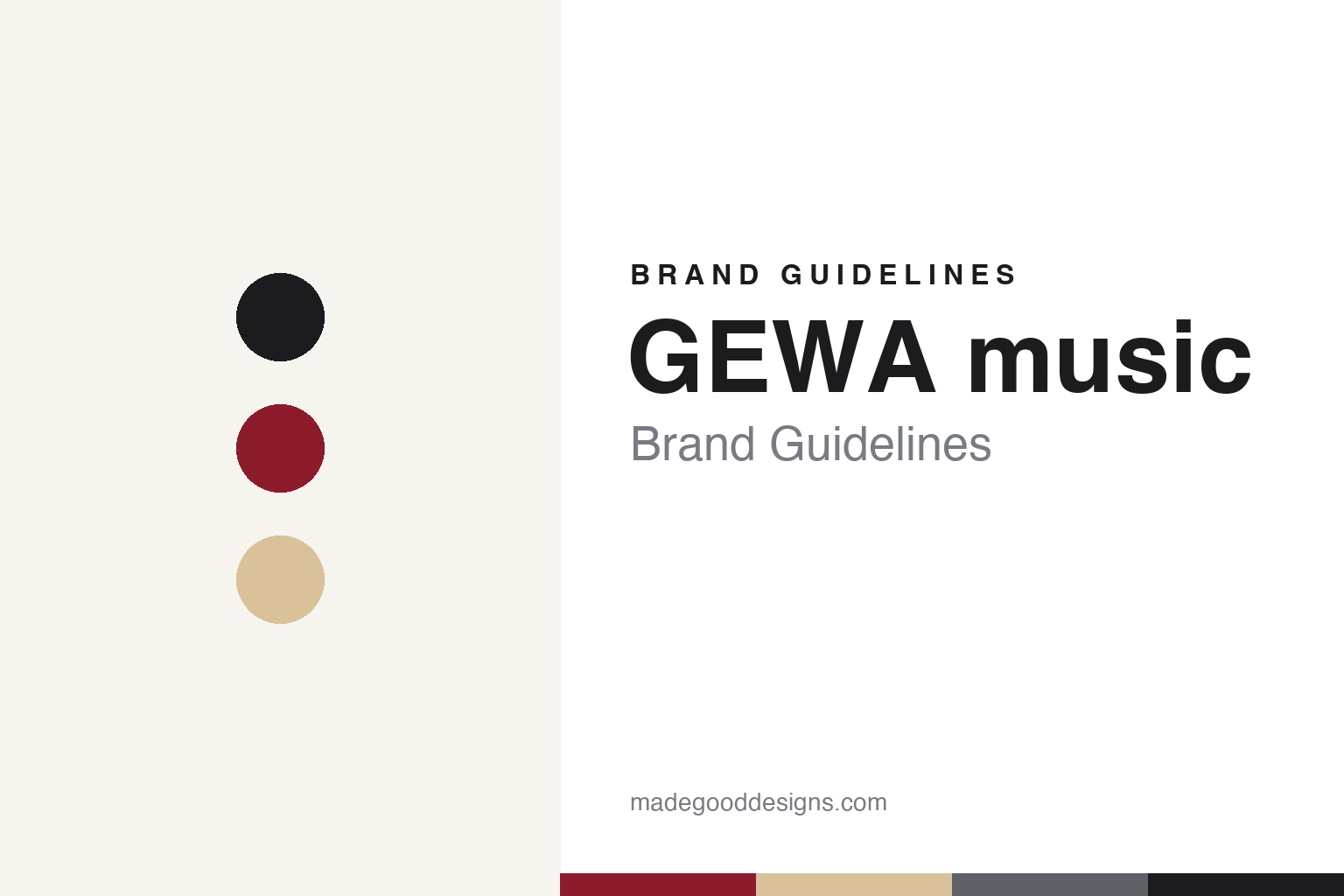
GEWA music Brand Guidelines
The Vogtland case maker that became a home for heritage brands.
Aa
Two constants: a GEWA case black, red and spruce palette and an engineered sans register. Abstract homage — not a GEWA product or mark; no instrument, case, logo or nameplate is reproduced.
Georg Walther’s case factory
From the Vogtland to Mittenwald and back.
GEWA music began in Adorf, in Saxony’s Vogtland — the instrument-making district the company calls the “Music Corner of Germany” — in 1925. Its founder, Georg Walther, came from the Ore Mountains, the company says, and the name is built from the first two letters of his first and last names, the Bavarian newspaper Merkur reported in February 2026. The business started as the Georg Walther Musikinstrumente-, Etui- und Taschenfabrik — a maker of instruments, cases and bags — with a small workforce; Merkur says it soon became known for handmade cases and accessories for string instruments, sold through music shops.
The Second World War and the Soviet occupation of the Vogtland ended that first chapter. Facing the threat of nationalisation, Walther moved the firm to Mittenwald, the Bavarian violin-making town — in 1949, according to the company and German Wikipedia, or in 1950, with about twenty of his best staff, according to Merkur. The company first worked on former barracks grounds and in 1958 bought its own site. Over five decades it became one of Mittenwald’s largest private employers, with up to 140 people in its workshops and about 50 home workers, the paper reported, while wholesale trade in instruments and accessories grew into a core business.
In early 1971 the founder’s son, Dieter Walther, took over the management. Looking for a partner in the late 1980s, he brought in Hans-Peter Messner, who joined in 1989, Merkur reported. After the fall of the Berlin Wall, Messner began moving the company back to Adorf step by step, a process completed in 2008. In 2025 GEWA marked its centenary with an anniversary chronicle, a copy of which a long-serving former manager presented to Mittenwald’s mayor, the paper reported.
Colour
Back to Adorf, and out to Asia.
The return was partly a matter of property. GEWA says its Adorf production site for string instruments, bows, cases and bags, and a European central warehouse, were set up in the 1990s “as part of the restitution of formerly expropriated property,” and that it took on skilled instrument makers from Musima, the former East German state-owned instrument works in Markneukirchen. Since 2008, the company says, development, product management, purchasing, production, logistics, sales, marketing and administration have been brought together at the Adorf headquarters. In April 2026 the regional broadcaster MDR put its workforce at more than 260.
Adorf is only part of the picture. From the late 1990s, GEWA says, it built long-term joint ventures with manufacturing partners in Asia, and it now describes “German, European, and Asian production sites.” Its own GEWA label is divided into lines it calls “Made in Germany,” “GEWA – Germany,” “German Engineered” and “PURE GEWA” — names that suggest differing degrees of German involvement; we give them as the company’s own categories. The German magazine site guitar-player.com described GEWA in 2026 as “not a classic guitar maker but a hybrid player” that develops products, organises international manufacturing, holds brand rights and distributes for many other makers.
The brand list has grown by acquisition. In January 2021 GEWA announced that it had bought Ovation Guitars, the American round-back acoustic brand, from Drum Workshop, Inc., together with Adamas and Applause; Guitar World reported that the deal had been finalised in September 2020, and that GEWA had been Ovation’s exclusive European distributor since DW acquired the brand in 2015. In January 2024 the German site Bonedo reported that GEWA had acquired a worldwide licence for Gretsch Drums. In the same year, GEWA says, it bought Wittner, the metronome and string-accessory maker of Isny in the Allgäu, whose own website now calls it a “Division of Gewa Music GmbH” and German “since 1895.” GEWA also lists Guitarras Manuel Rodríguez among its brands, and says it opened a US central warehouse in New Hartford, Connecticut, in 2024.
Typography
German makers, who owns them and where they build.
Two names came west after the Second World War from Schönbach in Bohemia, now Luby in the Czech Republic. Höfner was founded there by Karl Höfner in 1887 and now works in Baiersdorf in Franconia, where GEWA music took over its business on 1 April 2026 after an insolvency, with the brands held by a Thomann and GEWA holding company. Hoyer, founded in Schönbach by Franz Hoyer in 1874, was re-established at Tennenlohe near Erlangen in 1945 and stopped making guitars in 1987, German Wikipedia says; its website now announces a relaunch in 2027.
Hanika is a Baiersdorf neighbour. Helmut Hanika started his own firm in 1953, making archtop guitars, and later moved to classical guitars, from 1965 by the company’s account and in the 1970s by German Wikipedia’s; the business now belongs to his son Armin, and the company says its instruments are made mostly by hand.
Three are workshops founded by their makers. Lakewood, started in 1986 by Martin Seeliger, builds steel-string guitars at Buseck near Gießen; it says they are built in Germany. Teuffel is Ulrich Teuffel’s company in Neu-Ulm, founded in 1988, he says, and he builds the guitars himself. Marleaux is Gerald Marleaux’s bass workshop at Clausthal-Zellerfeld in the Harz, working since 1990, whose Consat Custom bass won a German musical instrument prize in 2017.
GEWA music is the odd one out, an instrument and accessory company rather than a single workshop: founded at Adorf in the Vogtland by Georg Walther in 1925, it spent five decades in Mittenwald before returning to Adorf, and says it makes products at German, European and Asian sites.
This guide sets out what can be checked about each brand — who founded it, who owns it, and what it says about where its products are made — and marks clearly what rests only on the company’s own word.
Aa
An engineered sans for a company whose slogan is “We engineer music since 1925.” (Specimen set in Archivo, a sans STAND-IN; NOT the GEWA logo.)
Höfner and Thomann
A family firm with a retailer alongside.
The biggest step came in 2026. Karl Höfner GmbH & Co. KG, the Franconian maker of the violin-shaped “Beatle bass,” had been placed under preliminary insolvency administration in December 2025, and proceedings opened on 1 March 2026. On 2 April the insolvency administrator, Hubert Ampferl, announced that GEWA music would take over Höfner’s business from 1 April and continue the Baiersdorf site, keeping 24 jobs and the Höfner and Paesold brands, the Abendzeitung München and MDR reported. The brands themselves went to Streetlife Music GmbH, described as a holding company of Thomann and GEWA. Höfner distribution in Europe went exclusively to Thomann GmbH, the large Bavarian music retailer, and outside Europe to GEWA, which also took Paesold worldwide. Höfner’s guitars and basses, its string instruments and bows are to go on being made in Baiersdorf, the reports said.
Thomann’s presence is not new. In September 2019 the music-industry site Backstage PRO reported that Thomann had taken a stake in GEWA; the size of that stake was not stated in the material we could check. GEWA still describes itself as “family-owned,” and its legal notice names Hans-Peter Messner and Marcel Messner as its chief executives. We report both: the company’s description of itself and the published report of an outside shareholding. The legal notice on Höfner’s own website now names Thomann GmbH as the site’s operator.
For a design guide, GEWA music shows how an old Vogtland name can become an umbrella for other companies’ heritage brands — Ovation, Wittner and now Höfner — while sorting its own label into tiers. Compare Höfner, the bass maker whose business it took over in 2026, and Framus, a postwar Franconian guitar maker later revived by Warwick. For this guide we use case black, a deep Vogtland red and spruce tones with a sans, an unofficial interpretation; no product or logo is reproduced.
Explore & save
Keep GEWA music’s identity on hand — save it to a board in the Made Good inspiration library.
GEWA music identity set
Pin the GEWA case black, red and spruce palette and the engineered sans register to your own board.