Slingerland Brand Guidelines
The Radio King, Gene Krupa and Chicago’s comeback drum name.
Aa
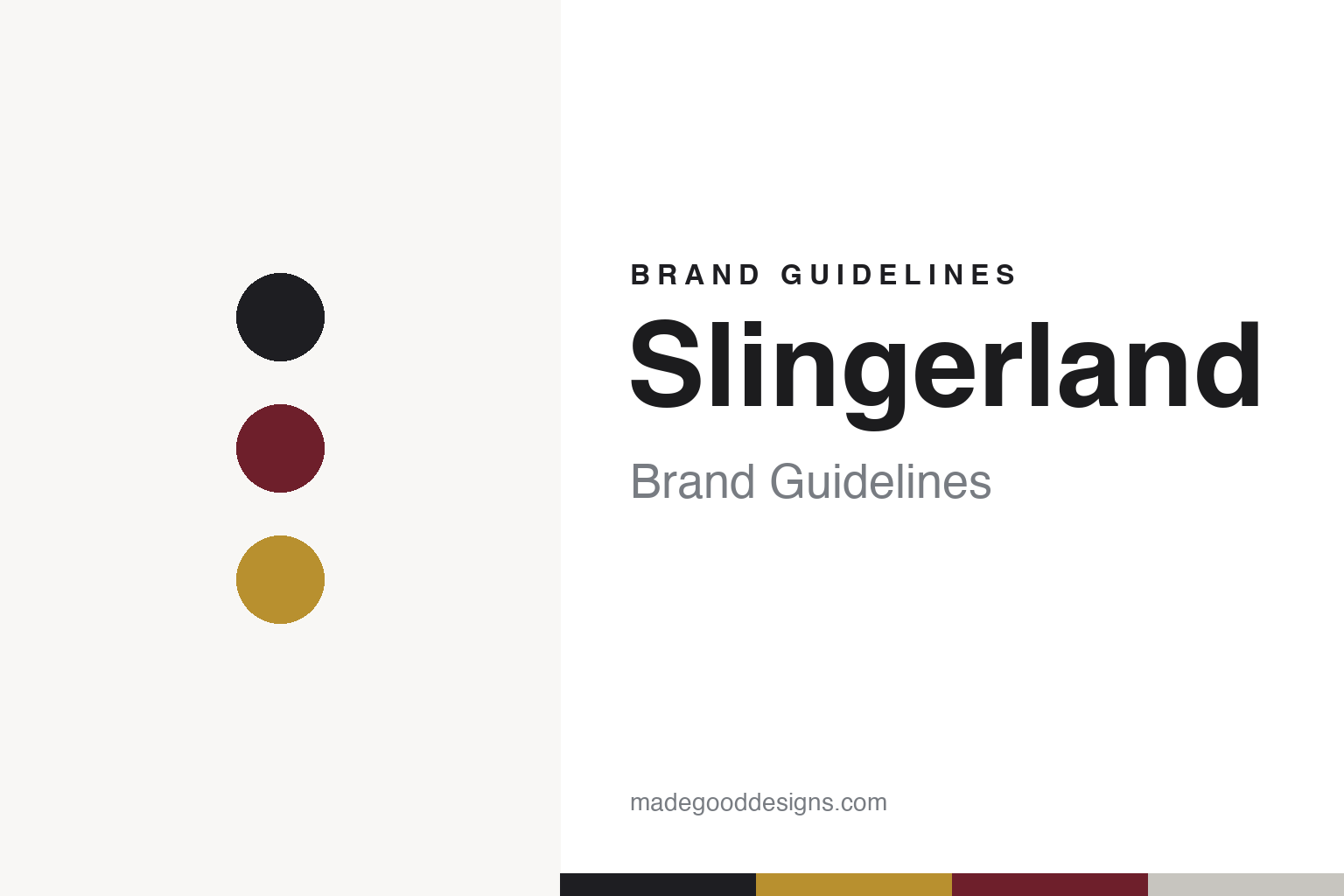
Two constants: a Slingerland black, maroon and gold palette and a Radio-era geometric sans register. Abstract homage — not a Slingerland product or mark; no instrument, logo or badge is reproduced.
Ukuleles first
A correspondence school, ukuleles and banjos.
Slingerland started in music teaching. Gibson’s 1999 history of the brand says the company was founded in 1912, when H.H. Slingerland won a business selling ukulele instruction books in a card game. The collector Dave Kolars, drawing on Rob Cook’s The Slingerland Book, treats that story with caution: he records that H.H., named both as Henry Heanon and Heanon Henry, taught at Chicago’s West Side Conservatory of Music and in 1914 bought the Chicago Correspondence School of Music, which became the Slingerland Correspondence School of Music. Students who bought its twelve ukulele lessons received a free ukulele.
Instruments followed the lessons. The firm imported ukuleles from Germany, Kolars writes, until it could not get enough, then hired a craftsman and set up its own production. Slingerland bought its first factory building, on Chicago’s Orchard Street, in 1923, making ukuleles, then banjos and guitars, and by the mid-1920s claimed to be the world’s largest banjo factory. Gibson’s history has banjos by 1919.
Drums came from a quarrel. Cook’s account, as quoted by Kolars, says H.H. Slingerland offered to stay out of drums if Ludwig & Ludwig stayed out of banjos; William F. Ludwig refused, and Slingerland began making drums in 1927. Gibson dates the first drums to 1928, when the firm became the Slingerland Banjo and Drum Company and opened a plant on Belden Avenue with its own tannery. In the 1930s Slingerland also made guitars, including the Songster electric of its 1939 catalogue, which English Wikipedia calls probably the earliest Spanish-style solid-body electric guitar model.
Colour
Krupa, the Radio King and the Rolling Bomber.
Slingerland’s name was made by jazz drummers. The current company says Gene Krupa became its first endorser in the 1930s, the decade it launched the Radio King, and lists Buddy Rich, Cozy Cole, Dave Tough and Ray McKinley among its endorsers then. Vintage Drum Guide says the Radio King name was used from at least 1936 until 1957, dropped out of the catalogues for a few years and returned around 1960. True Radio King snares had solid one-ply shells of steam-bent maple with maple reinforcing rings, the site says, while the toms and bass drums used a three-ply mahogany and poplar layup.
The war produced the Rolling Bomber, a kit with rosewood and walnut lugs made when metal was restricted, the company says. Its timeline adds the Super “Clamshell” strainer in the 1940s; the Zoomatic strainer and the Set-O-Matic tom mount in the 1960s; and, in the 1970s, the TDR snare strainer and a cut-away marching line. Slingerland also grew by acquisition: when C.G. Conn sold its drum divisions in 1955, Slingerland bought the Leedy trademark, according to English Wikipedia, and phased that brand out by 1965. Gibson’s history says Slingerland opened a plant in Niles, Illinois, in 1964 and for many years was the world’s largest drum company.
Rock players kept the name current. Wikipedia lists Neil Peart of Rush, Danny Seraphine of Chicago and Nigel Olsson, Elton John’s drummer, among Slingerland users of the 1970s.
Typography
Engraved details.
These seven brands fall into two camps: old American names that have passed through several owners, and small workshops that build drums by hand. Rogers began in 1849 as a drumhead maker in New York state; DRUM! Magazine reported in 2018 that the name is owned by Reliance Musical, a Taiwanese manufacturer, with drums finished in California. Slingerland, founded by H. H. Slingerland in 1912, according to English Wikipedia, was bought from Gibson by Drum Workshop in 2019, and its website says DW is now part of Roland.
Leedy, started in Indianapolis in 1897 by Ulysses G. Leedy, passed to C. G. Conn and then Slingerland; English Wikipedia says Gretsch has held the trademark since 1986 and the brand has lain largely dormant. Noble & Cooley is the exception among the old names: founded in Granville, Massachusetts, in 1854, its team page now lists Nick Jones, a seventh-generation Cooley descendant, and John Keane as owners, its site says it is part of York Creative Collective, and it says its drums are handcrafted in the USA.
The boutique makers are younger. Craviotto, founded by the drummer Johnny Craviotto, says it has made one-ply solid-shell drums since 2004 and now handcrafts them in Nashville. C&C, founded by Bill Cardwell, builds drums at its shop in Gladstone, Missouri, and says it has made its own shells since 2010.
Sakae is the outlier: an Osaka maker established in 1925 that, DRUM! reported, built Yamaha’s top-tier drums for 40 years. It suspended business in 2018, Kyodo reported; DRUM! later reported that Korg had bought the trademark, and the name now appears on drums sold as Sakae Osaka Heritage.
This guide sets out what can be checked about each brand — who founded it, who owns it, and what it says about where its products are made — and marks clearly what rests only on the company’s own word.
Aa
A radio-era geometric sans — the register of a 1930s drum catalogue. (Specimen set in Josefin Sans, a sans STAND-IN; NOT the Slingerland logo.)
Slingerland
Gretsch, Gibson, DW and Oxnard.
Family control ended in the 1970s, when, the company says, its chief executive “Bud” Slingerland retired. The current timeline says the business then “changes hands from Mardan to Sanlar to Fred Gretsch” in the 1980s; English Wikipedia’s Leedy article dates Fred W. Gretsch’s purchase to 1986, and the Slingerland timeline lists a company called HSS from 1990 to 1994. Gibson bought Slingerland from Gretsch in 1994, DRUM! reported, and Gibson’s 1999 history says it opened a Nashville plant in mid-1995 to build Radio King snares and Studio King kits. DRUM!’s Phil Hood wrote in 2018 that those Nashville drums of the mid-1990s were the last great ones made under the name. Gibson’s website still listed Slingerland snares and kits in 2010, while DW’s 2025 launch release says the company stopped producing drums in 2008.
Gibson filed for Chapter 11 in 2018, and on 25 November 2019 Drum Workshop announced that it had bought the Slingerland name; DRUM! reported that DW’s chief executive, Chris Lombardi, presented it to his father, the DW co-founder Don Lombardi, as a birthday surprise. In September 2022 MusicRadar reported that Roland Corporation had agreed to acquire all of Drum Workshop, Slingerland included. New drums arrived at the NAMM show in January 2025 with a Radio King Limited Edition snare of steam-bent solid maple, 50 made in each size and colour. The company says its Radio King outfits, with three-ply mahogany and poplar shells and steam-bent maple rings, are recrafted in Oxnard, California, and that Radio King snares are handcrafted in the United States from components sourced worldwide; a 200-piece Gene Krupa Radio King snare has a shell made at Craviotto’s Music City Workshop.
For a design guide, Slingerland shows how a revival can be built from engraved details: the Radio King script on stick-chopper hoops, the cloud badge and period finishes such as Black Diamond Pearl and Blue and Silver lacquer. Compare the DW Drums and Gretsch Drums guides. For this guide we use black diamond, maroon glass, Duco gold and nickel with a geometric sans, an unofficial interpretation; no product or logo is reproduced.
Explore & save
Keep Slingerland’s identity on hand — save it to a board in the Made Good inspiration library.
Slingerland identity set
Pin the Slingerland black, maroon and gold palette and the Radio-era geometric sans register to your own board.