Earasers Brand Guidelines
The Florida hearing-aid maker’s near-invisible musicians’ earplug.
Aa
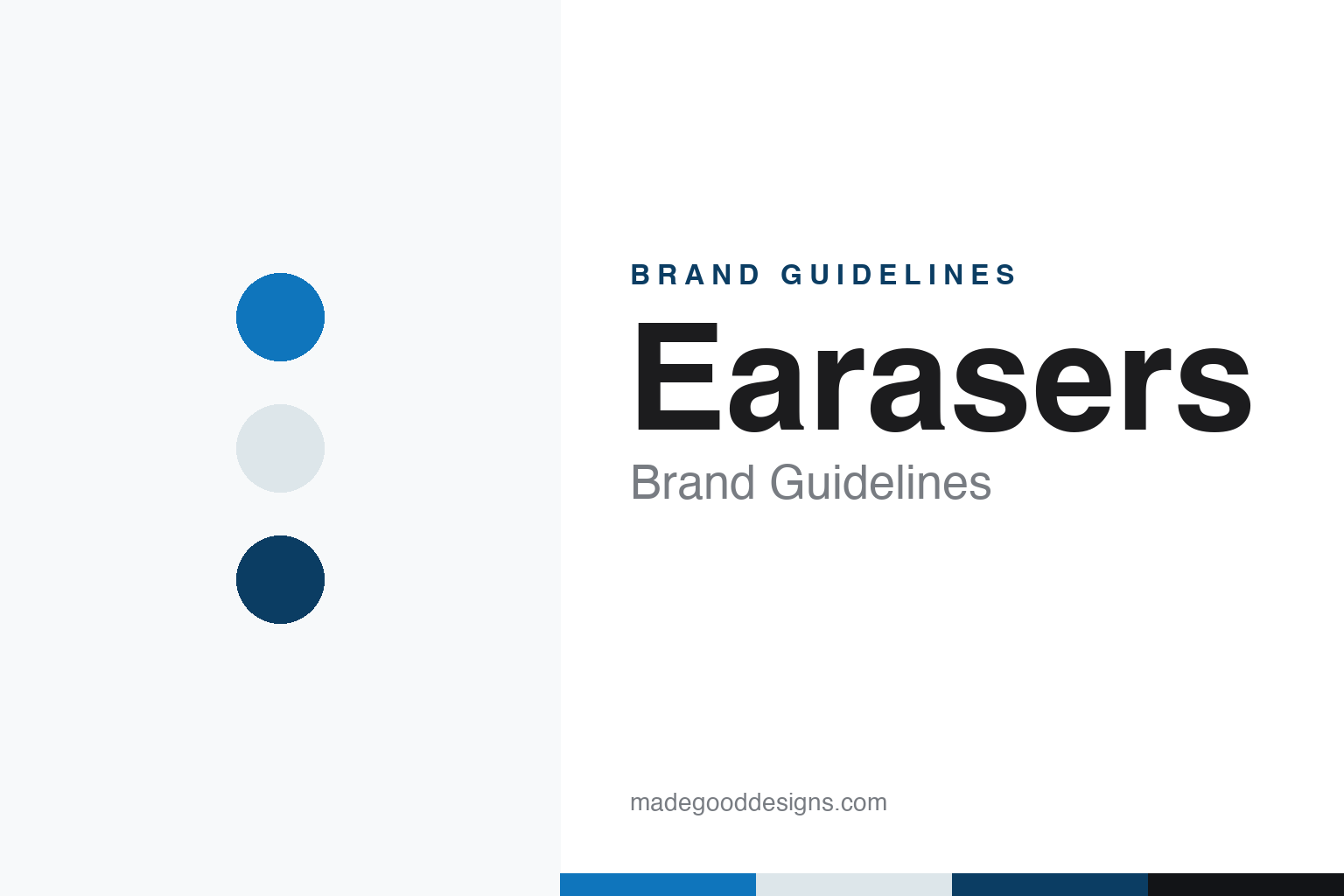
Two constants: an Earasers blue, navy and clear-silicone palette and a rounded sans register. Abstract homage — not an Earasers product or mark; no earplug, logo or packaging is reproduced.
Magnatone to Persona
A hearing-aid maker in Florida.
Earasers are made by Persona Medical, a hearing-aid company in Casselberry, Florida, a suburb of Orlando. Persona was not always called that. A 2009 version of its website, preserved by the Internet Archive, announced: “Backed by 43 years of experience, Magnatone is now Persona Medical!” Its footer described Persona Medical as a trademark of the Magnatone Hearing Aid Corporation. By that count the business goes back to the mid-1960s. The company now says it has “over five decades of experience” and “one million hearing aids delivered,” and we give both as its own figures.
Hearing aids, earmolds and custom hearing protection are the firm’s main trade. Its current website lists behind-the-ear and receiver-in-canal hearing aids, earmolds, shooting protection sold as Big Shots, and in-ear monitors under a separate name, InEarz Audio. In the late 2000s it promoted computer fitting systems called SpeechPro and Freelink, which it described in superlatives we have not checked. Earasers sits alongside those products as the company’s consumer brand, with its own web shop at earasers.net; the earasers.com address redirects there.
Colour
Don Campbell’s earplug.
The company credits the design to Persona Medical’s president, Don Campbell. Its About page says he drew on “35+ years of experience manufacturing custom ear plugs” and a background as a percussionist, guitarist and engineer. He set out, it says, to make an earplug that would work like a “custom product” without the expense of a visit to an audiologist for ear impressions. The patent record supports the authorship. US patent 8,800,712, “Ear tip piece for attenuating sound,” names Don E. K. Campbell and William Chiu as inventors and the Magnatone Hearing Aid Corp as assignee. It claims priority from August 2011 and was granted on 12 August 2014. The Earasers site adds that the design is also patented in Europe and Australia.
The idea is a small, soft, sized plug rather than a moulded one. Earasers use a sleeve of medical-grade silicone, which the company calls a “Smart Seal” and says conforms to the ear canal, around a small filter set deep in the tip. The company argues that placing the filter closer to the eardrum keeps more of the ear canal’s natural resonance, so music sounds less muffled; that is its explanation, not an independent finding. Sleeves come in sizes, a Starter Kit includes alternates to find the fit, and a Renewal Kit replaces worn sleeves so the filters can be reused.
The product went public in stages. An Internet Archive copy of earasers.net from October 2012 shows the name styled “EARasers,” marked “Patent Pending,” with a news item dated 28 June 2011 headed “Persona Medical Introduces Musicians Noise Filters.” The company’s own history gives the formal introduction as the Summer NAMM convention in Nashville in 2012. The early range was simple: earplugs for musicians, with earplugs for dentists and hygienists listed as coming soon.
Typography
Design and documentation.
The seven brands in this group all sell earplugs, but they come from very different places and decades. The oldest is German and more than a century old; the newest names arrived in the 2010s, selling online and, in one case, through crowdfunding. What they share is a product people put in their ears to turn the world down, sold to concert-goers, musicians, sleepers and travellers.
Three are new names built around filtered plugs for music and nightlife. Loop is a Belgian company founded in 2016 by the childhood friends Maarten Bodewes and Dimitri O., according to Wikipedia and the company, and CNBC reported in 2023 that it was headquartered in Antwerp. Eargasm says it is based in Southern California and was founded in 2015 by Ryan Parry. Earasers belongs to Persona Medical of Florida, whose president, Don Campbell, designed the soft silicone plug, the company says.
Two date from the 1990s. Alpine Hearing Protection says it was founded in the Netherlands in 1994 as a pioneer of reusable filtered earplugs for the general public. In 2025 the Belgian investor Gimv announced it was taking a majority stake. ACS says it was established in 1994 to make custom-fit hearing protection, and describes itself as a privately owned UK company that also makes in-ear monitors.
The last two are the outliers. Flare Audio began as a three-person pro-audio maker in a garden garage on England’s south coast, it says, before crowdfunding its Isolate ear protector; Companies House lists Flare Audio Limited, of Lancing in West Sussex, as incorporated in 2007. Ohropax was founded in Berlin in 1907 by the pharmacist Maximilian Negwer, is still run by his family, and makes its wax plugs in Wehrheim, near Frankfurt.
This guide sets out what can be checked about each brand — who founded it, who owns it, and what it says about where its products are made — and marks clearly what rests only on the company’s own word.
Aa
A friendly rounded sans for a plain-spoken brand. (Specimen set in Figtree, a sans STAND-IN; NOT the Earasers logo.)
Earasers
Clear silicone, sized sleeves and a canister.
Today the range is organised by use rather than by filter. The web shop sells Earasers for musicians and concertgoers, for sleeping (“Peace & Quiet”), for dentists and hygienists, for motorsports and for people sensitive to sound, plus a Safety/Industrial version that the company rates at NRR 16 and SNR 22. A Pro-Kit pairs two filter strengths. The company describes its standard music filter as −19 dB at its peak, and says its filter chart mixes figures from the European EN 352-2 standard and American ANSI testing. On its testing page it reports that Australia’s National Acoustic Laboratories measured two models on 20 subjects each in July 2017, giving SNR ratings of 13.1 and 12.3, and it publishes a field study in which 56 listeners rated 22 earplugs for music quality. We report those figures as the company presents them.
The look of the brand is mostly the look of the product: clear silicone that the 2012 site called “virtually invisible,” worn almost flush with the ear. The accessories carry more of the identity than the plugs do. There is a metal “Stash Can” carry canister that can be engraved with a name, a carabiner shaped like an ear, and, for retailers, a counter display and canisters engraved with the dealer’s own logo. The site’s buttons use a mid blue (#0F75BC), the nearest thing to a house colour we found; no official brand colour or typeface is published. Two phrases recur. “Your hearing ‘clearly’ matters” appears on both the Earasers and Persona Medical sites, and the site lists “Be Ear-responsible,” with “Earasers Earplugs,” as trademarks owned by Persona Medical.
On manufacture, the company says Earasers are “manufactured by a 57 year old hearing aid company,” meaning Persona Medical itself; the pages we checked give no more specific statement of where they are made.
For a design guide, Earasers shows how a small hearing-aid maker can build a consumer brand around a product designed to disappear, putting its personality into accessories and plain language instead. Compare Etymotic, whose musicians’ earplug came out of a hearing research lab, and Westone, the Colorado earmold lab. For this guide we use a mid blue, a deep navy and a pale silicone grey with a rounded sans, an unofficial interpretation; no product or logo is reproduced.
Explore & save
Keep Earasers’s identity on hand — save it to a board in the Made Good inspiration library.
Earasers identity set
Pin the Earasers blue, navy and clear-silicone palette and the rounded sans register to your own board.