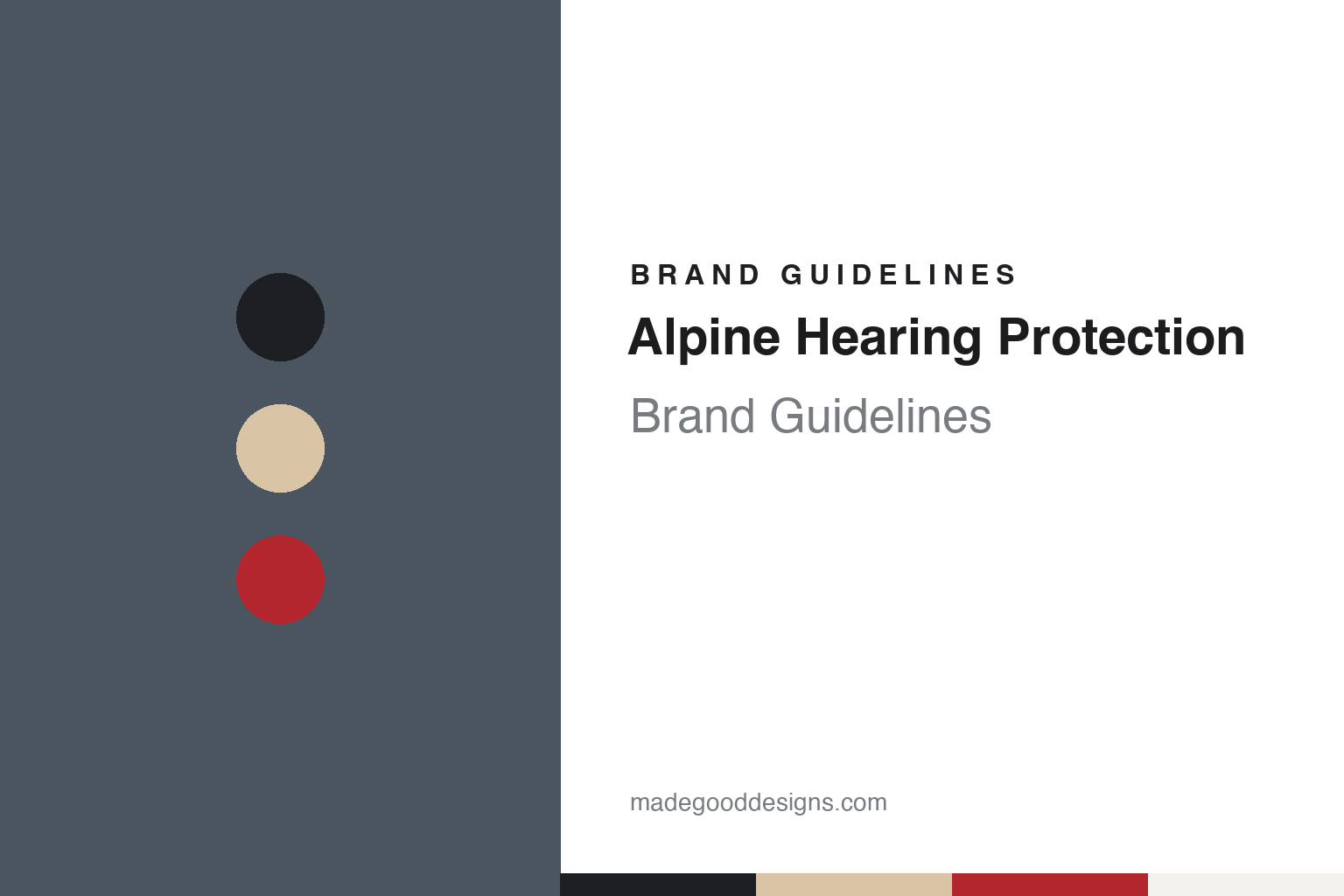
Alpine Hearing Protection Brand Guidelines
The Dutch earplug maker behind PartyPlug and Muffy.
Aa
Two constants: an Alpine charcoal, sand and filter-red palette and a geometric sans register. Abstract homage — not an Alpine Hearing Protection product or mark; no earplug, logo or packaging is reproduced.
Founded 1994
A hearing-protection specialist, his daughter and a marketer.
Alpine Hearing Protection was founded in the Netherlands in 1994. The company names three founders: Bert van Beek, who brought experience in hearing protection; his daughter Lisette; and Peter de Roode, the last two with backgrounds in marketing. Vendis Capital, the investor that later bought into the business, quotes Peter de Roode as a founder speaking of “Lisette and me,” which fits the company’s account. Alpine began by making custom-made earplugs for professionals in the Netherlands.
It is a different company from Alpine Electronics, the Japanese car-audio maker; the two share only a name. The earplug company trades as Alpine Nederland B.V., is based in Utrecht, and sells through national web shops including alpine.nl and alpinehearingprotection.com.
Its own timeline describes the early years as a run of firsts. In 1996, it says, it was the first to offer soft, custom-made earplugs with interchangeable filters. In 2000 it launched UniFit, which it calls the first earplug with a universal filter, originally meant for professionals waiting for their custom pair. Demand for UniFit, the company says, led it to build an international distribution network, and in 2002 it began expanding across Europe. Those “first” claims are Alpine’s own.
Colour
From professionals to festival crowds.
The turn to the general public came in 2010, the company says, with products named for the place they would be used: PartyPlug, SleepSoft and Pluggies Kids. In 2012 it sold earplugs at a festival for the first time and opened a web shop. Earmuffs for children followed: Muffy Kids in 2014 and Muffy Baby in 2017, replaced by an improved version in 2024. During the pandemic, in 2021, it introduced SleepDeep, and in 2022 alone, it says, it brought out 30 new products. In 2024 it launched Silence, the first of a line it says will have more versions. It redesigned its retail packaging in 2020, which it says made it more sustainable, and by 2023, it says, its products were stocked in shops in the Netherlands, Germany, France and the United Kingdom.
The current international shop lists about three dozen items. For music there are MusicSafe and MusicSafe Pro, the latter with three interchangeable filters that the company rates at 16, 19 and 22 dB (SNR). Others cover flying (FlyFit), swimming (SwimSafe and WaterSafe), work (WorkSafe), motorcycling (MotoSafe, in Tour and Sport versions the company rates at 17 and 20 dB SNR) and focus and sleep (Silence and Tune). There are licensed lines for Formula 1, MotoGP and the Indy 500, whose partnership Alpine dates to 2024. In its custom-made range, the company says, filters are colour-coded: white for 19 dB, black for 22 dB and red for 26 dB.
Alpine has also grown by buying. Vendis says Alpine integrated Thunderplugs, a Dutch earplug brand that the company says strengthened its presence in clubs and venues, and Acoufun in France, which Alpine credits with bringing it to motor races around the world.
Typography
Design and documentation.
The seven brands in this group all sell earplugs, but they come from very different places and decades. The oldest is German and more than a century old; the newest names arrived in the 2010s, selling online and, in one case, through crowdfunding. What they share is a product people put in their ears to turn the world down, sold to concert-goers, musicians, sleepers and travellers.
Three are new names built around filtered plugs for music and nightlife. Loop is a Belgian company founded in 2016 by the childhood friends Maarten Bodewes and Dimitri O., according to Wikipedia and the company, and CNBC reported in 2023 that it was headquartered in Antwerp. Eargasm says it is based in Southern California and was founded in 2015 by Ryan Parry. Earasers belongs to Persona Medical of Florida, whose president, Don Campbell, designed the soft silicone plug, the company says.
Two date from the 1990s. Alpine Hearing Protection says it was founded in the Netherlands in 1994 as a pioneer of reusable filtered earplugs for the general public. In 2025 the Belgian investor Gimv announced it was taking a majority stake. ACS says it was established in 1994 to make custom-fit hearing protection, and describes itself as a privately owned UK company that also makes in-ear monitors.
The last two are the outliers. Flare Audio began as a three-person pro-audio maker in a garden garage on England’s south coast, it says, before crowdfunding its Isolate ear protector; Companies House lists Flare Audio Limited, of Lancing in West Sussex, as incorporated in 2007. Ohropax was founded in Berlin in 1907 by the pharmacist Maximilian Negwer, is still run by his family, and makes its wax plugs in Wehrheim, near Frankfurt.
This guide sets out what can be checked about each brand — who founded it, who owns it, and what it says about where its products are made — and marks clearly what rests only on the company’s own word.
Aa
A clean geometric sans for a product named by occasion. (Specimen set in DM Sans, a sans STAND-IN; NOT the Alpine logo.)
Alpine
Own The Volume.
Ownership has changed twice. In 2018 the Dutch investor Vendis Capital bought into the company; Vendis says that during its ownership Alpine moved from a founder-led business to one run by a management team under chief executive Arthur van Keeken. In June 2025 Vendis announced that it had agreed to sell, and on 24 June 2025 Gimv, the Belgian investment company listed on Euronext Brussels, said it was acquiring a majority stake from Vendis, the founders and management, with management reinvesting part of its proceeds. Both announcements describe Alpine as headquartered in the Netherlands and active in more than 65 countries, and Gimv lists 64 staff. Van Keeken said in the Vendis announcement that the company had grown “sevenfold” during the partnership.
The brand speaks in plain, upbeat terms. Its slogan is “Own The Volume,” and Van Keeken is quoted on its About page saying that taking care of your ears “should be as simple as brushing your teeth.” Alpine says it became a certified B Corp in 2024, which the 2025 Vendis and Gimv announcements also mention. On design awards its statements differ: the About page says it won its first Red Dot award in 2015 and now holds eight, while its product pages carry a “2x Red Dot Award winner” badge; we could not check either figure against Red Dot’s own records. The company speaks of its “Dutch roots,” but its About page, contact page and the product pages we checked do not say where its earplugs are made. No official brand colour or typeface is published.
For a design guide, Alpine Hearing Protection shows how a specialist supplier to professionals can become a consumer brand by naming each product for a single occasion — party, sleep, swim, ride — and packaging it for a shop shelf. Compare Loop, another European earplug brand built for consumers, and Etymotic, whose musicians’ earplug came out of a hearing research lab. For this guide we use charcoal, sand and a filter red with a geometric sans, an unofficial interpretation; no product or logo is reproduced.
Explore & save
Keep Alpine Hearing Protection’s identity on hand — save it to a board in the Made Good inspiration library.
Alpine Hearing Protection identity set
Pin the Alpine charcoal, sand and filter-red palette and the geometric sans register to your own board.