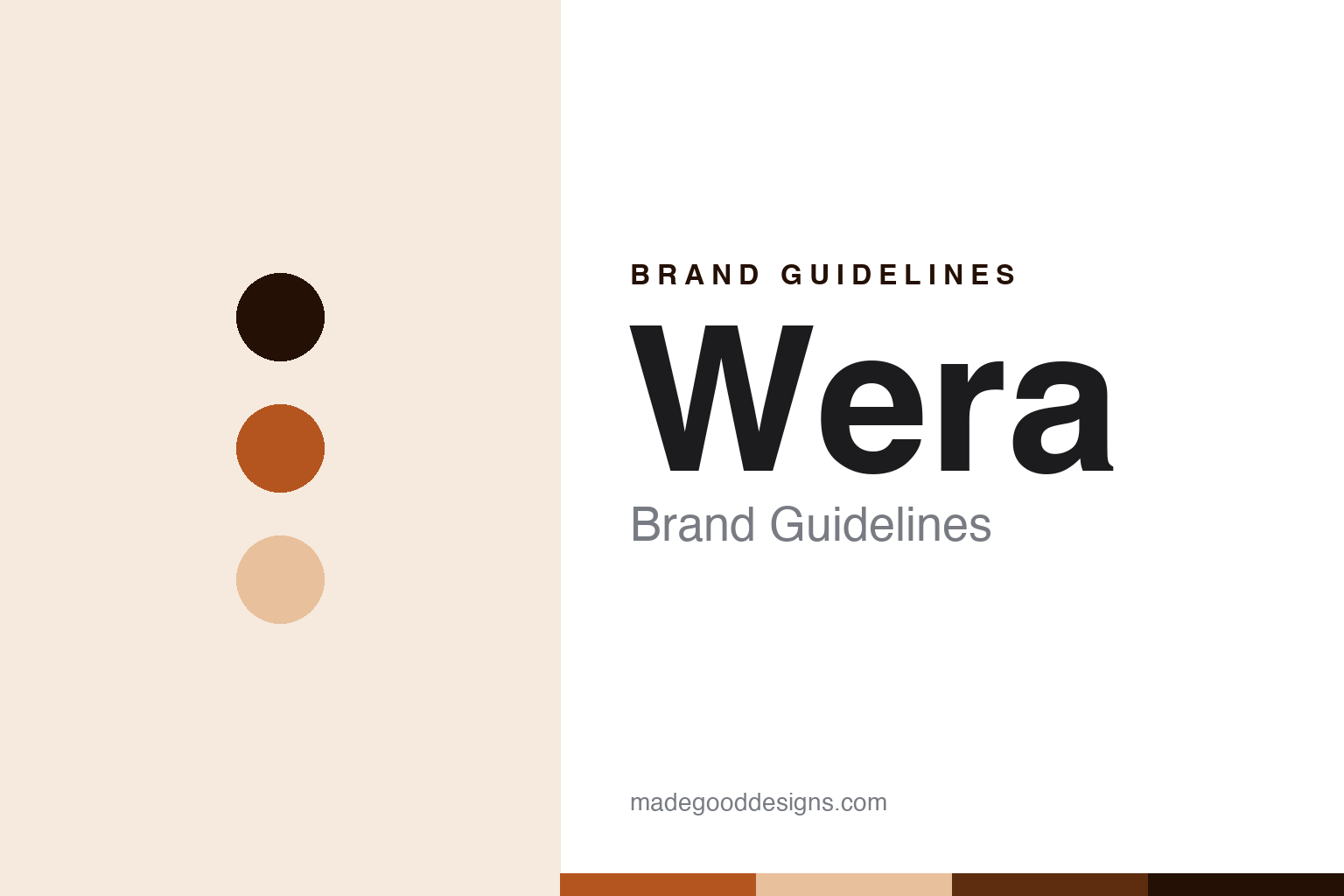
Wera Brand Guidelines
The tool-rebel screwdriver brand.
Aa
Two constants: a rebel-orange palette and a rebel-sans register. Abstract homage — not a Wera product or mark; no screwdriver, colour-coding or logo is reproduced.
The tool-rebel screwdriver brand
Wera is the German screwdriver and bit brand founded in 1936, known as the “Tool Rebels,” now owned by Bitburger Holding and made mostly in the Czech Republic.
Wera brings the precision-tool round its acquired-heritage node — a German screwdriver brand founded down the road from Knipex, in the same city, but with the opposite ownership and where-made story. It was founded in 1936 in Wuppertal by the businessman Hermann Werner, and its name is a portmanteau of two men who built it: Werner and his son-in-law Heinz Amtenbrink. Wera makes and sells screwdrivers, bits and wrenches, and its answer to a round about who owns tools and where they are made is a candid one: German-engineered, mostly made in the Czech Republic, and no longer family-owned.
Its identity is the tool-rebel screwdriver brand. The Tool-Rebels attitude, the Kraftform ergonomics and the acquired ownership are the story here. A brand, rebel — and acquired. The tool-rebel screwdriver brand.
(Honest notes, so the ownership and manufacture are stated plainly. Wera sells screwdrivers, bits and wrenches as its heroes — the Kraftform screwdrivers, the Zyklop ratchet and the Joker self-setting wrench — and we report its performance language as the brand’s own. On ownership, the point that carries the round: Wera was a family firm for decades, but it was sold to Bitburger Holding, the German group behind the brewery, in 2016, so we do not call it family-owned today. On where it is made: its headquarters and research remain in Cronenberg, Wuppertal, but the majority of its manufacturing has been in the Czech Republic since the mid-1990s, so we say “German-engineered, mostly made in the Czech Republic,” and we do not imply German-made across the range. Its Tool-Rebels slogan, its Kraftform handles and its colour-coding are IP we describe but do not reproduce; there is no official brand hex; these tones are an unofficial interpretation.)
Colour
Wera lives in a rebel orange. Click a swatch to copy the hex.
Wera’s identity is bold, ergonomic and irreverent — a rebel orange, an ink, a pale amber, a deep rust, and a paper. The palette leans rebel orange and pale amber: a confident, attitude-forward register that nods to the Tool-Rebels spirit rather than a loud logo colour. It signals a tool-rebel screwdriver brand — clever, bold and human-centred. The honest caveat: with no published brand hex, these values are an original, unofficial interpretation, not first-party colours.
The lesson is a rebel orange signals a bold, ergonomic identity. Wera’s world is the Kraftform handle and the colour-coded set. For designers, it is a reminder that a warm rebel orange and a soft pale amber can carry a tool brand — an attitude tone held as colour, not as a handle or a colour-coding scheme. Because these tones can fail as small text, keep type dark and let the colour live in the accents, palette and band. The takeaways: credit Hermann Werner; date it to 1936; name Bitburger Holding and the Czech manufacture; and treat any single hex as unofficial.
Typography
The register is a rebel sans — bold, modern, irreverent.
Wera’s identity carries a bold, modern, irreverent spirit — a Tool-Rebels brand, not a staid heritage house. A rebel sans captures the mood: clean, confident and a little cheeky, the register of a brand that calls its customers rebels. Set in a rebel-orange palette, the rebel sans feels bold and modern — exactly the personality Wera carries. It behaves like a designed, engineered thing rather than a stiff logo, mirroring an ergonomic handle. (Wera’s real screwdrivers, the Kraftform handle and the colour-coding are things we describe but do not reproduce, and the exact typeface is not ours to use.) Because it is not ours to use, the honest description is “a rebel-sans brand,” shown here in a stand-in. The type behaves like the brand: bold, modern and irreverent.
Aa
A rebel-sans brand — bold and modern. (Specimen set in Space Grotesk, a rebel-sans STAND-IN; NOT the Wera logo or the Kraftform handle.)
The precision tool
Wera stands for the tool-rebel screwdriver brand.
Wera brings the round its acquired-heritage node. A rebel-orange palette, a rebel sans and a 1936 founding make one thing — the tool-rebel screwdriver brand — the whole identity: bold, ergonomic and irreverent. The Tool-Rebels attitude is the pitch, and the honest ownership and manufacture are the where-made and who-owns truth. The point is a German heritage brand that is now acquired and mostly made abroad, set right beside Knipex, which stayed independent and made at home.
Put to work, the identity is the brand told straight, ownership named and manufacture stated. A maker in this spirit would credit Hermann Werner, date it to 1936, and name Bitburger Holding and the Czech manufacture. A reader in this spirit would keep the facts right: Wera sells screwdrivers, bits and wrenches as its heroes, led by the Kraftform range; it was founded in 1936 in Wuppertal; it was sold to Bitburger Holding in 2016 and is no longer family-owned; and it is German-engineered but mostly made in the Czech Republic since the mid-1990s. Wera sits beside Knipex as the round’s German counterpoint — same city, opposite ownership and where-made outcome. The honest editorial moves are to name the acquisition, to state the Czech manufacture, to credit the founders, and to keep any single hex unofficial.
For designers and brand-builders, Wera continues the precision tool: separate a heritage identity from who owns it now — and say where it is really made. The lessons: keep a strong brand attitude while stating current ownership; distinguish German engineering from German manufacture; credit the founders behind a portmanteau name; describe a signature handle rather than depict it; and never reproduce a mark. It is also a reminder to stay precise: Wera is the German screwdriver and bit brand founded in 1936, known as the Tool Rebels, now owned by Bitburger Holding and made mostly in the Czech Republic — with the palette here an unofficial interpretation. It is worth noting, too, that the Kraftform handle was co-developed with Germany’s Fraunhofer Institute in 1968 — early biomechanics in a screwdriver grip. Read that way, Wera is less a screwdriver than an attitude, acquired: bold, modern, irreverent. The lesson for a brand is that attitude and honesty reinforce each other, and naming the owner keeps the story earned. Wera made the-tool-rebel-screwdriver-brand the identity — proof that an acquired heritage name still carries a round when told straight.
Explore & save
Keep Wera’s identity on hand — save it to a board in the Made Good inspiration library.
Wera identity set
Pin the rebel-orange palette and the rebel-sans register to your own board.