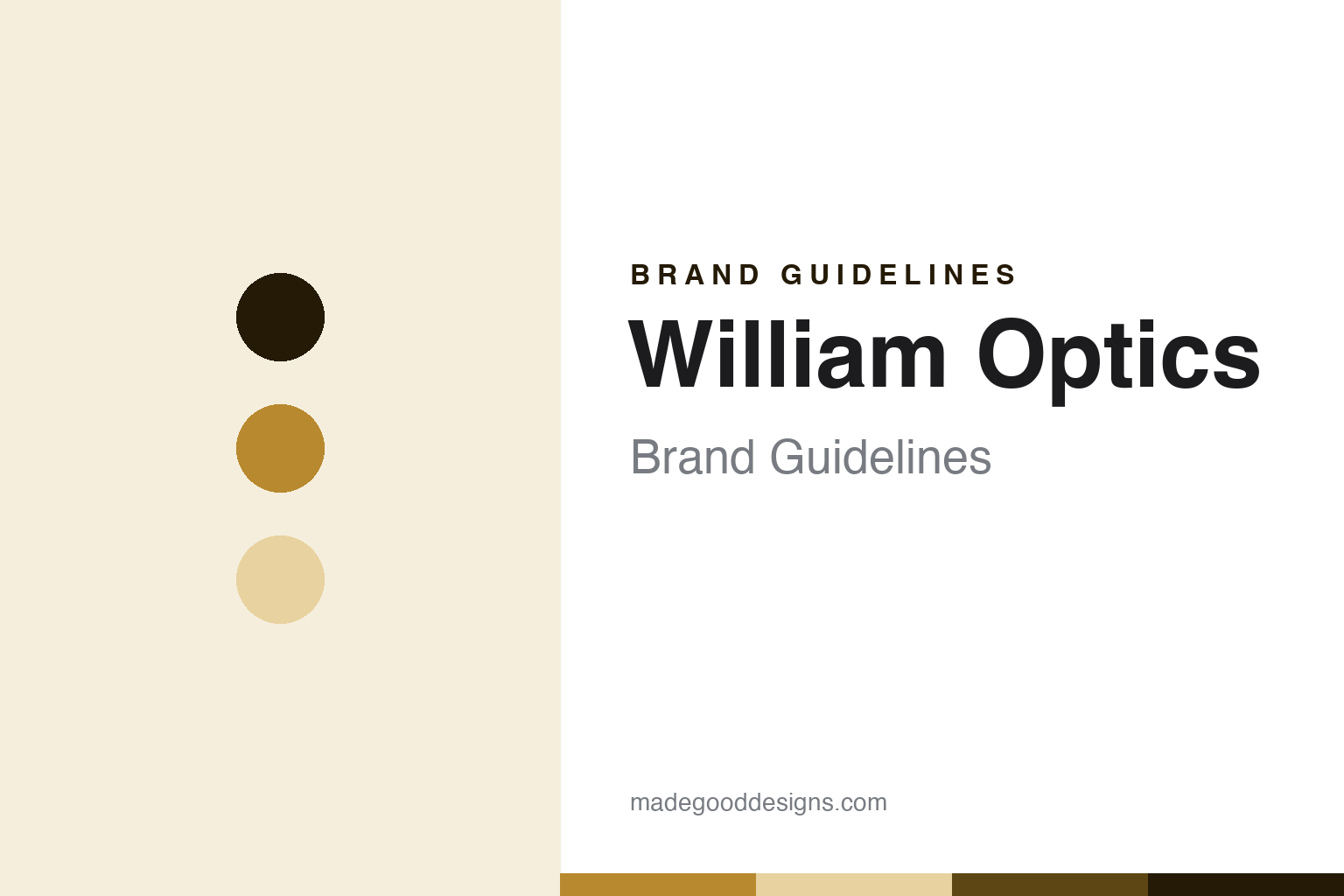
William Optics Brand Guidelines
The design-forward astrophotography refractor.
Aa
Two constants: an astro-gold palette and a design-sans register. Abstract homage — not a William Optics product or mark; no telescope, colourway or logo is reproduced.
The design-forward astrophotography refractor
William Optics is the founder-led Taiwanese maker of compact, design-forward astrophotography refractors, engineered and assembled in Taiwan.
William Optics brings the telescope round its design-forward node — a Taiwanese maker that treats a refractor as an industrial-design object, and made wide-field astrophotography accessible with a scope the size of a camera lens. It was founded in 1996 by William Yang, who was born in Taiwan, spent years in California, and returned home inspired by a visit to Takahashi’s factory in Japan. William Optics makes and sells the telescopes, and its answer to a round about where telescopes are made is a nuanced one: engineered and assembled in Taiwan, with optics from a supplier network.
Its identity is the design-forward astrophotography refractor. The Taiwanese design-and-assembly, the compact astrophotography refractors and the colourful, design-forward finishes are the story here. A maker, design-forward. The design-forward astrophotography refractor.
(Honest notes, so the where-made claim is precise and the ownership framed carefully. William Optics sells refractors as its heroes — the compact RedCat astrographs, the ZenithStar and Gran Turismo apochromats and the Fluorostar triplets — and we report its performance language as the brand’s own. It is private and founder-led, though its exact ownership is thinly documented, so we describe it as privately held and founder-associated. On where it is made, a nuance that matters: William Optics is a Taiwanese design house that engineers and assembles in Taiwan, but it is not a vertically integrated optics manufacturer — it does not grind its own glass, sourcing optics from a supplier network (historically the Taiwanese maker Long Perng, with some components sourced more broadly as the range grew) — so we say it is designed and assembled in Taiwan with optics from a supplier network, and do not claim every element is Taiwan-made. Its designs, the distinctive colourways and the model names are IP we describe but do not reproduce; there is no official brand hex; these tones are an unofficial interpretation.)
Colour
William Optics lives in an astro gold. Click a swatch to copy the hex.
William Optics’ identity is design-forward, compact and colourful — an astro gold, an ink, a pale sand, a deep bronze, and a paper. The palette leans astro gold and pale sand: a warm, design-led register that nods to the brand’s jewel-like anodised finishes rather than a loud logo colour, and deliberately not to its signature red-and-white livery. It signals a design-forward astrophotography refractor — considered, compact and expressive. The honest caveat: with no published brand hex, these values are an original, unofficial interpretation, not first-party colours.
The lesson is an astro gold signals a design-forward identity. William Optics’ world is a camera-lens-sized refractor finished like a design object. For designers, it is a reminder that a warm astro gold and a soft pale sand can carry a maker brand — a design-led tone held as colour, not the brand’s own red livery. Because these tones can fail as small text, keep type dark and let the colour live in the accents, palette and band. The takeaways: credit William Yang; date it to 1996; state the Taiwan-design/sourced-optics reality; and treat any single hex as unofficial.
Typography
The register is a design sans — considered, compact, expressive.
William Optics’ identity carries a considered, compact, expressive spirit — a design-led maker, not a plain-tube one. A design sans captures the mood: clean, modern and confident, the register of a refractor treated as an object of industrial design. Set in an astro-gold palette, the design sans feels considered and expressive — exactly the personality William Optics carries. It behaves like a designed object rather than a plain logo, mirroring anodised metal and ground glass. (William Optics’ real telescopes, the colourways and the model names are things we describe but do not reproduce, and the exact typeface is not ours to use.) Because it is not ours to use, the honest description is “a design-sans brand,” shown here in a stand-in. The type behaves like the brand: considered, compact and expressive.
Aa
A design-sans brand — considered and expressive. (Specimen set in Space Grotesk, a design-sans STAND-IN; NOT the William Optics logo or its red-and-white livery.)
The telescope
William Optics stands for the design-forward astrophotography refractor.
William Optics brings the round its design-forward node. An astro-gold palette, a design sans and a 1996 founding make one thing — the design-forward astrophotography refractor — the whole identity: design-forward, compact and colourful. The Taiwanese design-and-assembly is the pitch, and the industrial-design treatment is the character. The point is a maker that treats a telescope as an object of design, in a round about where telescopes are made.
Put to work, the identity is the brand told straight, where-made precise and ownership framed carefully. A maker in this spirit would credit William Yang, date it to 1996, and state the Taiwan-design/sourced-optics reality. A reader in this spirit would keep the facts right: William Optics sells refractors as its heroes, led by the RedCat astrographs; it was founded in 1996 by William Yang in Taiwan; it is privately held and founder-associated; and it engineers and assembles in Taiwan with optics from a supplier network, not as a vertically integrated glass maker. William Optics sits among the round’s craft makers, after Takahashi. The honest editorial moves are to date it to 1996, to state the design-and-assembly reality, to avoid overclaiming 100 per cent Taiwan-made, and to protect the red livery as trade dress.
For designers and brand-builders, William Optics continues the telescope: let industrial design be the identity — and be precise that design-and-assembly is not from-scratch manufacture. The lessons: bring design to a utilitarian category; credit the founder; distinguish design-and-assembly from vertical manufacture; respect a signature livery; and never reproduce a logo. It is also a reminder to stay precise: William Optics is the founder-led Taiwanese maker of compact, design-forward astrophotography refractors, engineered and assembled in Taiwan — with the palette here an unofficial interpretation. The hook is the RedCat 51 — a palm-sized Petzval astrograph that did as much as any single instrument to make wide-field deep-sky astrophotography accessible to beginners — paired with the brand’s unusual move for the category: treating telescopes as design objects, in bold anodised colours where the field had long defaulted to plain white or black. Read that way, William Optics is less a telescope than a design object: considered, compact, expressive. The lesson for a brand is that design and honest sourcing reinforce each other, and being precise about assembly keeps the story earned. William Optics made the-design-forward-astrophotography-refractor the identity — proof that design carries a round.
Explore & save
Keep William Optics’s identity on hand — save it to a board in the Made Good inspiration library.
William Optics identity set
Pin the astro-gold palette and the design-sans register to your own board.