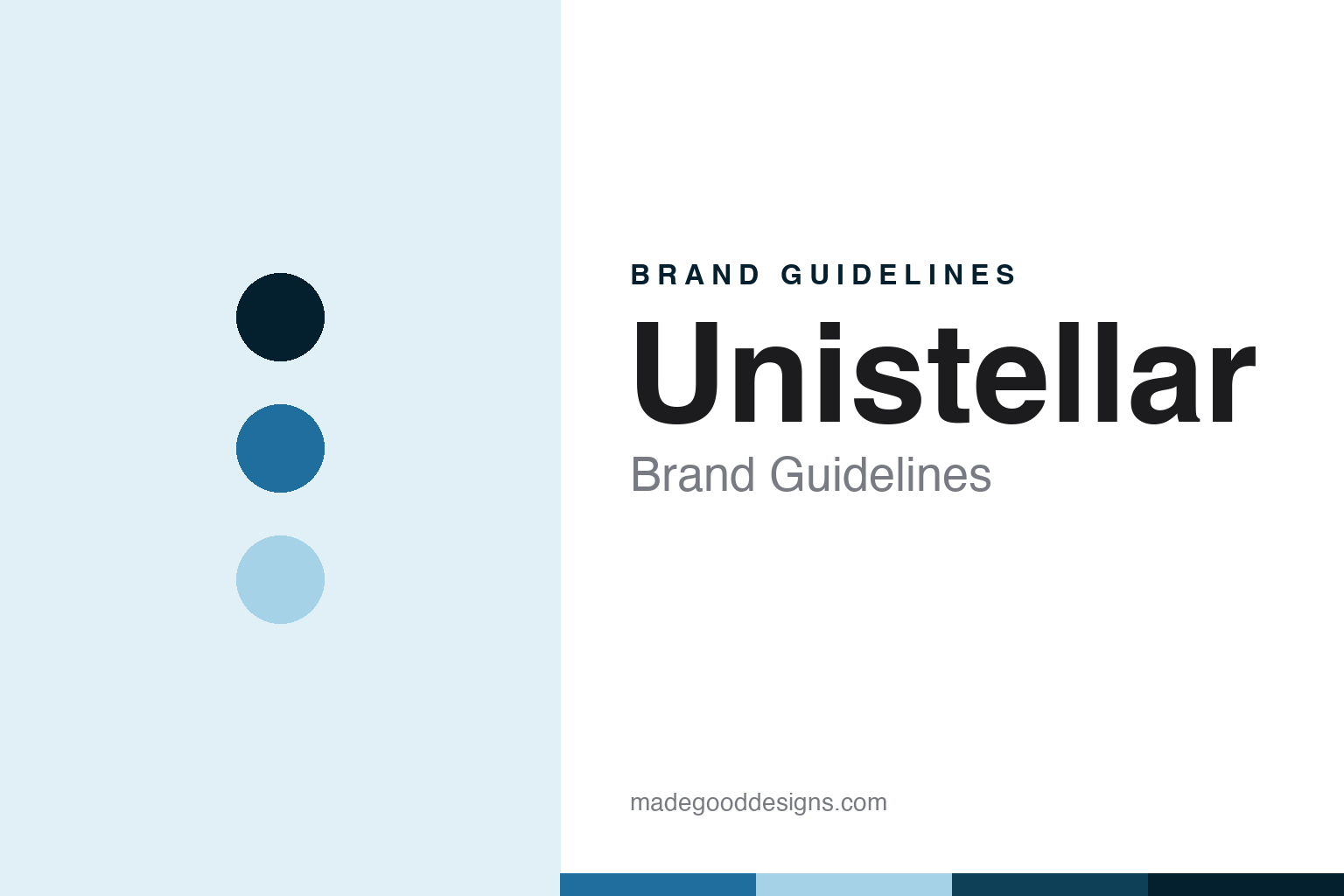
Unistellar Brand Guidelines
The citizen-science smart telescope.
Aa
Two constants: a signal-blue palette and a smart-sans register. Abstract homage — not a Unistellar product or mark; no telescope, silhouette or logo is reproduced.
The citizen-science smart telescope
Unistellar is the French smart-telescope pioneer, designed in Marseille, whose app-controlled scopes plug backyard astronomers into real science.
Unistellar brings the telescope round its smart-telescope disruptor node — the French startup widely credited with pioneering the consumer “smart telescope,” and the one that turns backyard scopes into a research array. It was founded in 2015 in Marseille, France, by a group of physicists including Laurent Marfisi and the astronomer Franck Marchis. Unistellar makes and sells the telescopes, and its answer to a round about where telescopes are made is honest: designed in France, with the manufacturing location not publicly disclosed.
Its identity is the citizen-science smart telescope. The app-controlled digital observation, the French design origin and the citizen-science network are the story here. A maker, smart. The citizen-science smart telescope.
(Honest notes, so the date is corrected and the where-made and partnership claims are precise. Unistellar sells smart telescopes as its heroes — the eVscope 2 and eQuinox 2, the Odyssey and Odyssey Pro, and now smart binoculars — and we report its performance language as the brand’s own. On a point of accuracy: it was founded in 2015, not 2017, which is when its prototype was unveiled at a trade show. It was founded by a group of physicists, of whom we can confirm Laurent Marfisi, its chief executive, and Franck Marchis, an astronomer tied to the SETI Institute, so we credit those two and describe the rest as the founding team. It is a private, venture-backed startup. On a partnership worth stating precisely: Nikon is both a technical partner and, since 2023, an investor, but not a parent, and some Unistellar models use a Nikon-made electronic eyepiece. On where it is made: Unistellar designs in France, but its manufacturing location is not publicly disclosed, so we do not claim where it is built. Its designs, its distinctive silhouette and its branded terms are IP we describe but do not reproduce; there is no official brand hex; these tones are an unofficial interpretation.)
Colour
Unistellar lives in a signal blue. Click a swatch to copy the hex.
Unistellar’s identity is smart, scientific and accessible — a signal blue, an ink, a pale sky, a deep marine, and a paper. The palette leans signal blue and pale sky: a digital, app-connected register that nods to enhanced-vision astronomy rather than a loud logo colour. It signals a citizen-science smart telescope — clever, scientific and open to beginners. The honest caveat: with no published brand hex, these values are an original, unofficial interpretation, not first-party colours.
The lesson is a signal blue signals a smart, scientific identity. Unistellar’s world is an app-controlled telescope that stacks light in real time and feeds real research. For designers, it is a reminder that a digital signal blue and a soft pale sky can carry a maker brand — a connected tone held as colour, not as a product silhouette. Because these tones can fail as small text, keep type dark and let the colour live in the accents, palette and band. The takeaways: credit Marfisi and Marchis; date it to 2015; state the Nikon partnership precisely; and treat any single hex as unofficial.
Typography
The register is a smart sans — clever, scientific, modern.
Unistellar’s identity carries a clever, scientific, modern spirit — a deep-tech startup, not a heritage house. A smart sans captures the mood: clean, precise and confident, the register of an app-controlled instrument. Set in a signal-blue palette, the smart sans feels clever and scientific — exactly the personality Unistellar carries. It behaves like a connected device rather than a heritage logo, mirroring digital sensors and glass. (Unistellar’s real telescopes, the silhouette and the branded terms are things we describe but do not reproduce, and the exact typeface is not ours to use.) Because it is not ours to use, the honest description is “a smart-sans brand,” shown here in a stand-in. The type behaves like the brand: clever, scientific and modern.
Aa
A smart-sans brand — clever and scientific. (Specimen set in Manrope, a smart-sans STAND-IN; NOT the Unistellar logo or any telescope.)
The telescope
Unistellar stands for the citizen-science smart telescope.
Unistellar brings the round its smart-telescope disruptor node. A signal-blue palette, a smart sans and a 2015 founding make one thing — the citizen-science smart telescope — the whole identity: smart, scientific and accessible. The app-controlled digital observation is the pitch, and the citizen-science network is the character. The point is the pioneer of the consumer smart telescope, turning backyard scopes into research, in a round about where telescopes are made.
Put to work, the identity is the brand told straight, date corrected and partnership stated precisely. A maker in this spirit would credit Marfisi and Marchis, date it to 2015, and state the Nikon partnership precisely. A reader in this spirit would keep the facts right: Unistellar sells smart telescopes as its heroes, led by the eVscope 2 and the Odyssey; it was founded in 2015 in Marseille by a group of physicists; it is a private, venture-backed startup; Nikon is a partner and investor, not a parent; and it is designed in France with an undisclosed manufacturing location. Unistellar sits among the round’s smart-telescope disruptors, after William Optics, beside Vaonis. The honest editorial moves are to date it to 2015, to credit the confirmable founders, to state the Nikon relationship precisely, and to not claim where it is built.
For designers and brand-builders, Unistellar continues the telescope: let a smart, scientific mission be the identity — and state a partnership and a founding date precisely. The lessons: build a category around a mission; correct a founding-vs-reveal date; credit only confirmable founders; describe a partner-and-investor relationship without calling it a parent; and never reproduce a silhouette. It is also a reminder to stay precise: Unistellar is the French smart-telescope pioneer, designed in Marseille, whose app-controlled scopes plug backyard astronomers into real science — with the palette here an unofficial interpretation. The hook is the citizen-science network: Unistellar telescopes plug into a global program run with the SETI Institute, so owners can contribute real observations of asteroid occultations, exoplanet transits and planetary-defence tracking — turning thousands of consumer scopes into a distributed research array, and letting city dwellers see galaxies through the light pollution. Read that way, Unistellar is less a telescope than a scientific network: clever, scientific, modern. The lesson for a brand is that a mission and honest specifics reinforce each other, and stating partnerships precisely keeps the story earned. Unistellar made the-citizen-science-smart-telescope the identity — proof that a mission carries a round.
Explore & save
Keep Unistellar’s identity on hand — save it to a board in the Made Good inspiration library.
Unistellar identity set
Pin the signal-blue palette and the smart-sans register to your own board.