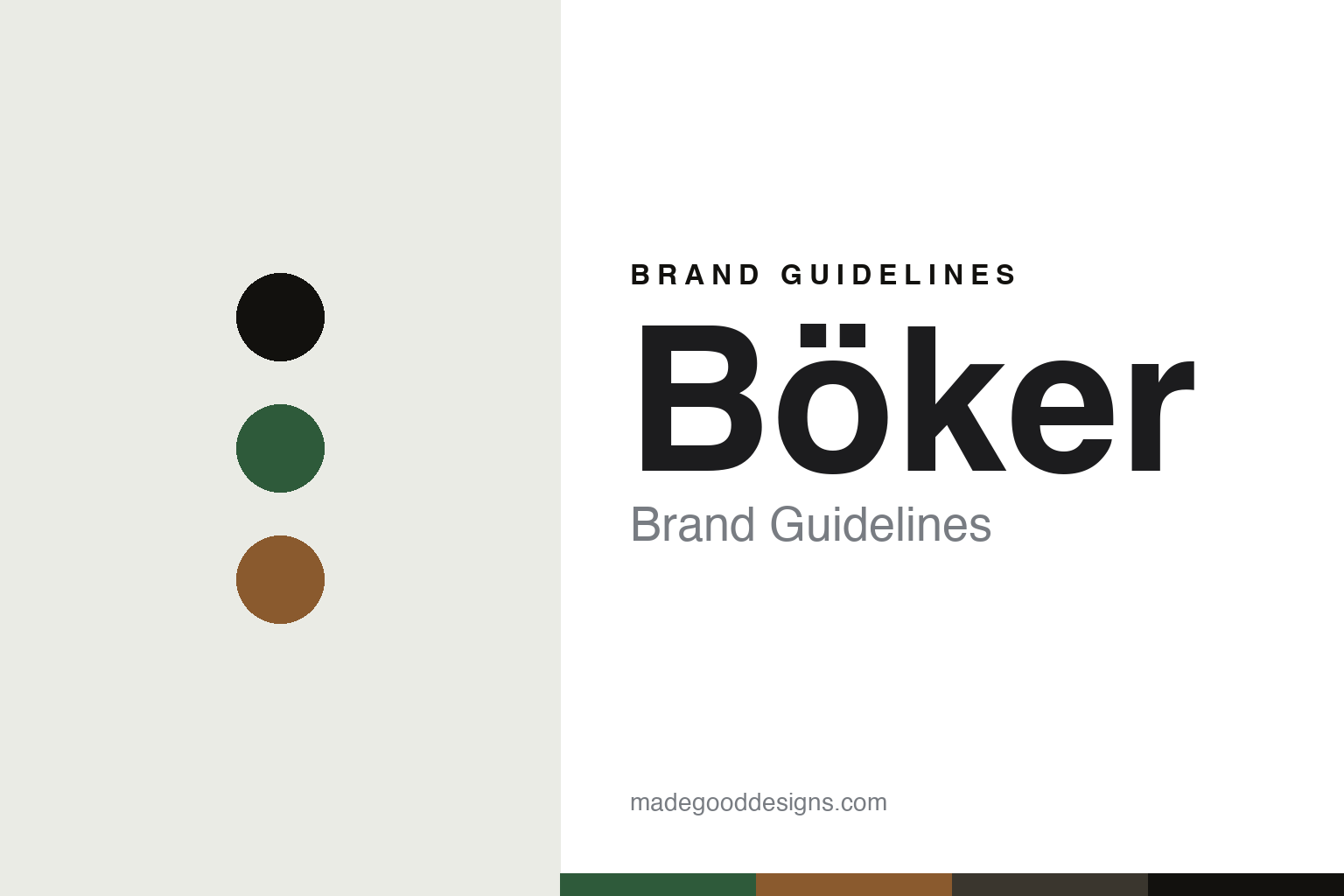
Böker Brand Guidelines
The Tree Brand of Solingen.
Aa
Two constants: a tree-green palette and a Solingen-sans register. Abstract homage — not a Böker blade, the Tree Brand mark or wordmark.
The Tree Brand of Solingen
Böker is the 1869 Solingen Tree Brand, whose Manufaktur kitchen knives are made in Germany.
Böker is a lesson in a heritage mark carried across a group as the identity. Founded in Solingen in 1869 and known worldwide by its chestnut-tree mark, the “Tree Brand,” it is an old house that survives as a modern group — with a Solingen manufactory at its core and other lines made abroad. Its answer to how an old house keeps going is a layered one: keep the heritage, hand-made Solingen line as the flagship, and use separate, honestly-named lines to reach the wider market. A famous mark, carried across more than one factory.
Its identity is the old mark that spans a group. Böker’s Tree Brand, its Solingen Manufaktur and its layered range are the work it is known for. A trademark, made a signature. A house whose tree grows on knives from several places.
(Honest notes, so the story stays precise. Böker — Heinr. Böker Baumwerk GmbH — is a family-owned Solingen house founded in 1869, with roots as a blade maker going back further, and the chestnut-tree “Tree Brand” is its long-standing trademark. The crucial, honest point is where things are made across its four lines: Böker Manufaktur Solingen is genuinely made in Solingen, Germany — and this is the line that includes its kitchen knives and German Damascus — while Böker Plus is made across Asia, the USA and Europe, Magnum is made in Asia, and Arbolito is made in Argentina. So we say Böker’s Manufaktur kitchen knives are made in Solingen, and are clear that other Böker lines are made offshore, rather than claiming all Böker knives are German. The Böker name was historically split between Solingen and a North American branch, reunified under the German house in 1986. Its designs and the Tree Brand are its IP, described but never reproduced, and there is no official brand hex — these tones are an unofficial interpretation. This is design commentary and does not promote any product.)
Colour
Böker lives in a tree-green palette. Click a swatch to copy the hex.
Böker’s identity is heritage, German and layered — a tree green, an ink, a chestnut, a bark, and a chalk. The palette leans tree green and chestnut: the register of the chestnut-tree mark and old Solingen steel. It signals heritage and the mark over any one product. The honest caveat: with no published brand hex, these values are an original, unofficial interpretation, not first-party colours.
The lesson is a tree-green palette signals a heritage, Solingen identity. Böker’s world is a Tree-Brand, Manufaktur-in-Solingen, group-spanning object. For designers, it is a reminder that a tree green and a chestnut can carry a brand built on a mark — the green of a chestnut tree and the brown of its wood — without copying the mark itself. Because these tones can fail as small text, keep type dark and let the colour live in the accents, palette and band. The takeaways: protect the mark; keep the flagship at home; be honest about which line is made where; and treat any single hex as unofficial.
Typography
The register is a Solingen sans — precise, engineered, clean.
Böker’s identity carries a precise, engineered, clean spirit — a heritage house with modern reach, not a single workshop. A Solingen sans captures the mood: even, technical and orderly, the register of a Solingen manufacturer. Set in a tree-green palette, the Solingen sans feels precise and engineered — exactly the personality Böker carries. It is clean rather than ornamental, mirroring a well-made German blade. (Böker’s real designs and the Tree Brand are things we describe but do not reproduce, and the exact typeface is not ours to use.) Because it is not ours to use, the honest description is “a Solingen-sans spirit,” shown here in a stand-in. The type behaves like the maker: precise, engineered and clean.
Aa
A Solingen-sans spirit — precise and clean. (Specimen set in IBM Plex Sans, a Solingen-sans STAND-IN; NOT the Böker wordmark, the Tree Brand or any blade design.)
The old houses
Böker stands for the mark carried across a group.
Böker is a lesson in making a heritage mark the identity. A tree-green palette, a Solingen sans and a Manufaktur blade make one thing — an old Tree Brand carried across a modern group — the whole maker: heritage, German and layered. The mark is the differentiator. The differentiator is a trademark strong enough to span several factories: a hand-made Solingen flagship at the top, and honestly-named lines made elsewhere for the wider market.
Put to work, the identity is a mark as design. A maker building in this spirit would treat its trademark as the asset that survives, keep a genuine home-made flagship to anchor the name, and be honest about which lines are made where rather than let the mark imply one origin. It would let the heritage line carry the reputation. A brand learning from it would see that an old mark can reach a wider market through tiers, but only if the tiers are labelled honestly, so the Solingen flagship is not confused with the offshore value lines. It would say plainly that its Manufaktur kitchen knives are made in Solingen. The lesson Böker teaches is that a mark can build a brand across a group: the Tree Brand gives it recognition, and the Solingen Manufaktur gives it substance. The mark is the personality, and the Solingen flagship is the proof.
For designers and brand-builders, Böker holds the heritage-mark pole in this round about the old houses: let the mark span the group, and be honest about each tier. The lessons: protect the mark; anchor it with a home-made flagship; label where each line is made; and never reproduce a protected mark. It is also a reminder to stay precise: Böker is a family-owned Solingen house founded in 1869, its Tree Brand carried across a group whose Manufaktur kitchen knives are made in Solingen while other lines are made offshore — with the palette here an unofficial interpretation. Böker made the mark the maker — proof that a heritage trademark can be the difference.
Explore & save
Keep Böker’s identity on hand — save it to a board in the Made Good inspiration library.
Böker identity set
Pin the tree-green palette and the Solingen-sans register to your own board.