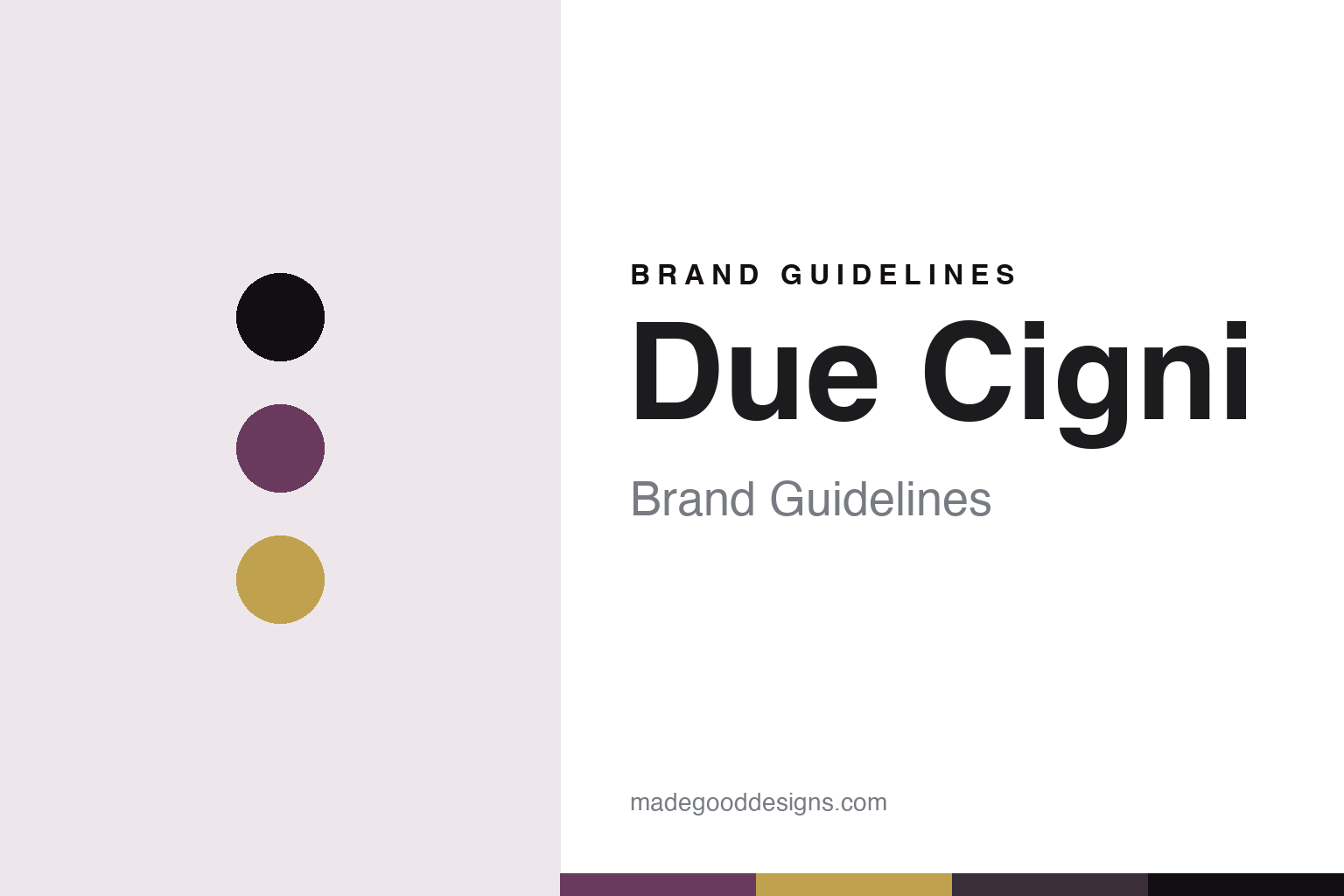
Due Cigni Brand Guidelines
The 1896 Italian house.
Aa
Two constants: a plum palette and an Italian-sans register. Abstract homage — not a Due Cigni knife, the two-swans mark or wordmark.
The 1896 Italian house
Due Cigni is the 1896 Frosolone cutlery house, made in Italy, now under the Fox Group in Maniago.
Due Cigni is a lesson in an old house kept alive inside a group as the identity. Founded in 1896 in Frosolone, a historic Italian knife town, it is a heritage kitchen-cutlery house — chef’s, santoku, paring and bread knives, plus scissors — that has survived by being taken into a modern Italian cutlery group, which keeps its name and its “1896” heritage while making it in Maniago, another famous Italian knife town. Its answer to how an old house keeps going is absorption: let a larger, capable group carry the old name forward. A century-old marque, made by a modern Italian works.
Its identity is the old marque carried by a group. Due Cigni’s 1896 heritage, its Italian making and its two-swans name are the work it is known for. A name, made a signature. A house that lives on under new stewardship.
(Honest notes, so the story stays precise. Due Cigni gives its founding as 1896 in Frosolone, in Molise, a genuinely historic Italian knife-and-scissors town; we attribute that date to the brand rather than as independently documented. Today the brand is part of the Fox Group — the Maniago cutlery company Oreste Frati — so it is no longer independent or family-run, and its production is now in Maniago, in Friuli, not Frosolone. We therefore say it was founded in 1896 in Frosolone and is today made in Italy under the Fox Group in Maniago, rather than implying unbroken Frosolone manufacture. It is a sister brand to Fox Knives, and distinct from the Scarperia house covered elsewhere. Its designs and the two-swans mark are its IP, described but never reproduced, and there is no official brand hex — these tones are an unofficial interpretation. This is design commentary and does not promote any product.)
Colour
Due Cigni lives in a plum palette. Click a swatch to copy the hex.
Due Cigni’s identity is heritage, warm and Italian — a plum, an ink, a gold, an aubergine, and a cream. The palette leans plum and gold: the register of an old Italian marque and a warm, decorative finish. It signals heritage and craft over novelty. The honest caveat: with no published brand hex, these values are an original, unofficial interpretation, not first-party colours.
The lesson is a plum palette signals a heritage, made-in-Italy identity. Due Cigni’s world is an 1896-heritage, group-made, made-in-Italy object. For designers, it is a reminder that a deep plum and a gold can carry a brand built on an old name — the plum of a heritage marque and the gold of a fine finish. Because these tones can fail as small text, keep type dark and let the colour live in the accents, palette and band. The takeaways: keep the old name alive; make it in Italy; be honest about the group and the town; and treat any single hex as unofficial.
Typography
The register is an Italian sans — warm, clean, contemporary.
Due Cigni’s identity carries a warm, clean, contemporary spirit — an old marque with modern making, not a museum piece. An Italian sans captures the mood: even, warm and current, the register of a heritage brand under a modern group. Set in a plum palette, the Italian sans feels warm and clean — exactly the personality Due Cigni carries. It is contemporary rather than antique, mirroring an old name made by a modern works. (Due Cigni’s real designs and the two-swans mark are things we describe but do not reproduce, and the exact typeface is not ours to use.) Because it is not ours to use, the honest description is “an Italian-sans spirit,” shown here in a stand-in. The type behaves like the maker: warm, clean and contemporary.
Aa
An Italian-sans spirit — warm and clean. (Specimen set in Manrope, an Italian-sans STAND-IN; NOT the Due Cigni wordmark, the two-swans mark or any knife design.)
The old houses
Due Cigni stands for the old marque kept alive by a group.
Due Cigni is a lesson in making an old name kept alive the identity. A plum palette, an Italian sans and a heritage kitchen blade make one thing — an 1896 marque carried forward by a modern group — the whole maker: heritage, warm and Italian. The survival-by-absorption is the differentiator. The differentiator is stewardship: a century-old name that would have been fragile alone, kept in production by a larger Italian cutlery group with the capacity to make it well.
Put to work, the identity is stewardship as design. A maker building in this spirit would recognise when an old name is worth preserving inside a bigger house, keep the making in a real cutlery town, and be honest that the marque is now part of a group rather than independent. It would treat the 1896 heritage as a story to honour accurately. A brand learning from it would see that joining a capable group is a legitimate way for a small heritage name to survive, provided the history is told straight — where it was founded, where it is made now, and who owns it. It would say plainly it is made in Italy under the group in Maniago. The lesson Due Cigni teaches is that stewardship can keep a name alive: the 1896 heritage gives it depth, and the Italian making gives it substance. The name is the personality, and the honest history is the proof.
For designers and brand-builders, Due Cigni holds the stewardship pole in this round about the old houses: let a capable group carry an old name, and tell its history straight. The lessons: preserve the name; keep the making in Italy; be honest about the group and the town; and never reproduce a protected mark. It is also a reminder to stay precise: Due Cigni is an Italian house founded in 1896 in Frosolone, today made in Italy under the Fox Group in Maniago — with the palette here an unofficial interpretation. Due Cigni made the kept-alive name the maker — proof that honest stewardship can be the difference.
Explore & save
Keep Due Cigni’s identity on hand — save it to a board in the Made Good inspiration library.
Due Cigni identity set
Pin the plum palette and the Italian-sans register to your own board.