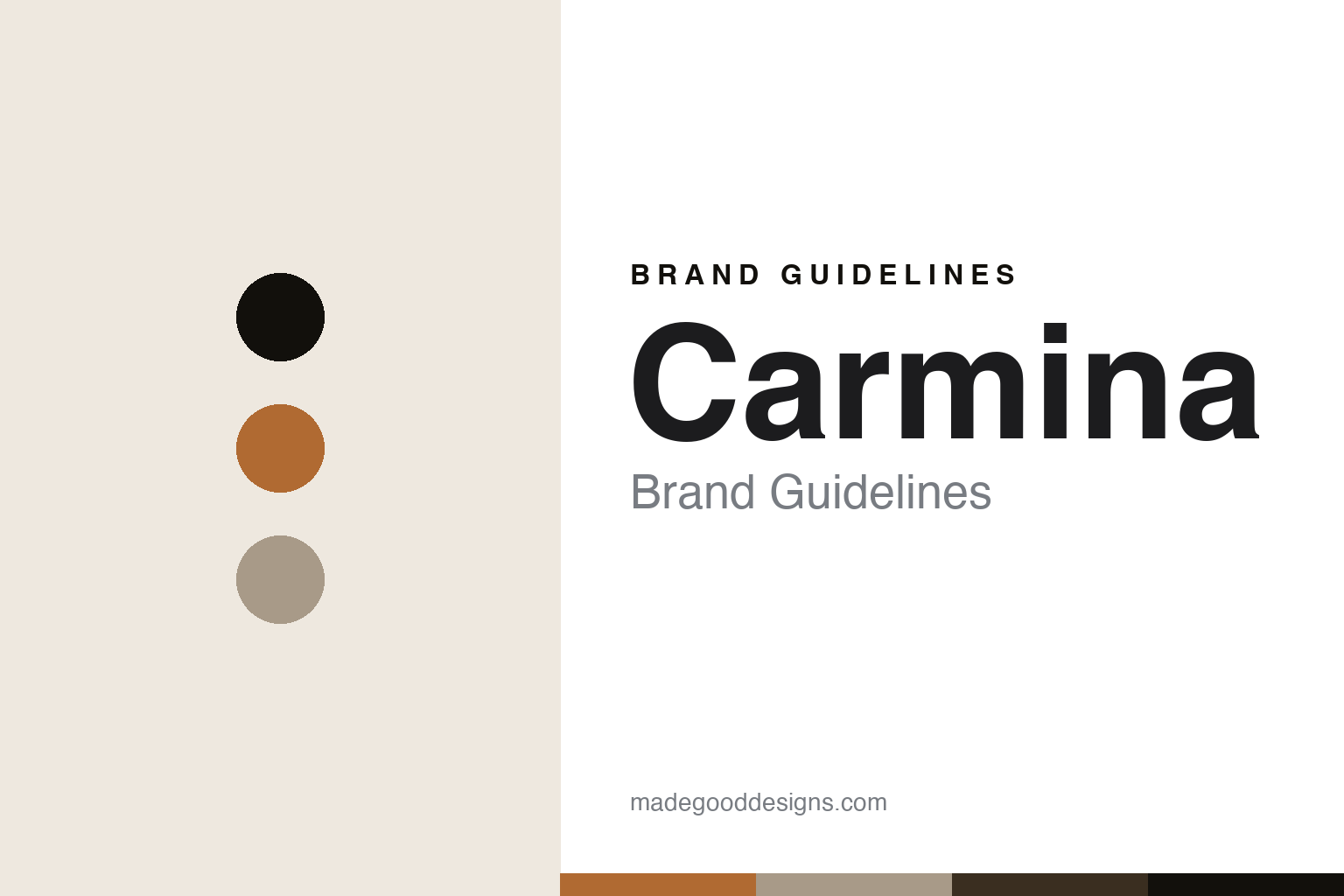
Carmina Brand Guidelines
The Mallorcan welted shoe.
Aa
Two constants: a cognac palette and a modern-sans register. Abstract homage — not a Carmina shoe, last or wordmark.
The Mallorcan welted shoe
Carmina is a Mallorcan family maker whose Goodyear-welted shoes are made in Inca, Spain — the brand founded in 1997 on shoemaking roots to 1866.
Carmina is a lesson in a welted construction, made on Mallorca, as the identity. From Inca, a Mallorcan town long known for its leather industry, it makes Goodyear-welted shoes the traditional way — the welt stitched so the shoe is resoleable and long-lived, in a family workshop rather than an anonymous plant. Its answer to how a welted shoe is made is Spanish and unshowy: keep the craft on the island, hold the quality, and price it below the great English and Italian names. A welted shoe pitched as honest value.
Its identity is the Mallorcan welted shoe, made in Spain. Carmina’s Goodyear welting, its Inca making and its family ownership are the work it is known for. A method, made a signature. A family that turned a long shoemaking line into a modern brand.
(Honest notes, so the story stays precise. This is a common point of confusion worth getting right: the family has made shoes on Mallorca since 1866, when Matías Pujadas began, but the Carmina brand itself was founded in 1997 by José Albaladejo Pujadas — so we credit the 1866 shoemaking roots while dating the brand to 1997, rather than saying Carmina was “founded in 1866.” It is a family-owned, independent maker, its shoes genuinely made in Inca, Mallorca, Spain; Goodyear welting is the house standard, with shell cordovan a well-known calling card, though some styles use other constructions. It is positioned as accessible luxury — strong value against Northampton and Italian welted makers. It is distinct from, though connected by the same Mallorcan shoemaking family to, other island brands; we keep that as reported association rather than corporate fact. Its designs and marks are its IP, described but never reproduced, and there is no official brand hex — these tones are an unofficial interpretation. This is design commentary and does not promote any product.)
Colour
Carmina lives in a cognac palette. Click a swatch to copy the hex.
Carmina’s identity is Spanish, warm and value-minded — a cognac, an ink, a calf sand, an umber, and a chalk. The palette leans cognac and calf sand: the register of warm Mediterranean leather and a Mallorcan bench. It signals craft-at-a-fair-price over prestige theatre. The honest caveat: with no published brand hex, these values are an original, unofficial interpretation, not first-party colours.
The lesson is a cognac palette signals a welted, made-in-Mallorca identity. Carmina’s world is a resoleable, warmly finished, island-made object. For designers, it is a reminder that a warm cognac and a soft calf sand can carry a brand built on value welting — the amber of Mediterranean leather and the sand of the last. Because these tones can fail as small text, keep type dark and let the colour live in the accents, palette and band. The takeaways: keep the craft on the island; date your heritage honestly; compete on value not theatre; and treat any single hex as unofficial.
Typography
The register is a modern sans — clean, warm, approachable.
Carmina’s identity carries a clean, warm, approachable spirit — a family maker offering real craft without ceremony. A modern sans captures the mood: even, friendly and contemporary, the register of a house that made an old craft accessible. Set in a cognac palette, the modern sans feels clean and warm — exactly the personality Carmina carries. It is approachable rather than austere, mirroring a well-made welted shoe at a fair price. (Carmina’s real designs and marks are things we describe but do not reproduce, and the exact typeface is not ours to use.) Because it is not ours to use, the honest description is “a modern-sans spirit,” shown here in a stand-in. The type behaves like the maker: clean, warm and approachable.
Aa
A modern-sans spirit — clean and warm. (Specimen set in Manrope, a modern-sans STAND-IN; NOT the Carmina wordmark or any shoe design.)
How a welted shoe is made
Carmina stands for the Mallorcan welt at fair value.
Carmina is a lesson in making a welted construction and honest value the identity. A cognac palette, a modern sans and a Goodyear-welted shoe make one thing — a well-made, resoleable shoe priced below the famous names — the whole maker: Spanish, warm and value-minded. The welt is the differentiator, and the fair price is the meaning. The point is a genuinely welted object, made on Mallorca by a family, that competes on quality-per-euro rather than prestige.
Put to work, the identity is value plus method as design. A maker building in this spirit would keep the craft local, hold the construction honest, and compete on value rather than borrowed status. It would also be precise about its own history rather than rounding it up. A brand learning from it would see that welted quality at a fair price is a durable identity — that a customer who discovers real craft under the usual price learns to trust the brand — and that dating your story truthfully, roots to 1866, brand since 1997, is more convincing than implying you are older than you are. A brand learning from it would treat family ownership and a real workshop as assets to state plainly, not gloss over. The lesson Carmina teaches is that a welted construction and honest value can hold an identity: the method gives it substance, and the fair price gives it reach. The craft is the personality, and the welted shoe is the proof.
For designers and brand-builders, Carmina holds the value pole in this round about how a welted shoe is made: offer real construction at a fair price, and date your heritage honestly. The lessons: keep the craft local; hold the welt; compete on value; and never reproduce a protected design or overstate your age. It is also a reminder to stay precise: Carmina is a Mallorcan family maker whose Goodyear-welted shoes are made in Inca, Spain, the brand founded in 1997 on shoemaking roots to 1866 — with the palette here an unofficial interpretation. Carmina made the Mallorcan welt the identity — proof that method and value can be the difference.
Explore & save
Keep Carmina’s identity on hand — save it to a board in the Made Good inspiration library.
Carmina identity set
Pin the cognac palette and the modern-sans register to your own board.