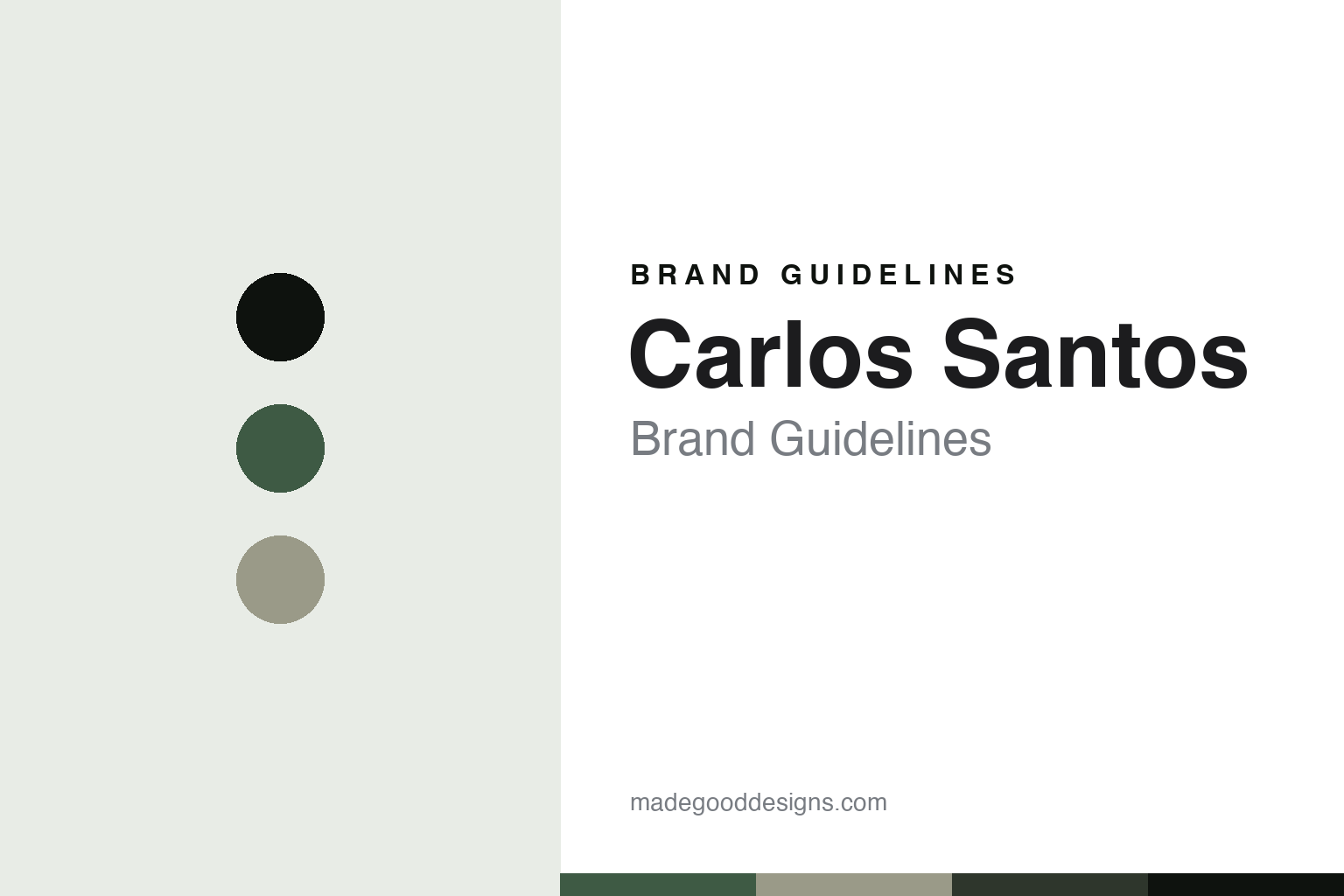
Carlos Santos Brand Guidelines
The Portuguese welted shoe.
Aa
Two constants: a patina-green palette and an understated-sans register. Abstract homage — not a Carlos Santos shoe, patina or wordmark.
The Portuguese welted shoe
Carlos Santos is a São João da Madeira maker whose Goodyear-welted shoes, known for hand-applied patina, are genuinely made in Portugal.
Carlos Santos is a lesson in a welted construction, genuinely made in Portugal, as the identity. From São João da Madeira — Portugal’s “capital of footwear” — it makes Goodyear-welted shoes the traditional way, the welt stitched so the sole can be replaced and the shoe worn for years. Its answer to how a welted shoe is made is quietly confident: real welted construction, in Portugal, at a price that undercuts its Spanish and Italian peers. A welted shoe whose whole case is where and how it is made.
Its identity is the Portuguese welted shoe, in a hand-applied patina. Carlos Santos’s Goodyear welting, its Portuguese making and its patina finishing are the work it is known for. A method and a finish, made a signature. A factory that became a name enthusiasts sought out.
(Honest notes, so the story stays precise. Carlos Santos is a São João da Madeira shoemaker, and its shoes are genuinely made in Portugal — the country’s footwear hub — which here is the whole point rather than a caveat. A few facts we deliberately do not overstate: its exact founding year is uncertain (a mid-twentieth-century date is cited from a single source), and we could not confirm a founder biography or a current official website, so we describe it as a mid-twentieth-century Portuguese maker reaching buyers largely through specialist retailers, and we do not assert a date, a founder or a URL we cannot verify. Goodyear welting is its signature construction, alongside some Blake-stitched styles and a higher Handgrade line, and it has historically produced shoes for other brands, whom we do not name. It is best understood as strong value welted footwear, using French calf leathers, with hand-applied patina a calling card — not a centuries-old house, a bespoke workshop, or the equal of the very top makers, comparisons some enthusiasts make as opinion. Its designs and marks are its IP, described but never reproduced, and there is no official brand hex — these tones are an unofficial interpretation. This is design commentary and does not promote any product.)
Colour
Carlos Santos lives in a patina-green palette. Click a swatch to copy the hex.
Carlos Santos’s identity is Portuguese, understated and patina-led — a patina green, an ink, a calf grey, a moss shadow, and a chalk. The palette leans patina green and calf grey: the register of a hand-shaded finish and a São João da Madeira bench. It signals craft and value over noise. The honest caveat: with no published brand hex, these values are an original, unofficial interpretation, not first-party colours — an abstract nod to its patina finishing, not any sampled colourway.
The lesson is a patina-green palette signals a welted, made-in-Portugal identity. Carlos Santos’s world is a resoleable, hand-finished, Portuguese-made object. For designers, it is a reminder that a muted patina green and a soft calf grey can carry a brand built on where and how it makes — the shaded green of a hand-applied finish and the grey of the last. Because these tones can fail as small text, keep type dark and let the colour live in the accents, palette and band. The takeaways: make it genuinely in Portugal; let the finish be the flourish; compete on value; and treat any single hex as unofficial.
Typography
The register is an understated sans — plain, quiet, value-honest.
Carlos Santos’s identity carries a plain, quiet, value-honest spirit — a working factory brand, not a heritage act. An understated sans captures the mood: even, unshowy and clear, the register of a maker that lets the shoe and the price speak. Set in a patina-green palette, the understated sans feels plain and quiet — exactly the personality Carlos Santos carries. It is honest rather than grand, mirroring a value welted shoe. (Carlos Santos’s real designs, patinas and marks are things we describe but do not reproduce, and the exact typeface is not ours to use.) Because it is not ours to use, the honest description is “an understated-sans spirit,” shown here in a stand-in. The type behaves like the maker: plain, quiet and value-honest.
Aa
An understated-sans spirit — plain and quiet. (Specimen set in Work Sans, an understated-sans STAND-IN; NOT the Carlos Santos wordmark, a patina, or any shoe design.)
How a welted shoe is made
Carlos Santos stands for the Portuguese welt at value.
Carlos Santos is a lesson in making a welted construction, and where it is made, the identity. A patina-green palette, an understated sans and a Goodyear-welted shoe make one thing — a genuinely Portuguese-made welted shoe at value — the whole maker: Portuguese, understated and patina-led. The welt is the differentiator, and the made-in-Portugal fact is the meaning. The point is a genuinely welted object, produced in the country’s footwear capital, whose case rests on how and where it is made rather than on a long name.
Put to work, the identity is where-and-how as design. A maker building in this spirit would make the shoe genuinely at home, let a finish like patina be the flourish, and be honest about its scale and its story rather than borrowing prestige. It would resist claiming a founding date or a rival’s peer status it cannot support. A brand learning from it would see that being genuinely made somewhere is itself a marketable identity — that “really made in Portugal” beats “designed here, made elsewhere” every time — and that stating only what you can verify, and letting value do the rest, builds more trust than a grand origin myth. A brand learning from it would treat a distinctive finish as a signature to lean on, without pretending the finish makes it something it is not. The lesson Carlos Santos teaches is that a welted construction plus honest provenance can hold an identity: the method gives it substance, and the made-in-Portugal fact gives it meaning. The craft is the personality, and the welted shoe is the proof.
For designers and brand-builders, Carlos Santos holds the provenance pole in this round about how a welted shoe is made: really make it where you say, and claim only what you can prove. The lessons: make it genuinely at home; let the finish be the flourish; state only verified facts; and never reproduce a protected design or patina. It is also a reminder to stay precise: Carlos Santos is a mid-twentieth-century São João da Madeira maker whose Goodyear-welted shoes are genuinely made in Portugal, known for hand-applied patina — with the palette here an unofficial interpretation, and its exact date, founder and official channel left unstated where unverified. Carlos Santos made honest provenance the identity — proof that where and how can be the difference.
Explore & save
Keep Carlos Santos’s identity on hand — save it to a board in the Made Good inspiration library.
Carlos Santos identity set
Pin the patina-green palette and the understated-sans register to your own board.