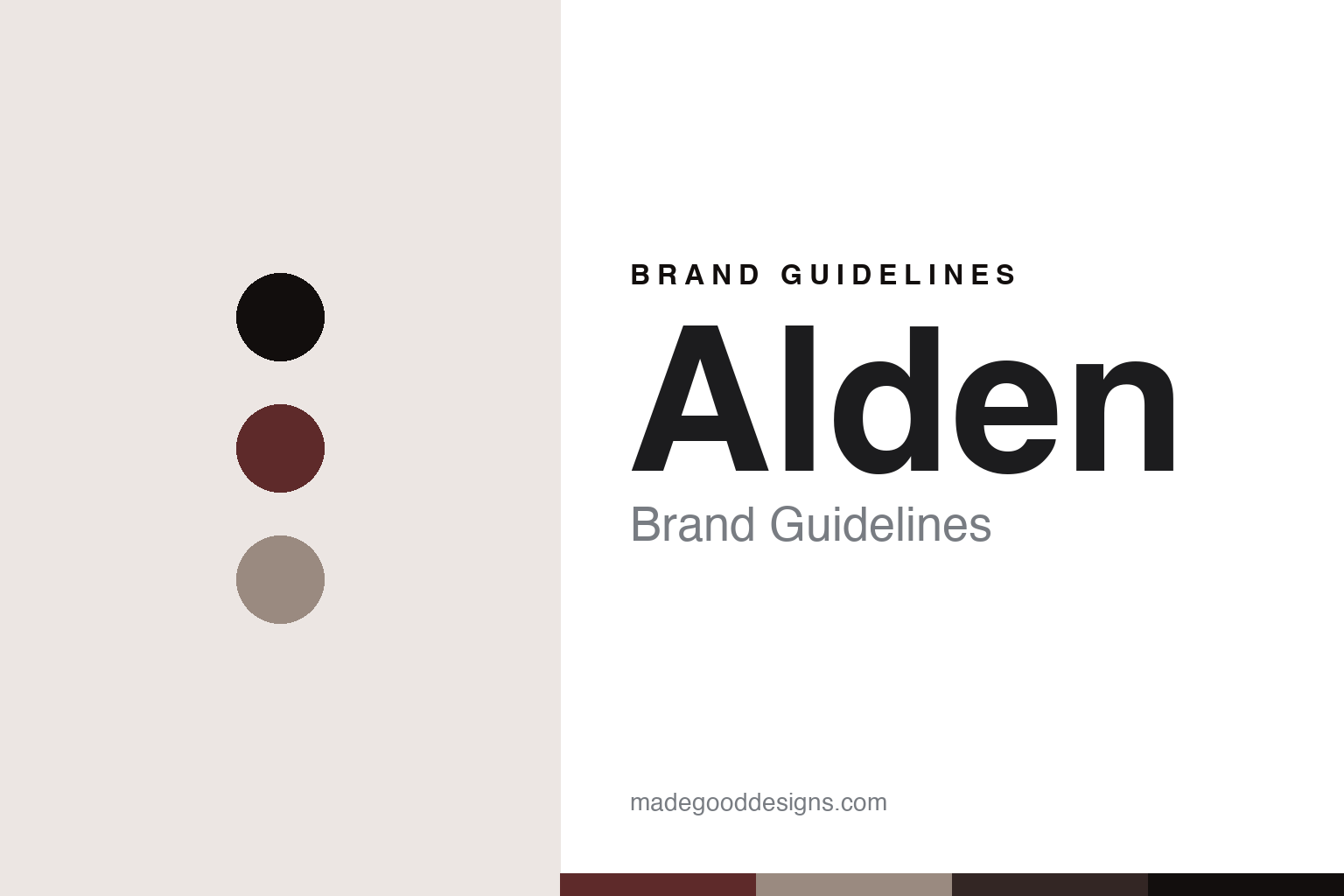
Alden Brand Guidelines
The American welted shoe.
Aa
Two constants: a shell-cordovan palette and a heritage-sans register. Abstract homage — not an Alden shoe, last or wordmark.
The American welted shoe
Alden is an independent Massachusetts maker whose Goodyear-welted shoes, famous for shell cordovan, are made in the USA since 1884.
Alden is a lesson in a welted construction, made in America, as the identity. From Middleborough, Massachusetts, it makes Goodyear-welted shoes the durable way — the welt stitched so the sole can be replaced and the shoe worn for a lifetime. Its answer to how a welted shoe is made is a New England one: keep the factory at home, keep the construction honest, and let the leather do the talking. A shoe built to outlast its first owner’s expectations.
Its identity is the American welted shoe, in shell cordovan. Alden’s Goodyear welting, its Massachusetts making and its famous cordovan leather are the work it is known for. A method and a material, made a signature. A maker that stayed put while the industry moved offshore.
(Honest notes, so the story stays precise. Alden Shoe Company was founded in 1884 by Charles H. Alden and is an independent, long family-held American maker, still producing in Middleborough, Massachusetts — not owned by a conglomerate. Goodyear welting is its defining construction, though some lines use other methods, so we call the welt its signature rather than its only one. Its halo material is shell cordovan, which it buys from Horween Leather of Chicago — a relationship dating to 1930 — rather than tanning itself; shell cordovan comes from a dense membrane in a horse’s hindquarters, not from a “shell” or an eel, and we state that plainly. Its best-known model, the 405 boot, is widely associated with a film character whose rights belong to others, so we mention the association as fact and imply no licence. Its designs, lasts and marks are its IP, described but never reproduced, and there is no official brand hex — these tones are an unofficial interpretation. This is design commentary and does not promote any product.)
Colour
Alden lives in a shell-cordovan palette. Click a swatch to copy the hex.
Alden’s identity is American, durable and material-led — a shell cordovan, an ink, a calf tan, a shadow, and a chalk. The palette leans shell cordovan and tan: the register of a deep, glossy leather and a New England workbench. It signals substance and longevity over flash. The honest caveat: with no published brand hex, these values are an original, unofficial interpretation, not first-party colours.
The lesson is a shell-cordovan palette signals a welted, made-in-USA identity. Alden’s world is a resoleable, cordovan-clad, American-made object. For designers, it is a reminder that a rich cordovan burgundy and a soft calf tan can carry a brand built on a method and a material — the depth of the leather and the tan of the last. Because these tones can fail as small text, keep type dark and let the colour live in the accents, palette and band. The takeaways: make it at home; let the material be the halo; credit the tannery honestly; and treat any single hex as unofficial.
Typography
The register is a heritage sans — plain, sturdy, American.
Alden’s identity carries a plain, sturdy, American spirit — a working heritage maker, not a fashion label. A heritage sans captures the mood: even, solid and unfussy, the register of a New England factory. Set in a shell-cordovan palette, the heritage sans feels plain and sturdy — exactly the personality Alden carries. It is understated rather than showy, mirroring a Goodyear-welted shoe. (Alden’s real designs and marks are things we describe but do not reproduce, and the exact typeface is not ours to use.) Because it is not ours to use, the honest description is “a heritage-sans spirit,” shown here in a stand-in. The type behaves like the maker: plain, sturdy and American.
Aa
A heritage-sans spirit — plain and sturdy. (Specimen set in Archivo, a heritage-sans STAND-IN; NOT the Alden wordmark or any shoe design.)
How a welted shoe is made
Alden stands for the American welt in cordovan.
Alden is a lesson in making a welted construction and a material the identity. A shell-cordovan palette, a heritage sans and a Goodyear-welted shoe make one thing — a durable, resoleable, American-made shoe in a famous leather — the whole maker: American, durable and material-led. The welt and the cordovan are the differentiators, and the making-at-home is the meaning. The point is a genuinely rebuildable object in a genuinely special leather, produced in Massachusetts while much of the trade left.
Put to work, the identity is a method plus a material as design. A maker building in this spirit would pair a durable construction with one halo material, keep production at home, and credit its suppliers honestly rather than pretending it did everything in-house. It would let the leather be the story without overclaiming. A brand learning from it would see that a durable object plus a distinctive material is a durable identity — that a shoe worth resoling in a leather worth waiting for earns devotion — and that being precise about what you make and what you buy, cordovan from Horween, not tanned in-house, builds trust rather than dents it. A brand learning from it would also treat an association with popular culture as a fact to note, not a right to borrow. The lesson Alden teaches is that a method and a material can hold an identity together: the welt gives it substance, and the cordovan gives it character. The craft is the personality, and the welted shoe is the proof.
For designers and brand-builders, Alden holds the American pole in this round about how a welted shoe is made: pair the construction with a signature material, and stay honest about both. The lessons: make it at home; choose one halo material; credit the tannery; and never reproduce a protected design or borrow a licence. It is also a reminder to stay precise: Alden is an independent Massachusetts maker founded in 1884, its Goodyear-welted shoes made in the USA and famous for Horween shell cordovan — with the palette here an unofficial interpretation. Alden made the American welt the identity — proof that a method and a material can be the difference.
Explore & save
Keep Alden’s identity on hand — save it to a board in the Made Good inspiration library.
Alden identity set
Pin the shell-cordovan palette and the heritage-sans register to your own board.