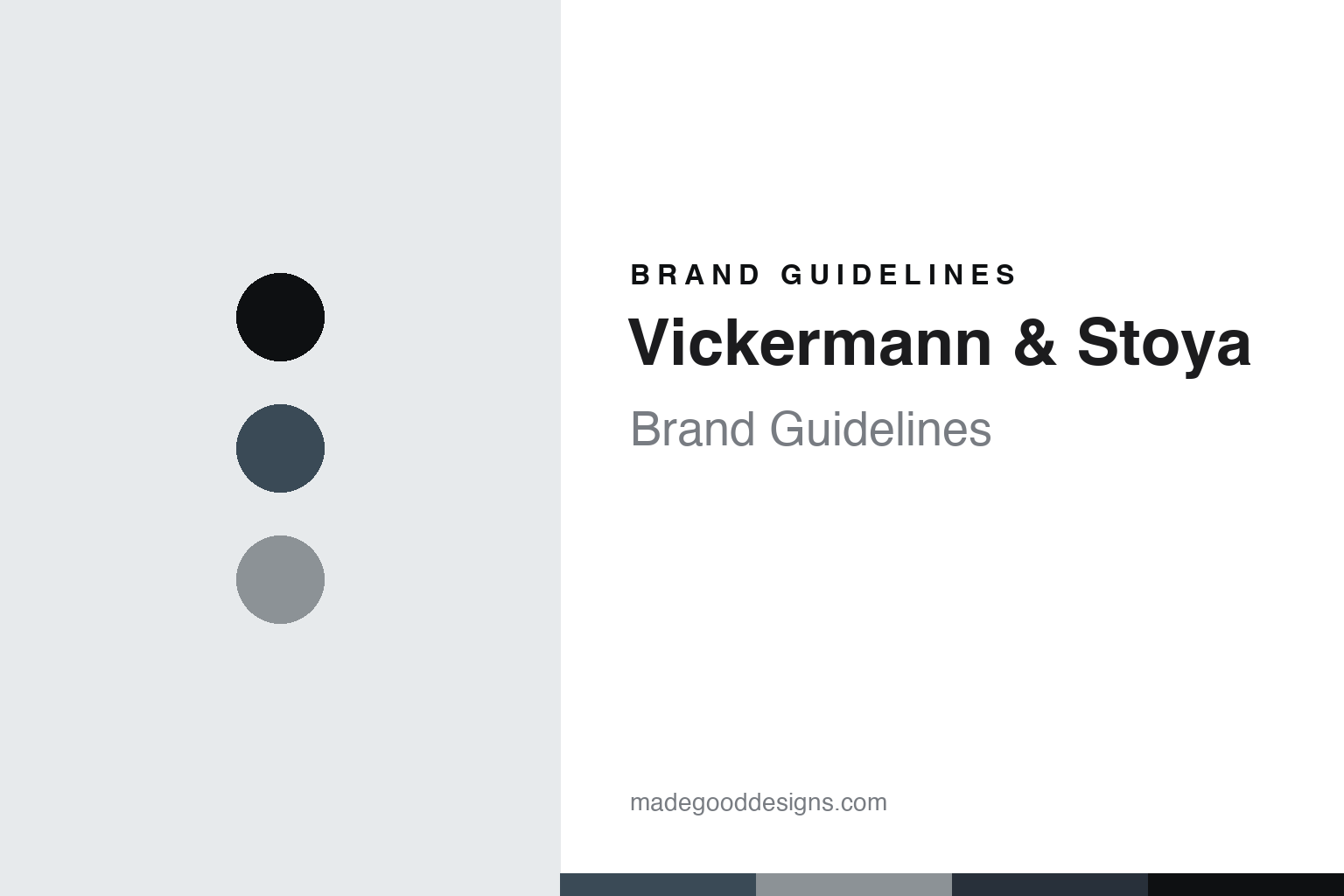
Vickermann & Stoya Brand Guidelines
The German bespoke bench.
Aa
Two constants: a steel-blue palette and a meticulous-sans register. Abstract homage — not a Vickermann & Stoya shoe, last or wordmark.
The German bespoke bench
Vickermann & Stoya is a Baden-Baden bespoke atelier making hand-made shoes on oak-bark-tanned soles in Germany.
Vickermann & Stoya is a lesson in how a modern bespoke atelier competes on sheer meticulousness. From Baden-Baden it makes bespoke shoes by hand to each client’s requirements, builds its own boot shafts, and soles its shoes with oak-bark-tanned leather — the slow-tanned material prized at the top of the craft. Its answer to the bespoke bench is German exactness: make each pair by hand, from the best materials, without shortcut. A shoe built to measure, on the finest soles.
Its identity is the German bespoke shoe, on oak-bark soles. Vickermann & Stoya’s hand-made bespoke, its in-house shafts and its oak-bark soles are the work it is known for. A craft, done meticulously. A young atelier at the top of German bespoke.
(Honest notes, so the story stays precise, about living makers whose public work only we describe. Vickermann & Stoya is a bespoke shoemaker in Baden-Baden, Germany, founded — per the Michelangelo Foundation’s Homo Faber profile — in 2004 by two people whose names the house uses: Matthias Vickermann and Martin Stoya. Its shoes are genuinely hand-made in Germany to individual requirements, it builds boot shafts in-house, and it soles its shoes with J.R. Rendenbach oak-bark-tanned leather, a hallmark material of top-tier welted work; it also makes leather goods and offers repairs and orthopedic work, so it is not purely bespoke. We describe it as hand-made bespoke with oak-bark soles rather than quoting a specific welt term the house does not publish, and we do not assert a waiting list. Its designs and marks are its IP, described but never reproduced, and there is no official brand hex — these tones are an unofficial interpretation. This is design commentary and does not promote any product.)
Colour
Vickermann & Stoya lives in a steel-blue palette. Click a swatch to copy the hex.
Vickermann & Stoya’s identity is German, precise and understated — a steel blue, an ink, a calf grey, a shadow, and a chalk. The palette leans steel blue and calf grey: the register of a cool, exact craft and a quiet atelier. It signals meticulousness and materials over show. The honest caveat: with no published brand hex, these values are an original, unofficial interpretation, not first-party colours.
The lesson is a steel-blue palette signals a hand-made, oak-bark-soled identity. Vickermann & Stoya’s world is a bespoke, meticulously-made, German object. For designers, it is a reminder that a cool steel blue and a soft grey can carry a brand built on exactness — a restrained palette for a precise craft. Because these tones can fail as small text, keep type dark and let the colour live in the accents, palette and band. The takeaways: make it by hand; use the best materials; be precise about your craft; and treat any single hex as unofficial.
Typography
The register is a meticulous sans — clean, exact, restrained.
Vickermann & Stoya’s identity carries a clean, exact, restrained spirit — a meticulous atelier, not a marketing brand. A meticulous sans captures the mood: precise, even and quiet, the register of a German bespoke bench. Set in a steel-blue palette, the meticulous sans feels clean and exact — exactly the personality the house carries. It is restrained rather than loud, mirroring a hand-made bespoke shoe. (Vickermann & Stoya’s real designs and marks are things we describe but do not reproduce, and the exact typeface is not ours to use.) Because it is not ours to use, the honest description is “a meticulous-sans spirit,” shown here in a stand-in. The type behaves like the house: clean, exact and restrained.
Aa
A meticulous-sans spirit — clean and exact. (Specimen set in Manrope, a meticulous-sans STAND-IN; NOT the Vickermann & Stoya wordmark or any shoe design.)
The bespoke bench
Vickermann & Stoya stands for meticulous German bespoke.
Vickermann & Stoya is a lesson in how a modern atelier competes on meticulousness and materials. A steel-blue palette, a meticulous sans and a hand-made bespoke shoe make one thing — a shoe built to measure on the finest soles — the whole atelier: German, precise and understated. The hand-work is the craft, and the oak-bark soles are the material signature. The point is a genuinely bespoke object, made by hand in Germany, on slow-tanned soles that mark the top of the trade.
Put to work, the identity is meticulousness as design. A young atelier in this spirit would compete not on heritage it lacks but on exactness and materials, make each pair by hand, and be precise about its craft rather than borrow grander language. It would let a hallmark material — oak-bark-tanned soles — quietly signal its tier. A brand learning from it would see that meticulousness plus the best materials is a viable identity even without centuries behind it — that “hand-made in Germany, on oak-bark soles” earns respect on merit — and that being exact, naming the material and the makers, describing the craft without overclaiming a welt term the house does not publish, is itself part of the precision. A brand learning from it would also treat its makers as public business figures and keep the register restrained. It would let the sole itself tell the story, since oak-bark tanning takes many months where a fast tannage takes days, and a customer who understands that difference values the patience built into every pair. The lesson Vickermann & Stoya teaches is that a hand-made bespoke craft plus a hallmark material can hold an identity: the hand-work gives it substance, and the soles give it distinction. The craft is the personality, and the bespoke shoe is the proof.
For designers and brand-builders, Vickermann & Stoya holds the meticulous pole in this round about the bespoke bench: compete on exactness and materials, and describe the craft precisely. The lessons: make it by hand; choose hallmark materials; claim only what you publish; and never reproduce a protected design. It is also a reminder to stay precise: Vickermann & Stoya is a Baden-Baden bespoke atelier, founded in 2004 by Matthias Vickermann and Martin Stoya, making hand-made shoes on oak-bark-tanned soles in Germany — with the palette here an unofficial interpretation. Vickermann & Stoya made meticulousness the identity — proof that exactness can be the difference.
Explore & save
Keep Vickermann & Stoya’s identity on hand — save it to a board in the Made Good inspiration library.
Vickermann & Stoya identity set
Pin the steel-blue palette and the meticulous-sans register to your own board.