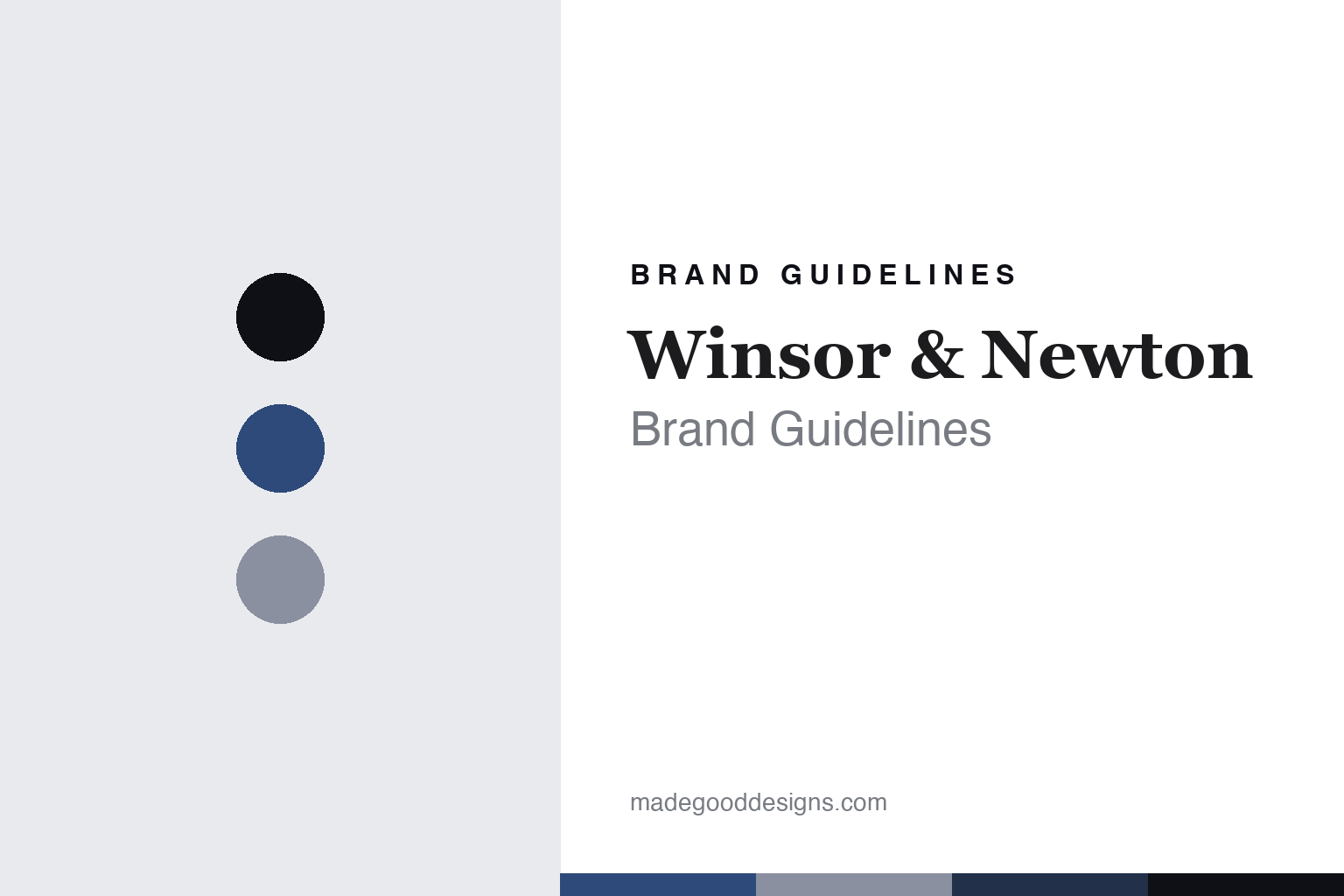
Winsor & Newton Brand Guidelines
The art-and-science colourmen.
Aa
Two constants: a Winsor-blue palette and a colourmen-serif register. Abstract homage — not a Winsor & Newton colour, label or wordmark.
The art-and-science colourmen
Winsor & Newton is the London colourmen since 1832 — art and science together — whose colours are now made in France.
Winsor & Newton is a lesson in how a colour is made when a chemist meets an artist. Founded in London in 1832 by a scientist and a painter, it set out to put artists’ colours on a rigorous footing — consistent, tested, standardised — and became the archetypal “colourmen.” Its answer to how a colour is made is a partnership of art and science: understand the pigment as chemistry, and make it behave for the painter. A colour made to a formula, not a guess.
Its identity is the art-and-science colour house. Winsor & Newton’s chemist-and-artist founding, its standardised colours and its Series 7 brush are the work it is known for. A method, made a signature. A house that turned colour-making into a discipline.
(Honest notes, so the story stays precise. Winsor & Newton was founded in 1832 in London by William Winsor, a chemist, and Henry Newton, an artist, and it holds a Royal Warrant first granted in 1841 — the art-and-science pairing is its own framing and the heart of its story. Two honest points on the modern reality: its paint is no longer made in England — colour manufacturing moved to France around 2010 under its corporate owner, ColArt, though its brushes are still made in the United Kingdom, at Lowestoft — so we say “London-born colourmen; colours now made in France, brushes still made in the UK.” And it is not an independent British family firm: it is a ColArt brand, ultimately owned by the privately held Swedish group Lindéngruppen, having earlier been owned by Reckitt & Colman until it was sold to ColArt in the early 1990s. Its Series 7 kolinsky sable brush was created for Queen Victoria in 1866. Generic pigment names are common terms; its logo, labels and product names are its IP, described but never reproduced, and there is no official brand hex — these tones are an unofficial interpretation. This is design commentary and does not promote any product.)
Colour
Winsor & Newton lives in a Winsor-blue palette. Click a swatch to copy the hex.
Winsor & Newton’s identity is precise, scientific and classic — a Winsor blue, an ink, a steel grey, a Prussian, and a paper. The palette leans Winsor blue and steel: the register of a laboratory-tested colour and a colourman’s bench. It signals rigour and consistency over romance. The honest caveat: with no published brand hex, these values are an original, unofficial interpretation, not first-party colours — an abstract nod to a famous blue, not a sampled paint.
The lesson is a Winsor-blue palette signals an art-and-science colour identity. Winsor & Newton’s world is a standardised, tested, made-to-formula object. For designers, it is a reminder that a deep blue and a cool steel can carry a brand built on chemistry — the blue of a benchmark colour and the grey of the lab. Because these tones can fail as small text, keep type dark and let the colour live in the accents, palette and band. The takeaways: treat colour as chemistry; standardise it; be honest about where it is made; and treat any single hex as unofficial.
Typography
The register is a colourmen serif — classical, precise, authoritative.
Winsor & Newton’s identity carries a classical, precise, authoritative spirit — the reference house, not a boutique. A colourmen serif captures the mood: traditional, exact and trusted, the register of a nearly-two-century colour authority. Set in a Winsor-blue palette, the serif feels classical and precise — exactly the personality the house carries. It is authoritative rather than playful, mirroring a standardised artists’ colour. (Winsor & Newton’s real labels and marks are things we describe but do not reproduce, and the exact typeface is not ours to use.) Because it is not ours to use, the honest description is “a colourmen-serif spirit,” shown here in a stand-in. The type behaves like the house: classical, precise and authoritative.
Aa
A colourmen-serif spirit — classical and precise. (Specimen set in Playfair Display, a colourmen-serif STAND-IN; NOT the Winsor & Newton wordmark or any label.)
How a colour is made
Winsor & Newton stands for art and science together.
Winsor & Newton is a lesson in how a colour is made a discipline. A Winsor-blue palette, a colourmen serif and a standardised colour make one thing — a paint made to a tested formula — the whole house: precise, scientific and classic. The chemist-and-artist founding is the differentiator, and the standardisation is the meaning. The point is a colour treated as chemistry: understood, tested and made consistent, so a painter gets the same behaviour from the tube every time.
Put to work, the identity is rigour as design. A colour house in this spirit would pair the artist’s eye with the chemist’s method, standardise its colours, and be honest about where they are actually made today. It would treat consistency as the promise. A brand learning from it would see that an art-and-science identity is durable — that “made to a formula, not a guess” is a real trust signal in a craft full of romance — and that being candid, colours now made in France under ColArt, brushes still in the UK, not a British family firm but Swedish-owned, is more trustworthy than trading on a London-heritage image alone. A brand learning from it would also let a single legendary object, the Series 7 brush, stand for the whole standard. The lesson Winsor & Newton teaches is that treating colour as chemistry can hold an identity: the science gives it consistency, and the art gives it purpose. The method is the personality, and the standardised colour is the proof.
For designers and brand-builders, Winsor & Newton opens this round about how a colour is made on the art-and-science pole: treat colour as chemistry, and be honest about where it is made. The lessons: pair art and science; standardise the colour; disclose the making and ownership; and never reproduce a protected label. It is also a reminder to stay precise: Winsor & Newton is a London colour house founded in 1832, its colours now made in France under ColArt and its brushes still in the UK — with the palette here an unofficial interpretation. Winsor & Newton made colour a science — proof that rigour can be the difference.
Explore & save
Keep Winsor & Newton’s identity on hand — save it to a board in the Made Good inspiration library.
Winsor & Newton identity set
Pin the Winsor-blue palette and the colourmen-serif register to your own board.