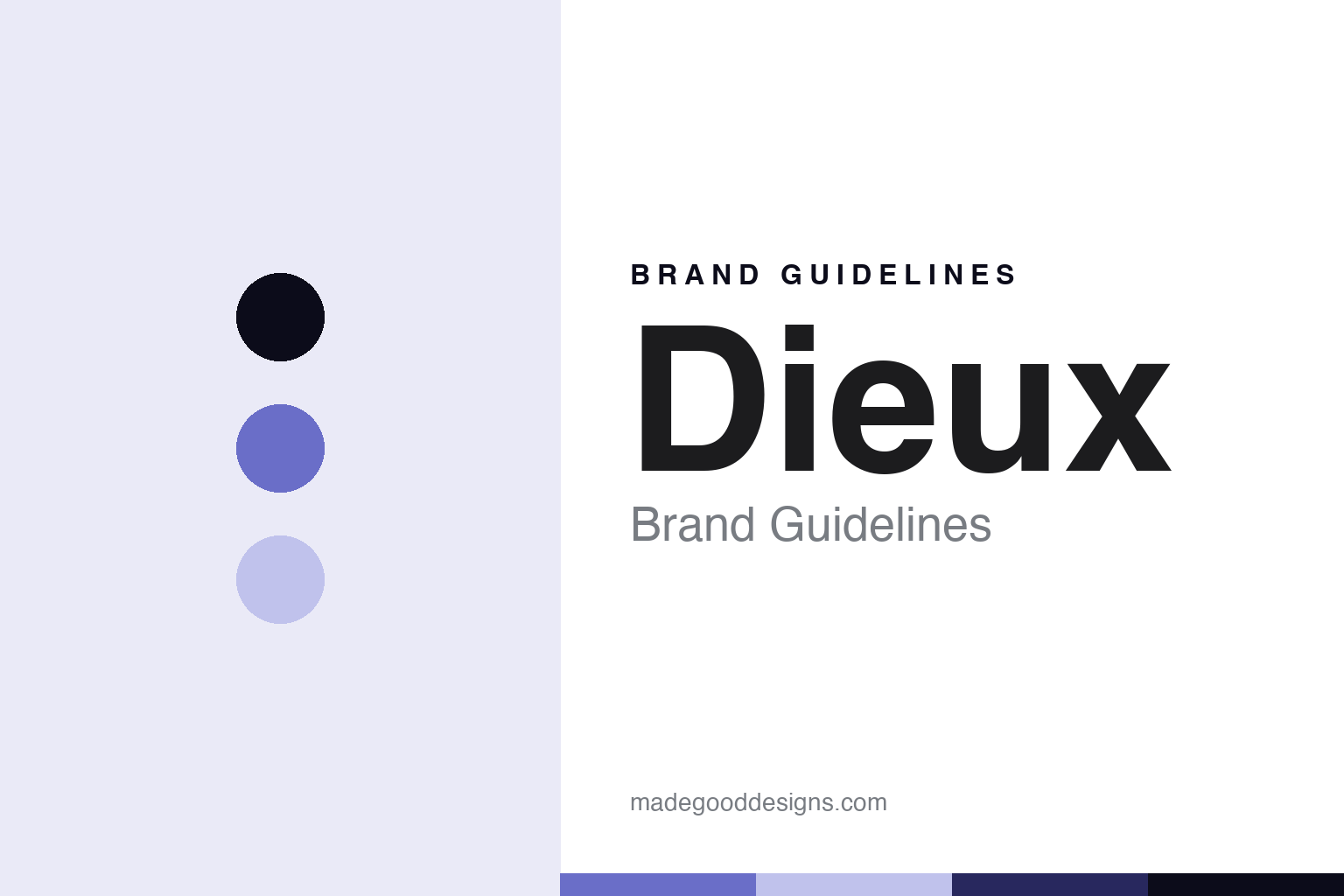
Dieux Brand Guidelines
The skincare that publishes its costs.
Aa
Two constants: a periwinkle palette and a transparent-sans register. Abstract homage — not a Dieux product or mark.
The skincare that publishes its costs
Dieux is the Brooklyn skincare brand built on radical transparency and a reusable eye mask.
Dieux brings the round radical transparency — the Brooklyn skincare brand, co-founded by three women, that publishes its costs and margins, and whose reusable Forever Eye Mask made sustainability its signature. Dieux makes skincare, and its answer to a round about the clean shelf is honesty as a feature: a brand that tells you what a formula costs, in a distinctive periwinkle world. A brand, transparent.
Its identity is the skincare that publishes its costs. Dieux’s cost transparency, its reusable eye mask and its co-founders are the story here. A brand, transparent. The skincare that publishes its costs.
(Honest notes, so the story stays precise, and the claims stay the brand’s own. Dieux, at dieuxskin.com, makes skincare, with a reusable Forever Eye Mask as its flagship, plus serums and treatments such as Instant Angel and Deliverance, and we report its clinically-vetted, sustainable and efficacy language as the brand’s own marketing. It was co-founded by Charlotte Palermino, a skincare educator, Joyce de Lemos, a cosmetic chemist, and Marta Freedman, based in Brooklyn, around 2020, so we say around 2020, we name the three co-founders, and we do not pin exact chief-executive titles. On its signature, a radical price and cost transparency, it publishes the cost of formulas, packaging and labour, which we can note. On sustainability, its reusable eye mask and a certified-plastic-negative claim are the brand’s own, which we attribute. On where it is made, a theme of this round, the location is not documented, and only a Brooklyn laboratory is described, so we do not claim it is made in the United States. On ownership, it is independent and female-founded, without a named investor. Its name, French for gods, and its packaging are IP we describe but do not reproduce; there is no official brand hex; these tones are an unofficial interpretation.)
Colour
Dieux lives in a periwinkle. Click a swatch to copy the hex.
Dieux’s identity is transparent, considered and periwinkle — a periwinkle, an ink, a lilac, a deep indigo, and a paper. The palette leans periwinkle and lilac: a soft, distinctive register that nods to a clean, considered brand and its own periwinkle world rather than a loud palette. It signals transparent skincare. The honest caveat: with no published brand hex, these values are an original, unofficial interpretation, not first-party colours.
The lesson is a periwinkle signals a transparent, considered identity. Dieux’s world is a considered, made object. For designers, it is a reminder that a periwinkle and a soft lilac can carry a skincare brand — the tone of a transparent brand. Because these tones can fail as small text, keep type dark and let the colour live in the accents, palette and band. The takeaways: publish the costs; reuse the object; report claims as marketing; and treat any single hex as unofficial.
Typography
The register is a transparent sans — considered, clear, plain.
Dieux’s identity carries a considered, clear, plain spirit — transparent skincare, not a fashion. A transparent sans captures the mood: clean, clear and confident, the register of an honest brand. Set in a periwinkle palette, the transparent sans feels considered and clear — exactly the personality Dieux carries. It is a policy rather than a logo, mirroring a serum and skin. (Dieux’s real packaging is a thing we describe but do not reproduce, and the exact typeface is not ours to use.) Because it is not ours to use, the honest description is “a transparent-sans skincare,” shown here in a stand-in. The type behaves like the brand: considered, clear and plain.
Aa
A transparent-sans skincare — considered and clear. (Specimen set in Mulish, a transparent-sans STAND-IN; NOT the Dieux logo.)
The clean shelf
Dieux stands for the skincare that publishes its costs.
Dieux brings the round radical transparency. A periwinkle palette, a transparent sans and a published cost make one thing — the skincare that publishes its costs — the whole identity: transparent, considered and periwinkle. The cost transparency is the policy, and the reusable eye mask is the signature. The point is a brand that tells you what a formula costs, in a distinctive periwinkle world.
Put to work, the identity is a policy told straight, as design. A maker in this spirit would publish the costs, reuse the object, and report claims as marketing. A reader in this spirit would keep the facts right: Dieux makes skincare, with the reusable Forever Eye Mask as its flagship; it was co-founded by Charlotte Palermino, Joyce de Lemos and Marta Freedman in Brooklyn around 2020; it publishes the cost of formulas, packaging and labour; its making location is undocumented; and it is independent and female-founded. Dieux anchors the round’s transparency thread with Typology, and it sits on the founder-led side of the who-owns thread. The honest editorial moves are to say around 2020, to name the three co-founders without pinning titles, to say the making is undisclosed, and to report the sustainability claims as marketing. The lesson Dieux teaches is that transparency can be a whole identity, and reporting the claims as marketing keeps it credible.
For designers and brand-builders, Dieux continues the clean shelf: publish the costs — and reuse the object. The lessons: make transparency a feature, publishing real costs; design a reusable object, like an eye mask; own a distinctive colour world; report efficacy and sustainability language as your own; and never reproduce packaging. It is also a reminder to stay precise: Dieux is the Brooklyn skincare brand built on radical transparency and a reusable eye mask — with the palette here an unofficial interpretation. Read that way, Dieux is less a serum than a policy: transparency as a product. The lesson for a brand is that transparency and honest claims reinforce each other, and saying the making is undisclosed keeps the story earned. Dieux made the-skincare-that-publishes-its-costs the identity — proof that a policy can define a brand. And the deeper lesson is that a brand’s values can be its most memorable design, because publishing a cost breakdown is itself a kind of packaging, one that tells the reader the company has nothing to hide.
Explore & save
Keep Dieux’s identity on hand — save it to a board in the Made Good inspiration library.
Dieux identity set
Pin the periwinkle palette and the transparent-sans register to your own board.