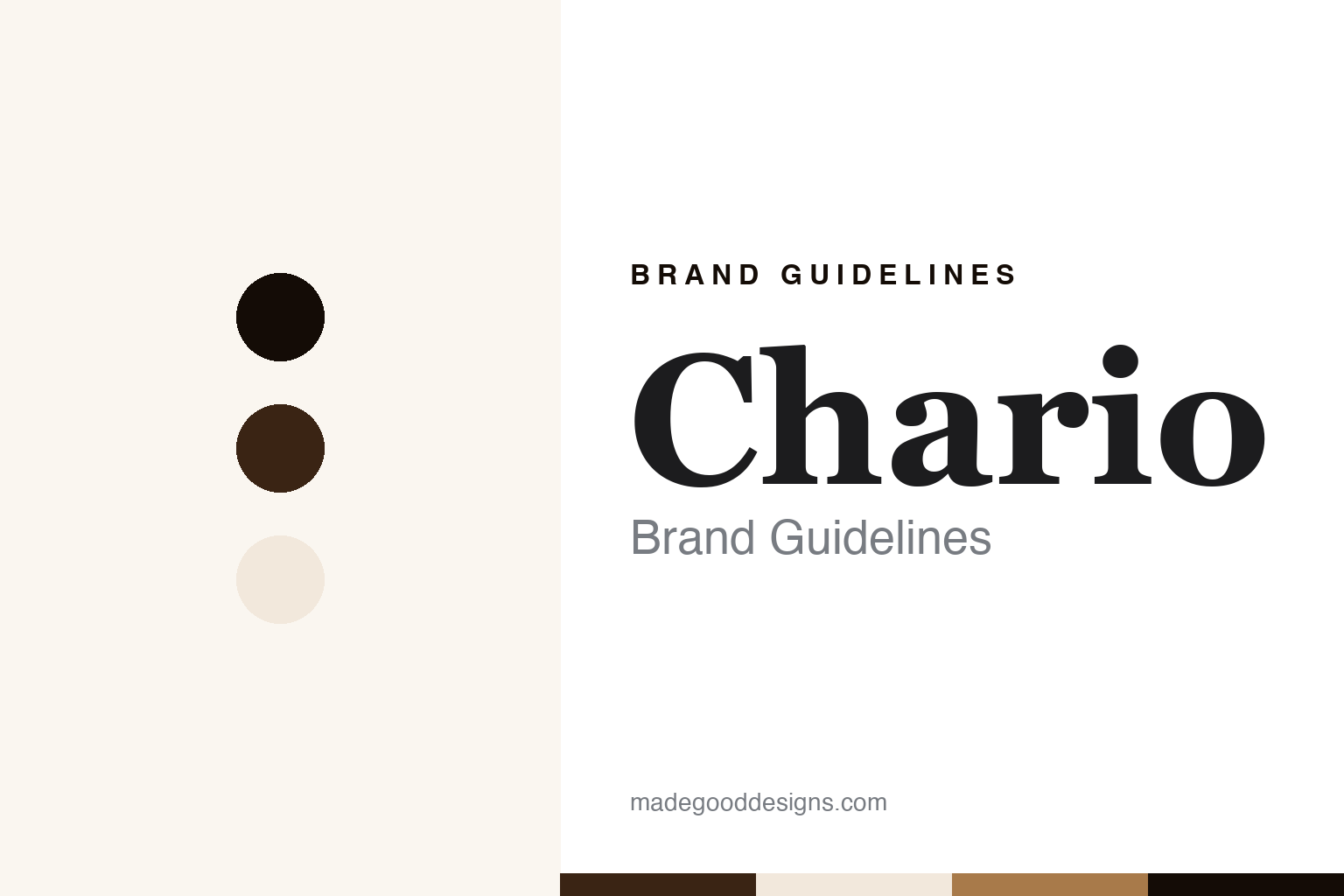
Chario Brand Guidelines
The Lombardy speaker maker of Academy and Constellation.
Aa
Two constants: a Chario walnut and veneer palette and a Bookish serif register. Abstract homage — not a Chario product or mark; no instrument, logo or nameplate is reproduced.
Thirty-five years in 2010
A three-speaker debut.
Chario dated itself to 1975, which makes it, by its own account, older than Sonus faber. Its website in 2010 said, “In 2010 we… celebrated our first 35 years,” and described a debut that year with a three-speaker system — left, centre and right — that it called the “Selective Expansion System” and said was patented. We found no patent record and no named founder, so we give the history as the company’s own.
Its website listed a series of design milestones: a 2,500-hertz crossover in 1980; the “Equal Loudness Envelope” and “Acoustic Pivot” in 1981; the WMT alignment at 1,300 hertz in 1986, NRS loading in 1987 and the RLX alignment in 1992; the T38 WaveGuide of 1998 — a soft-dome tweeter, the small high-frequency driver with a fabric dome — which it called the “largest soft-dome tweeter ever designed for home listening”; the seven-way Academy Millennium Grand of 2000, which split the sound into seven frequency bands; the Academy “S” series of 2005, with the five-way Serendipity, a T32 Silversoft tweeter and “Full Apex” woofer cones; and the Solitaire of 2006. We give those as its claims. Many of the milestones are named in hertz figures and acronyms — WMT, NRS, RLX — that the company does not explain on the pages we read.
By the companies’ own dates, Chario’s 1975 debut came eight years before Sonus faber’s founding. Its address in 2012 and 2013 was Via Bergamo in Merate, in the province of Lecco in Lombardy, north-east of Milan.
Colour
Stars, sonnets and solid wood.
Chario named its ranges and models with care. The Academy S line, alliterating on its S, included the Sonnet, Sovran, Serendipity, Sapphire and Solitaire; the Constellation line took its names from the sky — Lynx, Delphinus the dolphin, Cygnus the swan, Pegasus, Ursa Major, Phoenix and Hercules, all constellations; and there were Syntar and Syntar R models numbered 501 to 533, a Piccolo Star line with the Sat, Dialogue and Sw1, and older Academy Millennium, Hiper and Premium 1000 and 2000 ranges.
Craft was central to how it presented itself. Its 2012 tagline was “Chario srl | Handcrafted in Italy,” and its Italian pages spoke of the complete Italian craftsmanship of its work, of solid wood and selected veneers, and of computer-controlled CNC machines, sanders and hydraulic presses; each product series had its own “Handcrafting” section. It called itself, in 2010, “far more the biggest High-Definition-Home-Listening speaker systems manufacturer in Italy,” and in 2012 the largest Italian company in its field. We give those as its claims; we found no figures.
Its website credited its own design: “Concept and Design by Chario srl ©2011.”
Typography
Small makers, strong claims.
Italy’s best-known hi-fi brand shows how ownership can travel. Sonus faber was founded in 1983 by Franco Serblin near Vicenza; in 2007 the investment firm Quadrivio bought it and built a group, Fine Sounds, that went on to buy Audio Research, Sumiko and McIntosh, later renaming itself McIntosh Group and moving its headquarters to New York. Fine Sounds had sales of €50 million in 2011; a management buyout with LBO France followed in 2014, the group took the McIntosh name in 2016, and Highlander Partners bought it in 2022. In November 2024 the American company Bose announced that it would buy McIntosh Group, Sonus faber included, according to What Hi-Fi?. Serblin himself had left Sonus faber in 2006, and died in 2013.
Italian audio design also has a longer history. Brionvega, founded in Milan in 1945, worked with designers such as Marco Zanuso and Richard Sapper, and its radios and televisions are held by museums including MoMA and the V&A, according to English Wikipedia. It took the Brionvega name in 1963 and was sold to Sèleco in 1992; in 2016 David Bowie’s Brionvega RR 126 radiogram sold at Sotheby’s for £257,000.
That design tradition is collected and exhibited. Brionvega worked with Achille and Pier Giacomo Castiglioni and Mario Bellini as well as Zanuso and Sapper, won Compasso d’Oro design awards, and has products in the Centre Pompidou and Milan’s ADI Design Museum; in 2025 its pieces appeared in the San Francisco Museum of Modern Art’s exhibition “The Art of Noise,” according to English Wikipedia. Sonus faber, for its part, is based at Arcugnano, just outside Vicenza.
The makers in this guide are much smaller. They are private companies or partnerships, some still led by their founders, and they describe their own work in strong terms — handmade, entirely Italian, patented. We give each of those claims as the company’s own, and say where we could not check them.
Chario’s claims — patents, craft, scale — are among the strongest in this group, and among the hardest to check today.
Aa
A bookish serif — star names and solid wood. (Specimen set in Fraunces, a serif STAND-IN; NOT the Chario logo.)
Chario
Star names and solid wood.
Chario’s current status is unclear. From about 2016 its chario.it address redirected to another domain, which was parked in 2016, 2022 and late 2024; in October 2026 chario.it showed only an “under construction” page, built with WordPress and titled, with a typing error, “Chario Laudspeakers is under construction.” We found no record of a closure, sale or relaunch, and a dormant website is not proof that a company has closed, so we say only that its web presence has been dormant since about the mid-2010s and that its present status is unverified. We could not reach an Italian company register to check whether Chario srl is still active. Unlike Sonus faber, whose changes of ownership are well documented, Chario’s later history is simply not on the record we could find.
We found no documented logo, colours or typeface beyond the placeholder page’s Roboto, and no published brand guidelines. The palette here draws on the solid wood the company described, and is our own.
For a design guide, Chario shows how a naming system — stars, sonnets — and a material can define a speaker brand. Compare Opera Loudspeakers, which names its speakers after singers and also stresses wood, and Sonus faber, founded near Vicenza in 1983. For this guide we use a walnut and a veneer gold with a serif, an unofficial interpretation; no product or logo is reproduced.
Explore & save
Keep Chario’s identity on hand — save it to a board in the Made Good inspiration library.
Chario identity set
Pin the Chario walnut and veneer palette and the Bookish serif register to your own board.