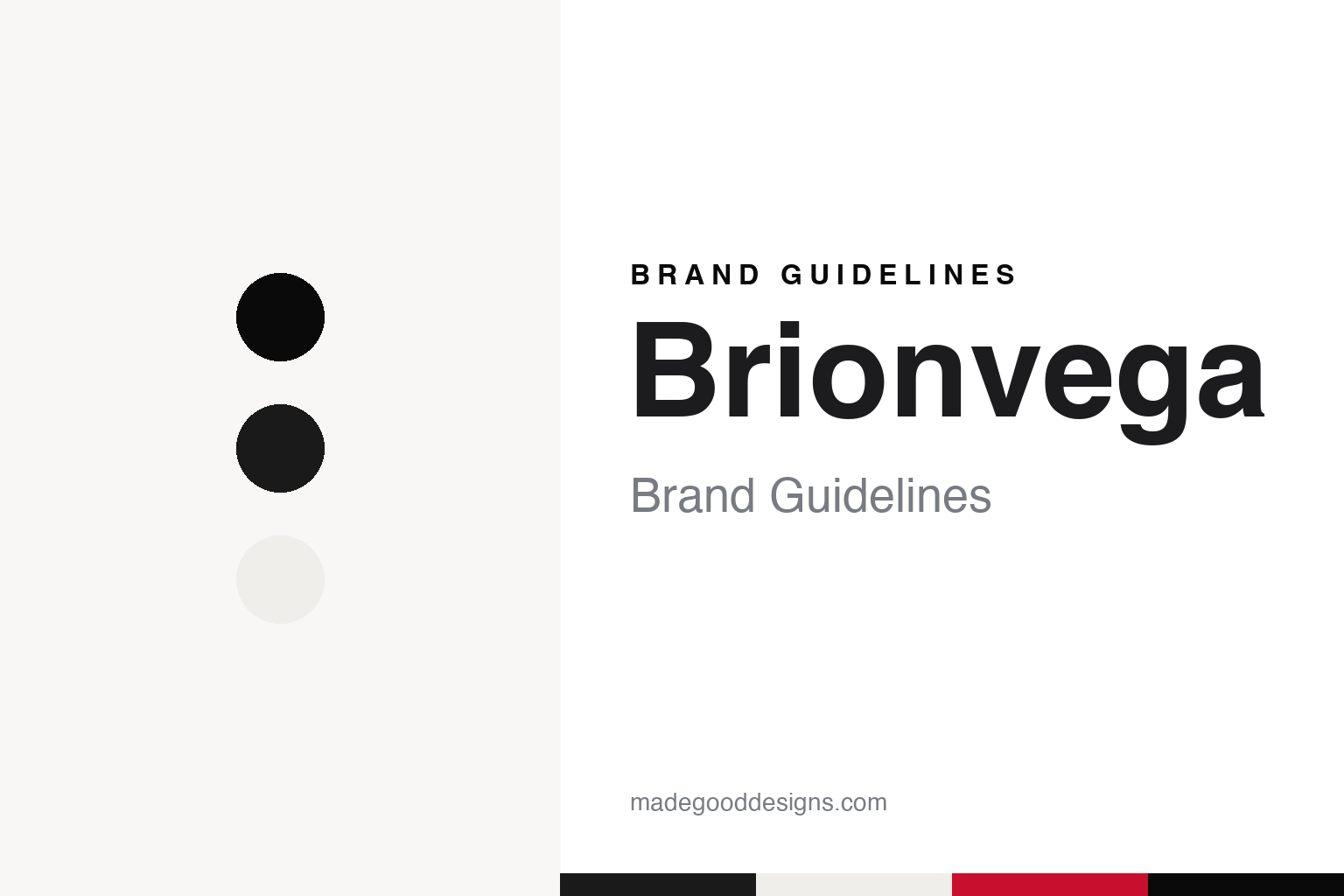
Brionvega Brand Guidelines
The Milan radio maker that made electronics into design icons.
Aa
Two constants: a Brionvega black, white and red palette and a Modernist sans register. Abstract homage — not a Brionvega product or mark; no instrument, logo or nameplate is reproduced.
BP Radio
A couple, an engineer and a workshop in Milan.
Brionvega began in Milan in 1945. Italian Wikipedia, citing a 1946 advertisement and a history of the company by De Ruggiero, gives its first name as BP Radio and its founders as Giuseppe Brion (1909–1968), his wife Onorina Tomasin (1919–2002) and the engineer Leone Pajetta; English Wikipedia gives the first name as “B.P.M. Radio,” so we note the difference. Its radios carried the Vega name and were made in a workshop on Via Pacini, in Milan’s Città Studi, the university district.
The company grew through name changes. It became Vega BP Radio in 1950 and began making televisions in 1953 after buying a factory from Homelight. In 1960 Pajetta left and the firm became Brion Vega Radio Televisione; the “Brion Vega” mark was designed by Massimo Vignelli, the graphic designer later known for the New York subway map, Italian Wikipedia says. In 1963 the name was fixed as one word, Brionvega.
After Giuseppe Brion’s death in 1968, Onorina Brion became president and chief executive, with their son Ennio.
Colour
Zanuso, Sapper and the Castiglionis.
Brionvega’s reputation rests on its designers, and on radios, televisions and record players rather than hi-fi separates. With Marco Zanuso and Richard Sapper it made the Doney 14-inch television of 1962, which Italian Wikipedia calls the first transistor portable television made in Europe, following the Orion 23-inch set of 1961; the Algol portable television of 1964; the RR127 radio of 1965; the TS502 radio, the “Radio Cubo,” dated 1963 by the Victoria and Albert Museum and 1964 by Italian Wikipedia; and the Black ST/201 television. With Achille and Pier Giacomo Castiglioni it made the RR126 radio-phonograph, which the company says was unveiled in September 1965 and the V&A dates to 1966.
Other designers followed: Mario Bellini, with a 26-inch television in 1968; Lucci and Orlandini, with the Mizar of 1976 and the Coro of 1981; and, according to Italian Wikipedia, Ettore Sottsass, with a “Memphis” model in 1980. English Wikipedia adds names including Franco Albini, Sergio Asti, Rodolfo Bonetto and Livio Castiglioni, and, later, Michael Young and Hannes Wettstein.
Recognition came early. The Doney won the Compasso d’Oro in 1962, and in 1970 the company itself received the award “for having sought to give a high level of quality to most of its production and for having drawn on the work of the best Italian designers,” according to the jury citation quoted by Italian Wikipedia. The V&A’s collection includes the TS502, the RR126 and the Black ST/201.
English Wikipedia lists further museum holdings — at the ADI Design Museum in Milan, the Centre Pompidou, the Powerhouse in Sydney, the Cooper Hewitt and MoMA in New York and Milan’s science museum — which we have not checked one by one. In 2019 the Udine newspaper Messaggero Veneto reported that the reissued RR226 had been acquired by MoMA.
Typography
Design and documentation.
Italy has a long record of treating audio equipment as design. The Compasso d’Oro, the industrial-design award associated with Italy’s ADI design association, went to Brionvega’s Doney television in 1962 and to the company as a whole in 1970, according to Italian Wikipedia; Brionvega’s radios and record players are now held by museums including London’s Victoria and Albert Museum.
The country’s hi-fi makers range from that design-led tradition to small engineering workshops. Sonus faber, the loudspeaker maker founded near Vicenza in 1983, has passed through several investors and in November 2024 was included in Bose’s announced purchase of McIntosh Group, according to What Hi-Fi?. Many smaller makers remain private, and some are hard to document beyond their own websites.
Italy’s hi-fi trade has its own shows and press. Milan’s Top Audio show is where Norma says it launched its range in 1997, and where Audia Flight says its Strumento amplifiers won an award in 2012; Italian magazines such as Audio Review and Fedeltà del Suono review the country’s equipment and appear in the makers’ own lists of press coverage.
The makers in this guide are spread across northern and central Italy rather than gathered in one district: Brionvega in Milan, Diapason in Brescia, Lector near Pavia, Norma near Cremona, Mastersound at Arcugnano outside Vicenza, Viva Audio’s research workshop at Camisano in the same province — with a legal address in Latvia — and Synthesis at Morrovalle in the Marche, according to their own websites.
This guide sets out what can be checked about each brand — who founded it, who owns it, and what it says about where its products are made — and marks clearly what rests only on the company’s own word.
Brionvega is the clearest example of that tradition: an electronics maker whose products ended up in museums.
Aa
A modernist sans — a mark first drawn by Massimo Vignelli. (Specimen set in Inter Tight, a sans STAND-IN; NOT the Brionvega logo.)
Brionvega
A mark first drawn by Massimo Vignelli.
The company did not stay independent. In 1992 the television maker Sèleco of Pordenone, in Friuli, bought a quarter in March, La Repubblica reported, and the Brion family’s and the auction house Finarte’s stakes by August; by 1994, the Corriere della Sera reported, Brionvega had become “simply a brand.” After Sèleco failed in 1997, Formenti of Lissone bought the marks at the bankruptcy auction in December, La Repubblica reported — English Wikipedia gives 1998; that business too went into administration in the mid-2000s. In 2006 the Asquini brothers’ company Smart TV, later called Super//Fluo, took it over and in 2007 relaunched the brand with the Alpha, a 19-inch LCD television designed by Valerio Cometti, and limited reissues of the Algol and Doney. Sources differ on when SIM2 Multimedia of Pordenone took it over — 2004 or 2010 — and the mark passed to BV 2 S.r.l. of Milan, controlled by SIM2 BV of Rivignano Teor, near Udine. In 2019 SIM2 launched a reissued radio-phonograph, the RR226, reported as “made in Friuli” at about €8,000.
Today the website names Brionvega S.r.l., on Via Morimondo in Milan, “The Brionvega Art Products Company,” selling the Radiofonografo — including a 60th-anniversary edition launched in September 2025 — the Totem and the Radio.cubo. It describes “iconic, timeless audio products, made in Italy,” and says the radio-phonograph “continues to be made in Italy with the same passion and craft”; we give those as its claims, and could not confirm whether the company is still linked to SIM2. Its website also names Francis Ford Coppola and Karl Lagerfeld as owners of its products, which we could not confirm. The documented case is David Bowie: in November 2016 an RR126 he owned sold at Sotheby’s in London for £257,000, What Hi-Fi? reported.
For a design guide, Brionvega shows how a brand can outlive its company through its designs. Compare Sonus faber, another Italian audio name that has changed hands, and Opera Loudspeakers. For this guide we use black, white and a red with a sans, an unofficial interpretation; no product or logo is reproduced.
Explore & save
Keep Brionvega’s identity on hand — save it to a board in the Made Good inspiration library.
Brionvega identity set
Pin the Brionvega black, white and red palette and the Modernist sans register to your own board.