Raidho Brand Guidelines
The Danish ribbon-tweeter loudspeaker maker owned by Dantax since 2009.
Aa
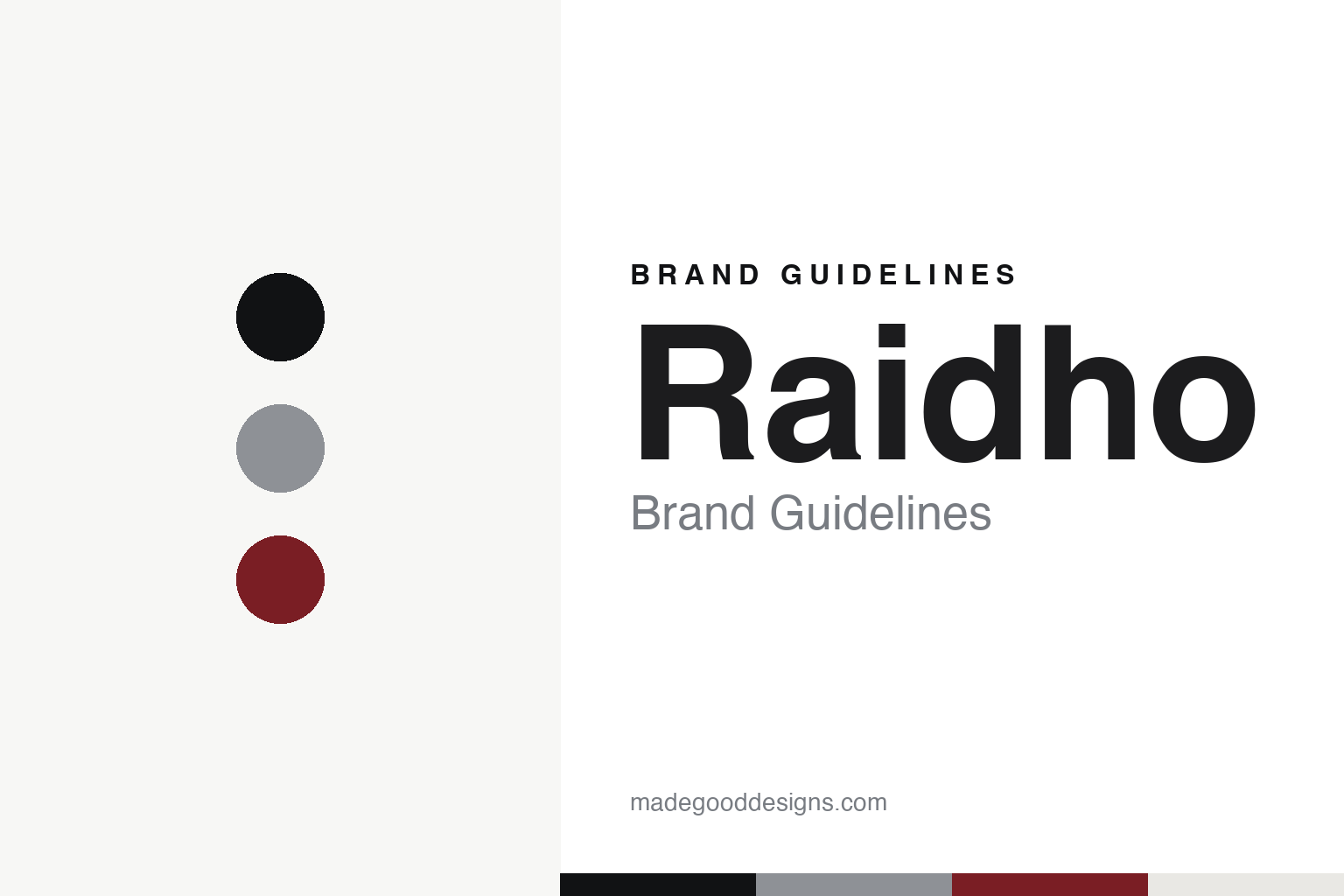
Two constants: a Raidho black, aluminium and red palette and a geometric sans register. Abstract homage — not a Raidho product or mark; no loudspeaker, logo or nameplate is reproduced.
A ribbon tweeter
Two old acquaintances and a farm in North Jutland.
Raidho began with a tweeter. Michael Børresen, a Danish engineer who studied at Aarhus University, told the Swiss website avguide.ch in October 2021 that he made his first ribbon tweeter in 1998, at first as a project of his own, and that in 2001 he founded Raidho together with Lars Kristensen, fitting that tweeter to all of their loudspeakers. The year is not quite settled. A Facebook post by Kristensen dated 2 July 2017, as quoted on the Audiogon forum, said it was “15 years ago” that the two had started Raidho Acoustics, which would point to 2002. SoundStage! Hi-Fi gave 2001 in April 2025, and we follow the founder’s own date.
The two men already knew each other. In a December 2013 report on a visit to the company, SoundStage! writer Sven Bilén said they had met years earlier, when Børresen was a demanding customer, and met again late one evening at a hot-dog stand, where Børresen mentioned the ribbon tweeter he was developing; they sold tweeters at first, then complete loudspeakers. Audio Group Denmark, the company the pair run today, says the story began in the 1980s, when Kristensen managed an audio shop in Aalborg and Børresen was an engineering student. Both later worked for the cable maker Nordost: Bilén described Kristensen as its international representative, and the Malaysian site av2day reported in 2017 that Børresen spent eight years in Nordost’s research and development department before leaving in 2012.
Raidho was small and rural. In 2013 Bilén found it on Børresen’s farm in the northernmost part of Jutland, “in the middle of the Danish countryside,” making nearly 1,000 pairs a year, all by hand, Kristensen told him. The earliest archived version of the company’s website, from April 2006, shows it selling loudspeakers under other names: eben by Raidho, with an X-Streme series designed by Børresen, and emilie by Raidho, whose S series was built around what the site called Raidho’s “unique sealed ribbon tweeter.” By April 2008 the site was introducing the Ayra C1.0 and C3.0. The word Raidho is also the name of a rune in the old Norse runic alphabet; Ansuz, the cable brand the two founders later launched, is another.
Colour
Ceramic, diamond and tantalum.
Raidho’s reputation rests on pairing that ribbon tweeter with very stiff, very light cone drivers. In the C-series of the early 2010s, the tweeter — described by The Absolute Sound as a “quasi-ribbon” made in-house — sat above a mid/bass driver whose cone is a sandwich of thin ceramic layers formed on an aluminium core. The small C1.1 standmount was priced at about $17,000 to $18,000 in the excerpts from Jonathan Valin’s Absolute Sound coverage that Raidho quoted on its own website in 2012.
The diamond step came next, in 2013, with the D-1. The British magazine hi-fi+, reviewing it in December 2013, explained that it shared the C1.1’s sealed quasi-ribbon tweeter but replaced the white aluminium-oxide cone with one carrying one and a half carats of industrial diamond, bonded to the ceramic in a layer ten microns thick, which gave the driver its matt-black face. The magazine called it “an astonishingly good loudspeaker.”
The TD series followed under new designers. TD stands for tantalum and diamond: according to Raidho’s dealers and reviewers, the cones have a ceramic core sealed in a very thin layer of tantalum, with diamond added on top, and the series uses a revised version of the ribbon tweeter. The engineer credited with that work, Benno Baun Meldgaard, was chief designer at Raidho until December 2020 before moving to Gryphon, 6moons reported in 2022. In March 2021 Dantax named Lars Goller chief designer for both Raidho and its sister brand Scansonic HD; the announcement, reported by HiFi Pig, said Goller had begun at Scan-Speak, later owned GamuT and designed its loudspeakers, and had worked for Bang & Olufsen, Harman Automotive and Dynaudio.
In April 2025 SoundStage! Hi-Fi’s Doug Schneider described two current lines: the X series, which he called Raidho’s high-value range, and the premium TD series. Prices ran from €6,000 a pair for the X1t standmount to €230,000 a pair for the TD6 floorstander, with its ribbon tweeter, two midrange drivers and three woofers a side.
Typography
Design and documentation.
Denmark has been making loudspeakers and audio equipment for a century. Bang & Olufsen was founded in Struer in 1925 by Peter Bang and Svend Olufsen, and Ortofon began in Copenhagen in 1918 as the Electrical Phono Film Company, according to English Wikipedia.
Much of the industry grew around drive units. The loudspeaker factory that became Vifa was set up in Videbæk in 1933, initially supplying Bang & Olufsen, English Wikipedia says; Vifa took over the driver maker Scan-Speak in the late 1980s and its Danish rival Peerless in 2000, and in 2005 the combined business passed to Tymphany, which sold Scan-Speak to its Danish management in 2009.
Complete-speaker brands followed: Jamo in 1968, by its own account; Dynaudio in Skanderborg in 1977; and DALI, founded by Peter Lyngdorf in 1983 and based in Nørager, according to English Wikipedia. Several have since passed to foreign owners — Dynaudio to China’s Goertek in 2014, and Jamo to Klipsch in 2005.
The makers in this guide are spread mostly across Jutland, with one on Zealand: Jamo, founded at Glyngøre on the Limfjord; Scan-Speak in Herning; Raidho at Pandrup, care of Dantax; Børresen in Aalborg; Audiovector at Skovlunde, outside Copenhagen; Densen, founded in Esbjerg and moved to North Jutland after a 2021 change of ownership; and Lyngdorf in Skive — according to their own websites and Danish trade press.
This guide sets out what can be checked about each brand — who founded it, who owns it, and what it says about where its products are made — and marks clearly what rests only on the company’s own word.
Aa
A geometric sans for a ribbon-and-cone engineering brand. (Specimen set in Jost, a sans STAND-IN; NOT the Raidho logo.)
Raidho
From the founders’ farm to Dantax in Pandrup.
Raidho has belonged to Dantax since 2009. Dantax’s own history says simply that “in 2009 a new era began as Dantax took over the fantastic Raidho loudspeaker project.” Børresen gave his account to avguide.ch in 2021: the business ran well until the 2008 financial crisis, when an investor ran into difficulties and the American market collapsed; the bank wanted collateral, and Dantax came in. He said the founders remained directors for a time but left when Dantax wanted to take over day-to-day management.
The dates show that the founders stayed for years after the sale. Bilén’s 2013 visit found the two still running Raidho, and Kristensen’s July 2017 Facebook post, as quoted on Audiogon, said they had designed, made, marketed and sold Raidho loudspeakers until the end of the previous month — June 2017 — and would now work full time on their own brands Ansuz and Aavik. avguide.ch wrote in 2021 that the pair left “due to the sale of Raidho to Dantax and other reasons.” We found no public statement from either side describing a dispute, and do not suggest one. The founders went on to launch Børresen, a loudspeaker brand under Michael Børresen’s own name, in 2018.
Dantax is a small listed company in Pandrup, North Jutland. It says it was founded there in March 1971, listed on the Copenhagen stock exchange in 1984, took over the Scan-Speak driver factory in 1977 and sold its loudspeaker factory in 1997. Its 2025/26 annual report lists the brands Scansonic, Raidho, GamuT and Harmony. Raidho’s website has given its address as care of Dantax Radio A/S, Bransagervej 15, Pandrup, since at least 2016. On where its loudspeakers are made, SoundStage! Hi-Fi reported in 2025, after a visit, that Raidho builds its own ribbon tweeters, midrange drivers, woofers and crossovers by hand and buys in only the cabinets, with a staff of about a dozen.
For a design guide, Raidho shows how a brand can keep its founder’s technology — the ribbon tweeter and the stiff cone — after the founders themselves have moved on. Compare Børresen, the brand its founders started next, and Gryphon, where Raidho’s former chief designer went. For this guide we use piano black, aluminium grey and a deep red with a geometric sans, an unofficial interpretation; no product or logo is reproduced.
Explore & save
Keep Raidho’s identity on hand — save it to a board in the Made Good inspiration library.
Raidho identity set
Pin the Raidho black, aluminium and red palette and the geometric sans register to your own board.