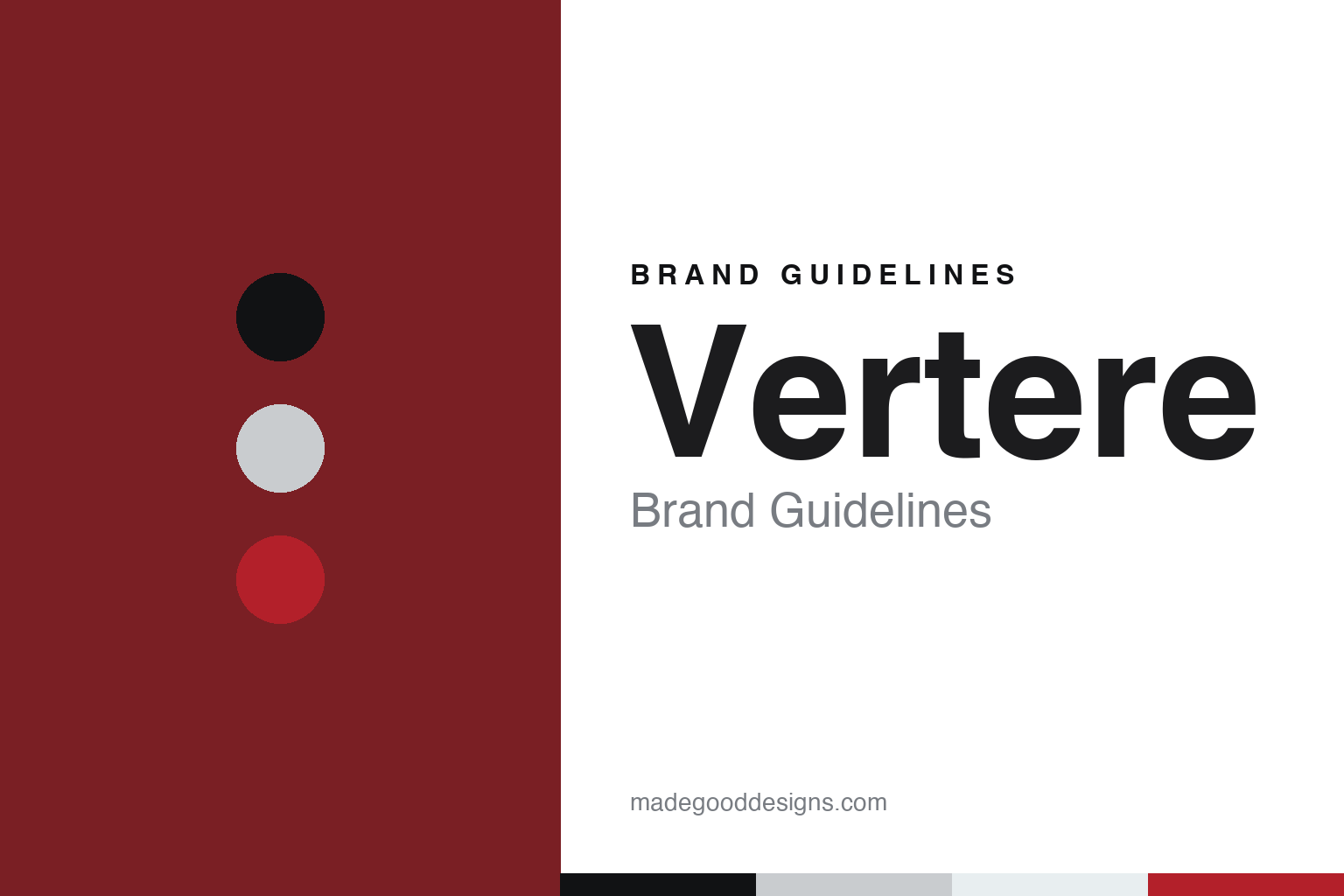
Vertere Brand Guidelines
The London record-player maker built by a Roksan co-founder.
Aa
Two constants: a Vertere acrylic black, silver and red palette and a geometric sans register. Abstract homage — not a Vertere product or mark; no turntable, logo or nameplate is reproduced.
After Roksan
An engineer’s second turntable company.
Vertere is the second turntable company of Touraj Moghaddam. English Wikipedia, citing Hi-Fi News, says he co-founded Roksan with Tufan Hashemi in 1985, having just finished a PhD at Imperial College London, and that his Xerxes turntable — first built as a prototype on a fire door — was launched at a London hi-fi show that year. Hi-Fi News also credits him with Roksan’s Artemiz tonearm of 1987, the Radius turntable of 1989 and the TMS deck of 1991, whose initials, Wikipedia says, stood for “Touraj Moghaddam Signature.”
The company that became Vertere was registered at Companies House on 27 October 2006 as TM Systems Limited, with Moghaddam as a director from the first day; it took the name Vertere Limited in January 2011. That fits his own account. In a September 2011 interview with Superyachts.com, republished on Vertere’s website, he dated “the beginning of Vertere” to “about five years ago.” Wikipedia, citing public records, says he resigned his Roksan directorships on 15 July 2011, and Hi-Fi News wrote in 2022 that he “departed in 2011 to focus on his new brand.” Roksan itself was bought by Monitor Audio in 2016, Wikipedia says, citing What Hi-Fi?.
Vertere began with cables, not turntables. The 2011 interview described the company as a maker of “high-end audio cables,” and its early website listed the Pulse and Pulse D-Fi ranges. Its homepage, as archived in April 2011, opened with a list of “milestones” from what it called two decades of experience — a single-point main bearing, a sprung, isolated loudspeaker tweeter, a counterweight that corrected tracking force over warps — and a line from Antoine de Saint-Exupéry about perfection being reached “when there is nothing left to take away.” The quotation still heads the company’s “Our Passion” page, which calls Moghaddam “the founder and creative force behind the brand.”
Colour
Reference, Super, Magic and Dynamic Groove.
The turntables came later. According to Hi-Fi News, the Reference tonearm “broke cover” at CES in January 2013, followed later that year by the RG-1 Reference Groove and SG-1 Super Groove record players. Alan Sircom of Hi-Fi+ summed up the sequence in 2017: “First came the cables, then that tonearm (the one that costs as much as a new BMW), followed by a matching turntable,” then a cheaper deck and arm, the UK distribution of FM Acoustics, and the MG-1 Magic Groove. The DG-1 Dynamic Groove, released in late 2019 according to Hi-Fi+, brought the range down to £2,750 without a cartridge. Today the website lists four record players, from the DG X, priced from £3,650, to the RG-1, from £30,000, and a Reference Tonearm Gen III from £48,250, alongside cartridges, phono stages, motor drives and cables.
The designs share a vocabulary. The company describes layered cast-acrylic plinths with compliant and rigid isolation stages, machined aluminium platters and, on the RG-1 and SG-1, a “Swiss-made” synchronous motor with an external power supply. Reviewing the DG-1 in 2020, Hi-Fi News described a 24-pole synchronous motor run by a microprocessor-controlled circuit, a platter with cork, neoprene and nitrile bonded to its underside, and a flat “Groove Runner” arm built around a printed-circuit track. In its 2022 review of the revised DG-1 S, What Hi-Fi? noted that the arm now used a Kevlar thread for its vertical bearing and nylon for the horizontal, and that the motor body is allowed to move to absorb changes in belt tension.
The entry deck is also where Vertere has been most decorated. What Hi-Fi? called the DG-1 S “a class leader,” and Vertere says the DG-1 and DG-1 S won the magazine’s awards in every year from 2020 to 2024, as did its PHONO-1 phono stage. In Japan, Vertere says, Stereo Sound gave the MG-1 its Grand Prix for 2021. The same What Hi-Fi? review recorded a detail the company does not stress: the Magneto moving-magnet cartridge sold in the starter package is “essentially a rebadged Audio Technica AT-VM520EB with a different coloured body.” Hi-Fi News had noted in 2020 that the original DG-1 could be bought with an Audio-Technica VM520EB already fitted.
Typography
Turntable makers, old and new.
The turntable makers in this guide span more than a century. The oldest name is Garrard: Wikipedia says its engineering company was formed in 1915 and moved to Swindon in 1919, and that its 401 turntable was used by the BBC. Since 2018 the brand has belonged to the owners of SME, and Garrard’s website says each revived 301 is rebuilt from an original drive at SME’s works in Steyning, West Sussex.
The other British maker is younger. Vertere is run from north-west London by Roksan co-founder Touraj Moghaddam; its company was registered in 2006, and Hi-Fi News reported that its first turntables followed in 2013.
Two makers share a city: Ljubljana, in Slovenia. Holbo, Boštjan Holc’s air-bearing turntable, debuted at a Ljubljana hi-fi show in 2017, HighFidelity reported. Pear Audio trades there as Pear Audio Europe d.o.o.; AnalogPlanet reported in 2014 that its designs grew from Peter Mezek’s work with the late Tom Fletcher of Nottingham Analogue.
In Germany, Sperling Audio is Ansgar Sperling’s business at Welver, in North Rhine-Westphalia; it showed its first high-mass turntable at the High End show in Munich in 2013 and says its products are made by hand in Germany.
Australasia supplies the rest. Wand comes from Design Build Listen Ltd, incorporated in New Zealand in 2004, which says its products are handmade there; Dohmann Audio, Mark Dohmann’s company, is based in Melbourne and says every product is made in Australia.
This guide sets out what can be checked about each brand — who founded it, who owns it, and what it says about where its products are made — and marks clearly what rests only on the company’s own word.
Aa
A geometric sans for a ladder of “Groove” names. (Specimen set in Jost, a sans STAND-IN; NOT the Vertere logo.)
Vertere
Privately held, with a London address.
Vertere is privately held. Companies House lists Touraj Moghaddam as a director since 2006 and as the person with significant control, holding more than half but less than three-quarters of the shares; the company files small-company accounts, and its declared activity is “other manufacturing not elsewhere classified.” Its registered office and its website give the same address, on Oliver Road in north-west London, and Hi-Fi News lists the company as Vertere Ltd, London. The business has branched out: it distributes FM Acoustics in the UK, and its label, Vertere Records, has issued vinyl by artists including the Dutch singer Elles Springs and the guitarist Will McNicol. Vertere also says that Nick Mason of Pink Floyd uses its MG-1 record player in his studio.
Where the products are made is less clearly stated. On the pages we checked in October 2026, Vertere’s website describes engineering and materials but makes no general “made in” claim; the one origin it names is the “Swiss-made” motor in its two upper turntables. Hi-Fi+ quoted the company saying the DG-1’s electronics are set “during manufacture,” without saying where, and calls Vertere “a British high-end audio manufacturer.” We found no published statement of which parts are machined or assembled in London, so we do not describe the turntables as made there. The cartridge sourcing documented by What Hi-Fi? is a reminder that a Vertere badge does not always mean Vertere made every part.
For a design guide, Vertere shows how an engineer’s second company can build on the reputation of his first, with names — Reference, Super, Magic and Dynamic Groove — that turn a product line into a ladder. Compare Roksan, the company Moghaddam co-founded, and Linn, another British turntable maker. For this guide we use acrylic black, machined silver and a deep groove red with a geometric sans, an unofficial interpretation; no product or logo is reproduced.
Explore & save
Keep Vertere’s identity on hand — save it to a board in the Made Good inspiration library.
Vertere identity set
Pin the Vertere acrylic black, silver and red palette and the geometric sans register to your own board.