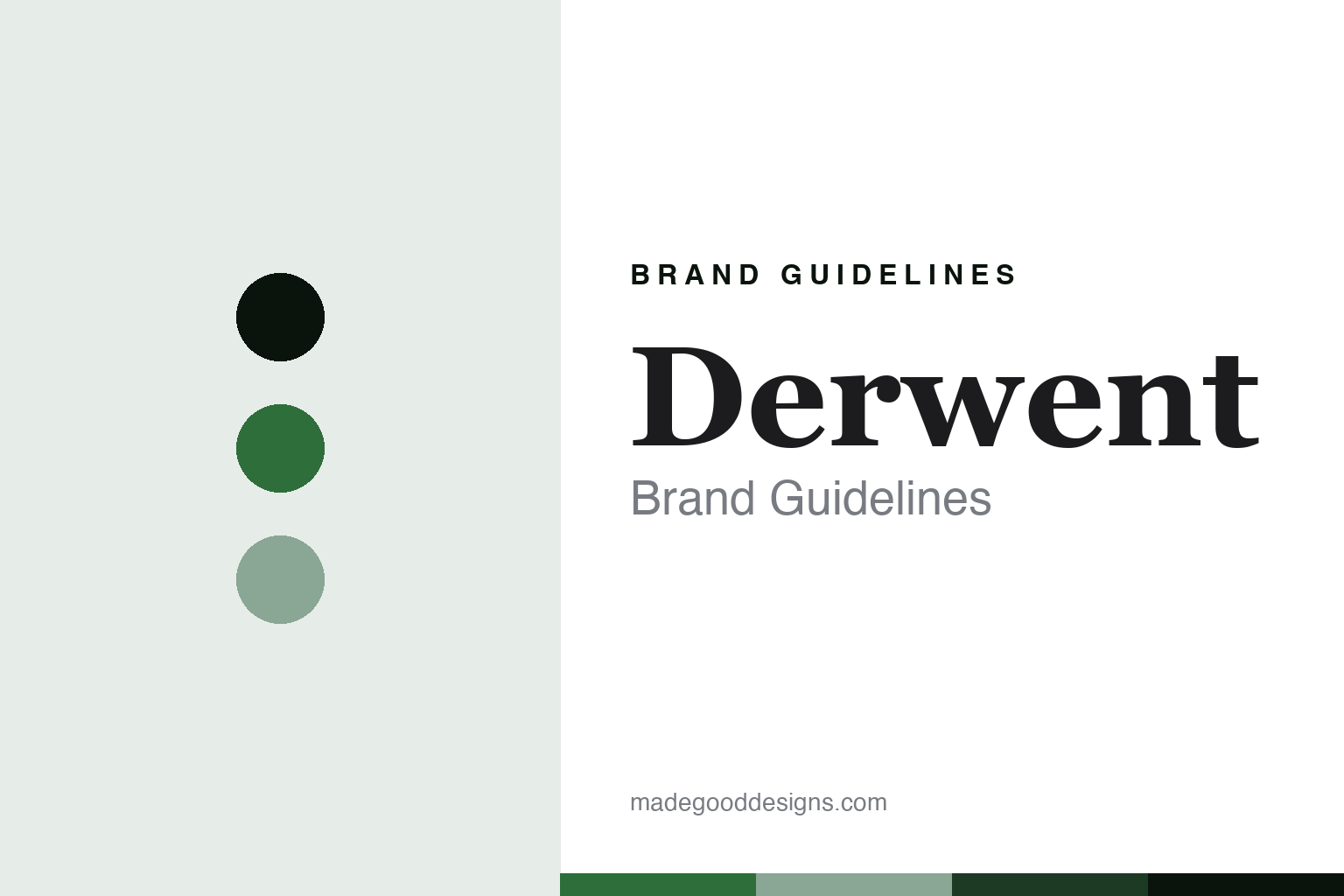
Derwent Brand Guidelines
The Cumberland pencil.
Aa
Two constants: a Lakeland-green palette and a heritage-serif register. Abstract homage — not a Derwent colour, label or barrel.
The Cumberland pencil
Derwent is the Cumberland pencil house from the English Lake District, now an ACCO brand, known for its Coloursoft and Lightfast pencils.
Derwent is a lesson in how a colour is made a pencil in the place the pencil was born. It grew out of Cumberland, in the English Lake District, where graphite from Borrowdale gave rise to the world’s first pencil industry, and it built a range of artist coloured pencils on that heritage — from soft, wax-based colour to oil-based lightfast leads. Its answer to how a colour is made a pencil is a Cumbrian one: case a fine colour core in wood, and carry the name of the region that started it all. A pencil made where the pencil began.
Its identity is the Cumberland pencil house. Derwent’s Coloursoft, its Artists and Lightfast ranges, and its Inktense ink pencils are the work it is known for. A colour core, cased in cedar. A house that turned a region’s graphite heritage into a colour range.
(Honest notes, so the story stays precise. Derwent traces to the Cumberland Pencil Company, with a founding usually dated to 1832 in Keswick, in a region whose pencil story goes back to the discovery of Borrowdale graphite — the “world’s first pencil” is a regional and museum heritage claim, which we present as such, not as a Derwent invention. Two honest corrections on the present. First, where it is made: pencil manufacture moved from Keswick to Workington, in Cumbria, in 2007 — the Keswick site is now the Derwent Pencil Museum, a heritage attraction, not the factory, so we do not say pencils are still made in Keswick. Second, ownership: Derwent is not independent; it is a brand of ACCO Brands. Its cores span wax-based colour (Coloursoft, Artists) and oil-based lightfast leads (Lightfast), plus Inktense ink pencils that become permanent when dry. Its name, logo and line names are its IP, described but never reproduced, and there is no official brand hex — these tones are an unofficial interpretation. This is design commentary and does not promote any product.)
Colour
Derwent lives in a Lakeland-green palette. Click a swatch to copy the hex.
Derwent’s identity is heritage, natural and British — a Lakeland green, an ink, a sage, a pine, and a paper. The palette leans Lakeland green and sage: the register of the Cumbrian fells and a wood-cased pencil. It signals landscape and lineage over novelty. The honest caveat: with no published brand hex, these values are an original, unofficial interpretation, not first-party colours — an abstract nod to the Lake District, not a sampled pencil.
The lesson is a Lakeland-green palette signals a Cumberland-heritage identity. Derwent’s world is a heritage, wood-cased, British object. For designers, it is a reminder that a deep green and a soft sage can carry a brand built on a place — the green of the fells and the grey-green of cedar. Because these tones can fail as small text, keep type dark and let the colour live in the accents, palette and band. The takeaways: carry the place; case the core in wood; be honest about where it is made now; and treat any single hex as unofficial.
Typography
The register is a heritage serif — classical, rooted, English.
Derwent’s identity carries a classical, rooted, English spirit — a heritage pencil house, not a modern label. A heritage serif captures the mood: traditional, settled and literary, the register of a house named for a Cumbrian river. Set in a Lakeland-green palette, the heritage serif feels classical and rooted — exactly the personality Derwent carries. It is English rather than flashy, mirroring a wood-cased heritage pencil. (Derwent’s real labels, logo and line names are things we describe but do not reproduce, and the exact typeface is not ours to use.) Because it is not ours to use, the honest description is “a heritage-serif spirit,” shown here in a stand-in. The type behaves like the house: classical, rooted and English.
Aa
A heritage-serif spirit — classical and rooted. (Specimen set in Cormorant Garamond, a heritage-serif STAND-IN; NOT the Derwent wordmark or any label.)
The coloured-pencil houses
Derwent stands for the pencil of its place, honestly dated.
Derwent is a lesson in how a colour core carries a place, and a heritage told honestly. A Lakeland-green palette, a heritage serif and a wood-cased colour make one thing — a pencil rooted in the birthplace of pencils — the whole house: heritage, natural and British. The Cumberland lineage is the differentiator, and the honest present is the meaning. The point is a house that grew from the Lake District’s graphite story, and that offers both a soft wax colour and an oil-based lightfast lead.
Put to work, the identity is heritage as design. A colour house in this spirit would carry its place proudly, case its cores in good wood, and be candid about the modern facts — pencils now made in Workington, not Keswick; a museum where the factory used to be; ownership by ACCO rather than a local family. A brand learning from it would see that a genuine place-story is a durable identity — that “the pencil from the region that invented the pencil” is a claim few can make — but only if paired with an honest present, since a heritage undermined by a false “still made here” loses the trust it trades on. A brand learning from it would also let its range do real work: distinguishing a wax Coloursoft from an oil-based Lightfast, or an Inktense ink pencil that turns permanent, tells buyers you understand the craft. The lesson Derwent teaches is that a place can hold an identity: the Cumberland heritage gives it depth, and the honest present keeps it credible. The lineage is the personality, and the cased colour is the proof.
For designers and brand-builders, Derwent opens this new vein of the coloured-pencil houses from Britain: carry your place, and date your heritage honestly. The lessons: own the origin story; case the core well; disclose where it is made now and who owns it; and never reproduce a protected label. It is also a reminder to stay precise: Derwent is the Cumberland pencil house, founded around 1832, its pencils now made in Workington and its brand owned by ACCO — with the palette here an unofficial interpretation. Derwent made its place the identity — proof that a heritage, honestly dated, can be the difference.
Explore & save
Keep Derwent’s identity on hand — save it to a board in the Made Good inspiration library.
Derwent identity set
Pin the Lakeland-green palette and the heritage-serif register to your own board.