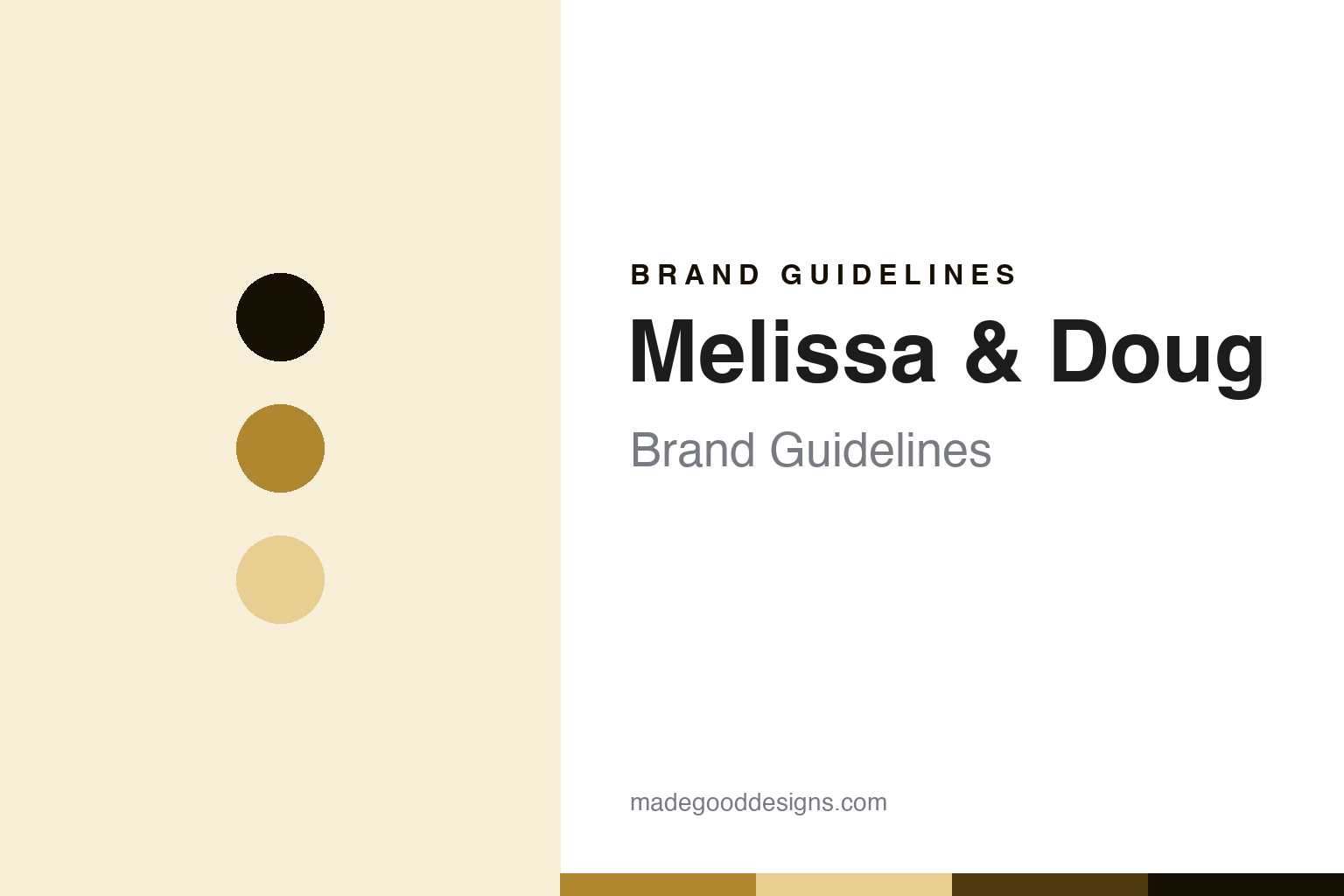
Melissa & Doug Brand Guidelines
The American wooden-puzzle brand, owned by Spin Master.
Aa
Two constants: a yellow-gold palette and a wooden-toy-sans register. Abstract homage — not a Melissa & Doug product or mark; no toy or logo is reproduced.
The American wooden-puzzle brand
Melissa & Doug is the American wooden-toy brand of puzzles and play, now owned by Spin Master.
Melissa & Doug closes the round as its mass-market maker — the American wooden-toy brand founded by a husband and wife, known for wooden puzzles, arts and crafts and pretend play, that grew into a category leader and was recently acquired by a large toy group. Melissa & Doug makes wooden puzzles and toys, and its answer to a round about the wooden shelf is reach — a wooden-toy brand at scale, honestly made across several countries, now inside a bigger house. A brand, mass-market.
Its identity is the American wooden-puzzle brand. The reach, the multi-country making and the group ownership are the story here. A brand, mass-market. The American wooden-puzzle brand, owned by Spin Master.
(Honest notes, so the story stays precise, and the making stays honest. Melissa & Doug, at melissaanddoug.com, makes wooden puzzles, arts and crafts, and educational and pretend-play toys, with its wooden puzzles as heroes, and we report its educational language as the brand’s own marketing. It was founded in 1988 by Melissa and Doug Bernstein, in Connecticut. On where it is made, the star theme of this round, its toys are made across the United States, China and India — an honest US-brand, mostly-Asia-made picture rather than a single flag. On who owns it, a theme of this round, it was acquired by Spin Master, a large toy company, in a deal announced in late twenty twenty-three and closed in early twenty twenty-four. Its toy designs are IP we describe but do not reproduce; there is no official brand hex; these tones are an unofficial interpretation.)
Colour
Melissa & Doug lives in a yellow gold. Click a swatch to copy the hex.
Melissa & Doug’s identity is mass-market, warm and made — a yellow gold, an ink, a pale straw, a deep bronze, and a paper. The palette leans yellow gold and pale straw: a warm, primary register that nods to a wooden puzzle rather than a loud palette. It signals a mass-market wooden-toy brand. The honest caveat: with no published brand hex, these values are an original, unofficial interpretation, not first-party colours.
The lesson is a yellow gold signals a mass-market, warm identity. Melissa & Doug’s world is a made, playful object. For designers, it is a reminder that a yellow gold and a soft pale straw can carry a toy brand — the tone of a wooden puzzle. Because these tones can fail as small text, keep type dark and let the colour live in the accents, palette and band. The takeaways: reach the many; report the making honestly; report claims as marketing; and treat any single hex as unofficial.
Typography
The register is a wooden-toy sans — mass-market, plain, warm.
Melissa & Doug’s identity carries a mass-market, plain, warm spirit — a scale brand, not a graphics label. A wooden-toy sans captures the mood: clean, friendly and confident, the register of a wooden puzzle. Set in a yellow-gold palette, the wooden-toy sans feels mass-market and warm — exactly the personality Melissa & Doug carries. It is a made object rather than a logo, mirroring wood and puzzle. (Melissa & Doug’s real toys are things we describe but do not reproduce, and the exact typeface is not ours to use.) Because it is not ours to use, the honest description is “a wooden-toy-sans brand,” shown here in a stand-in. The type behaves like the brand: mass-market, plain and warm.
Aa
A wooden-toy-sans brand — mass-market and warm. (Specimen set in Archivo, a wooden-toy-sans STAND-IN; NOT the Melissa & Doug logo or any toy.)
The wooden shelf
Melissa & Doug stands for the American wooden-puzzle brand, owned by Spin Master.
Melissa & Doug closes the round as its mass-market maker. A yellow-gold palette, a wooden-toy sans and a Connecticut origin make one thing — the American wooden-puzzle brand — the whole identity: mass-market, warm and made. The reach is the pitch, and the multi-country making is the honest half. The point is a wooden-toy brand at scale, now inside a bigger house.
Put to work, the identity is reach told straight, as making — with the split reported honestly and the owner named. A maker in this spirit would reach the many, report the making honestly, and report claims as marketing. A reader in this spirit would keep the facts right: Melissa & Doug makes wooden puzzles, arts and crafts, and educational and pretend-play toys, its wooden puzzles the heroes; it was founded in 1988 by Melissa and Doug Bernstein in Connecticut; its toys are made across the United States, China and India; and it was acquired by Spin Master, a large toy company, in a deal announced in late twenty twenty-three and closed in early twenty twenty-four. Melissa & Doug joins BRIO and Hape on the designed-in-a-home-country, made-across-Asia side of the round’s where-made thread, and anchors the rollup side of the who-owns thread with BRIO. The honest editorial moves are to date it to 1988, to name the Bernsteins, to report the US-China-India making, and to name Spin Master as the owner. The lesson Melissa & Doug teaches is that reach can be a whole identity, and reporting the making and the owner honestly keeps it credible.
For designers and brand-builders, Melissa & Doug closes the wooden shelf: reach the many — and report the making honestly. The lessons: make scale and reach the brand; report a multi-country making rather than a single flag; report educational language as marketing; name the group that acquires a founder brand; and never reproduce a toy. It is also a reminder to stay precise: Melissa & Doug is the American wooden-toy brand of puzzles and play, now owned by Spin Master — with the palette here an unofficial interpretation. Read that way, Melissa & Doug is less a puzzle than a reach: mass-market, made across three countries. The lesson for a brand is that reach and honest making reinforce each other, and naming Spin Master keeps the story earned. Melissa & Doug made the-American-wooden-puzzle-brand the identity — proof that reach can close a round. And it leaves the wooden shelf on its clearest lesson: that across a shelf of wooden toys, the two facts a reader most wants are where each toy is made and who owns the maker — genuinely-made PlanToys, Grimm’s and Ostheimer, openly-moved BRIO, Hape and Melissa & Doug, and the questioned label of Sophie la Girafe — an honest guide reporting each one exactly.
Explore & save
Keep Melissa & Doug’s identity on hand — save it to a board in the Made Good inspiration library.
Melissa & Doug identity set
Pin the yellow-gold palette and the wooden-toy-sans register to your own board.