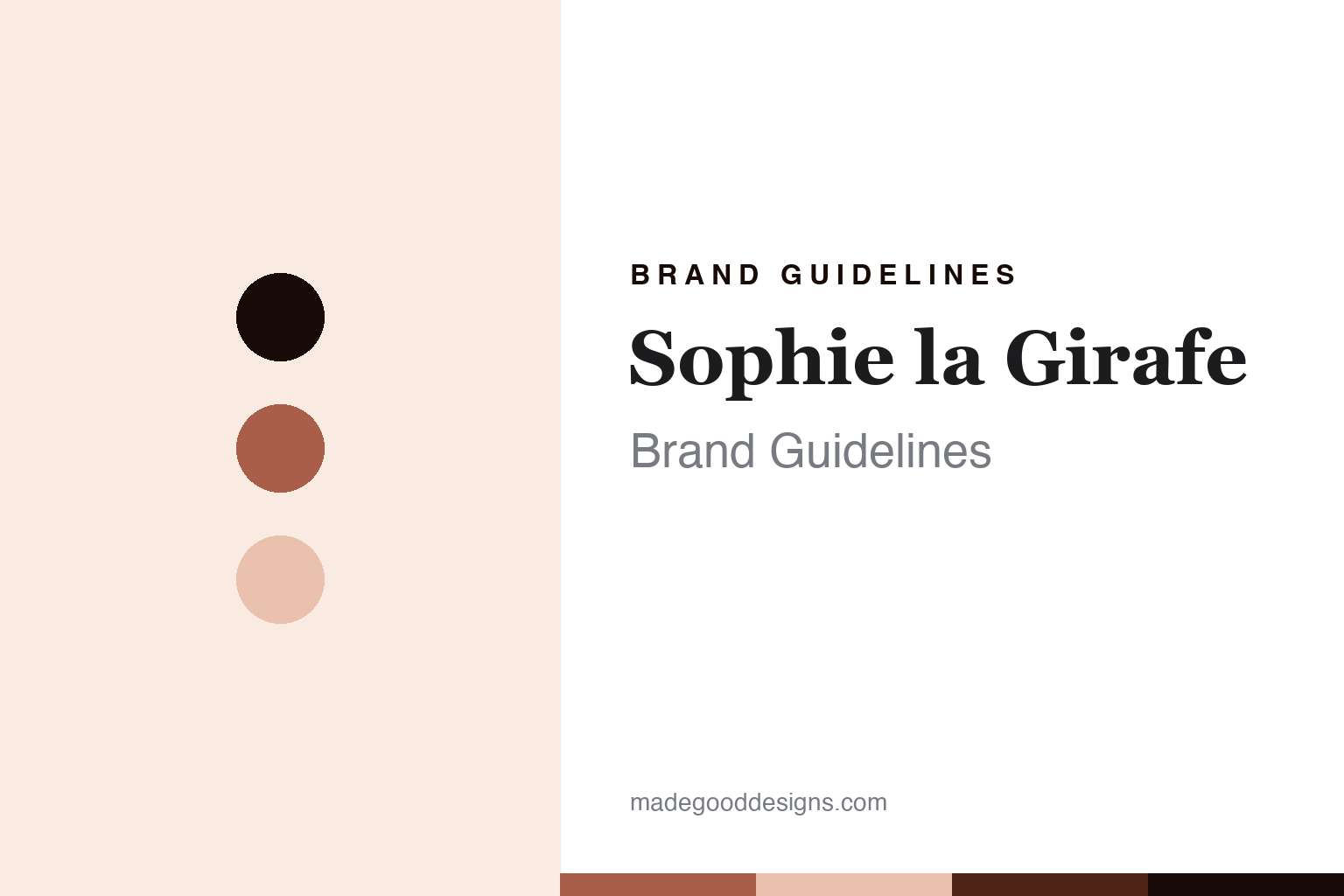
Sophie la Girafe Brand Guidelines
The rubber-teether icon and the Made-in-France question.
Aa
Two constants: a terracotta-rose palette and a heritage-rubber-serif register. Abstract homage — not a Sophie la Girafe product or mark; ⚠no giraffe silhouette or logo is reproduced.
The teether and the Made-in-France question
Sophie la Girafe is the French rubber-teether icon whose maker, Vulli, moved production to China while long marking it Made in France.
Sophie la Girafe brings the round its where-made case study — the French natural-rubber teether, shaped as a giraffe, that has been a nursery icon since 1961, and whose maker, Vulli, became the centre of a made-in-France question when reporting found production had moved to China. Sophie la Girafe makes a rubber teether, and its answer to a round about the wooden shelf is not wood at all but rubber, and a lesson: what a where-made label says, and where a thing is actually made, are not always the same. A brand, questioned.
Its identity is the teether and the Made-in-France question. The icon, the disputed making and the ownership are the story here. A brand, questioned. The rubber-teether icon and the Made-in-France question.
(Honest notes, so the story stays precise, and the reporting stays fair. Sophie la Girafe, at sophielagirafe.fr, makes a natural-rubber teether and related baby items, with the teether as its hero, and we report its safety and heritage language as the brand’s own marketing, not a safety guarantee. The character was created in 1961, in France; the maker is Vulli, based at Rumilly in the French Alps, associated with the brand since the early nineteen-nineties. On where it is made, the star theme of this round, this is the round’s clearest case study: reporting in twenty twenty-six found that Vulli had made Sophie in China since around twenty-thirteen, with French production reported to have ended by twenty-nineteen, while packaging long carried a “Made in France” line — later reworded to “Born in Paris” after scrutiny. We report this as documented reporting, not as an accusation, and it is exactly why where-made honesty is this round’s star theme. On who owns it, a theme of this round, it is Vulli. Cultural and IP care: the Sophie silhouette is strong brand IP; we describe it but reproduce none of it. There is no official brand hex; these tones are an unofficial interpretation.)
Colour
Sophie la Girafe lives in a terracotta rose. Click a swatch to copy the hex.
Sophie la Girafe’s identity is iconic, soft and questioned — a terracotta rose, an ink, a pale peach, a deep rust, and a paper. The palette leans terracotta rose and pale peach: a soft, nursery register that nods to natural rubber rather than reproducing the giraffe or its spots. We keep it abstract precisely because the Sophie silhouette is strong IP. The honest caveat: with no usable brand hex — and a duty to leave the silhouette alone — these values are an original, unofficial interpretation.
The lesson is a terracotta rose signals an iconic, soft identity — without copying the giraffe. Sophie la Girafe’s world is a made, nursery object. For designers, it is a reminder that a soft rose can evoke a rubber teether while avoiding a signature shape. Because these tones can fail as small text, keep type dark and let the colour live in the accents, palette and band. The takeaways: keep the icon; report the where-made fairly; report claims as marketing; and never copy the silhouette.
Typography
The register is a heritage-rubber serif — iconic, editorial, soft.
Sophie la Girafe’s identity carries an iconic, editorial, soft spirit — a nursery icon, not a graphics label. A heritage-rubber serif captures the mood: refined, editorial and confident, the register of a sixty-year-old icon. Set in a terracotta-rose palette, the heritage-rubber serif feels iconic and soft — exactly the personality Sophie la Girafe carries. It is a made object rather than a logo, mirroring rubber and a spot. (Sophie la Girafe’s real teether — its silhouette above all — is a thing we describe but do not reproduce, and the exact typeface is not ours to use.) Because it is not ours to use, the honest description is “a heritage-rubber-serif icon,” shown here in a stand-in. The type behaves like the brand: iconic, editorial and soft.
Aa
A heritage-rubber-serif icon — iconic and soft. (Specimen set in EB Garamond, a heritage-rubber-serif STAND-IN; NOT the Sophie la Girafe logo or the giraffe silhouette.)
The wooden shelf
Sophie la Girafe stands for the teether and the Made-in-France question.
Sophie la Girafe brings the round its where-made case study. A terracotta-rose palette, a heritage-rubber serif and a sixty-year-old icon make one thing — the teether and the Made-in-France question — the whole identity: iconic, soft and questioned. The icon is the draw, and the where-made question is the lesson. The point is that a label saying one country and a making in another are not always the same, and an honest guide reports the gap.
Put to work, the identity is a where-made case told straight, as fair reporting — with the silhouette untouched. A maker in this spirit would keep the icon, report the where-made fairly, and report claims as marketing. A reader in this spirit would keep the facts right: Sophie la Girafe is a natural-rubber teether, created in 1961 in France; its maker is Vulli, based at Rumilly, associated with the brand since the early nineteen-nineties; reporting in twenty twenty-six found production had moved to China since around twenty-thirteen, with French production reported ended by twenty-nineteen, while packaging long carried a “Made in France” line later reworded to “Born in Paris”; and it is owned by Vulli. Sophie la Girafe is the sharpest point of the round’s where-made-honesty thread, standing beside PlanToys and Grimm’s (genuinely made) and BRIO and Hape (openly moved) as the case where the label itself was questioned. The honest editorial moves are to report the reporting as documented rather than as an accusation, to distinguish the label from the making, and to reproduce none of the silhouette. The lesson Sophie la Girafe teaches is that a where-made label is a claim to be checked, and reporting the gap fairly is what keeps a guide honest.
For designers and brand-builders, Sophie la Girafe continues the wooden shelf: keep the icon — and report the where-made fairly. The lessons: an icon does not exempt a maker from where-made scrutiny; distinguish a label from a making; report documented reporting as reporting, not accusation; treat safety and heritage language as marketing; and never reproduce a signature silhouette. It is also a reminder to stay precise: Sophie la Girafe is the French rubber-teether icon whose maker, Vulli, moved production to China while long marking it Made in France — with the palette here a deliberate non-brand interpretation. Read that way, Sophie la Girafe is less a teether than a lesson: an icon, and a where-made question. The lesson for a brand is that an icon and honest where-made reporting must coexist, and reporting the gap fairly keeps the story earned. Sophie la Girafe made the-teether-and-the-Made-in-France-question the identity — proof that a where-made question can carry a brand, and can sharpen a whole round about where things are made.
Explore & save
Keep Sophie la Girafe’s identity on hand — save it to a board in the Made Good inspiration library.
Sophie la Girafe identity set
Pin the terracotta-rose palette and the heritage-rubber-serif register to your own board.