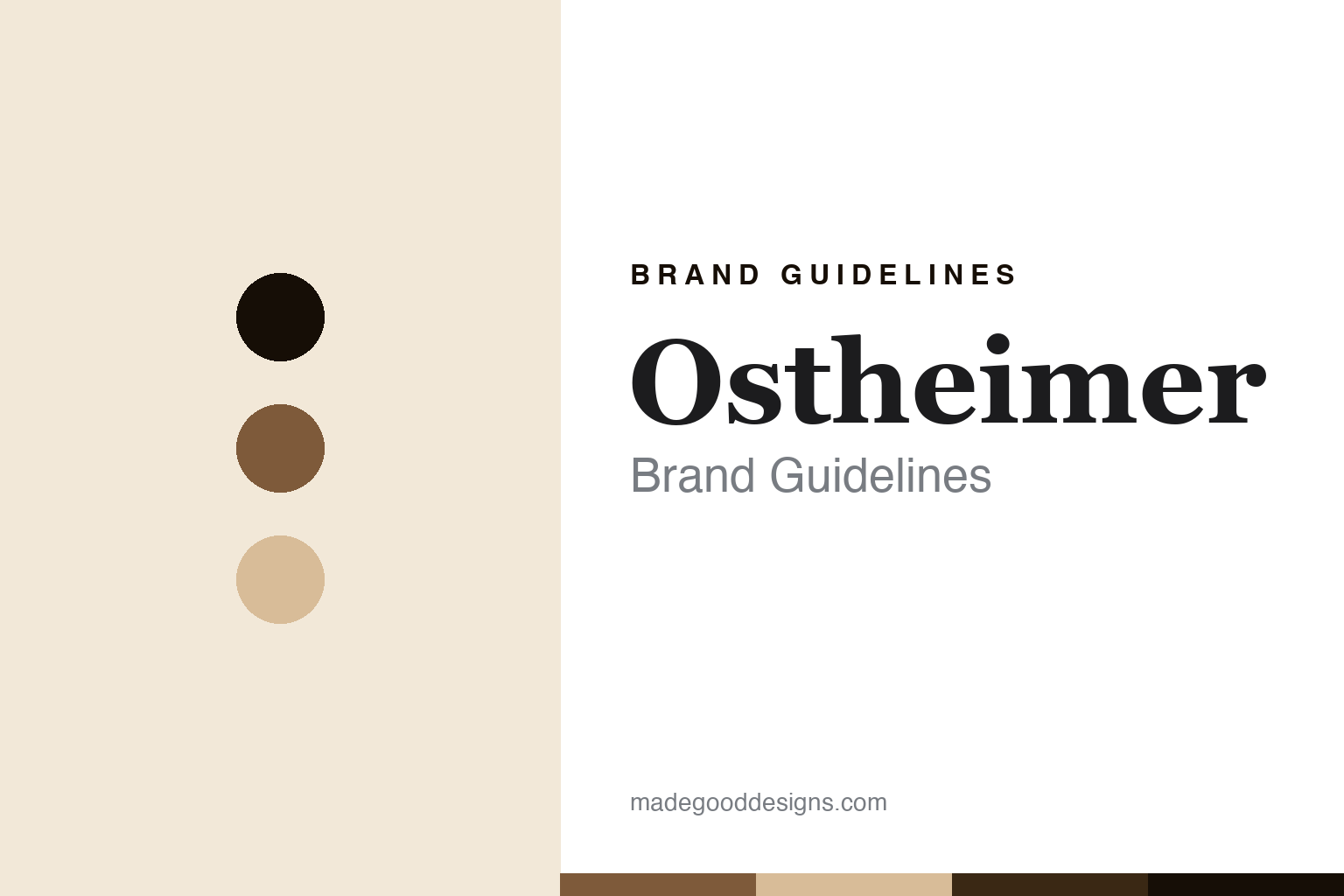
Ostheimer Brand Guidelines
The hand-carved Waldorf figure maker, made in Germany.
Aa
Two constants: a wood-brown palette and a hand-carved-serif register. Abstract homage — not an Ostheimer product or mark; no figure or logo is reproduced.
The hand-carved Waldorf figure maker
Ostheimer is the German maker of hand-carved, hand-painted Waldorf wooden figures, made in Germany.
Ostheimer brings the round its craft maker — the German house, founded in 1919, that hand-carves and hand-paints wooden Waldorf figures and animals, small heirloom pieces made one at a time in Germany. Ostheimer makes hand-carved figures, and its answer to a round about the wooden shelf is the human hand — a figure carved and painted by a person, in the Waldorf tradition, at home in Germany. A brand, hand-carved.
Its identity is the hand-carved Waldorf figure maker. The hand-craft, the German making and the independence are the story here. A brand, hand-carved. The hand-carved Waldorf figure maker, made in Germany.
(Honest notes, so the story stays precise, and the claims stay the brand’s own. Ostheimer — Margarete Ostheimer GmbH, at ostheimer.de — makes hand-carved, hand-painted wooden figures and animals, with its Waldorf nativity and animal figures as heroes, and we report its craft and Waldorf language as the brand’s own account, framing Waldorf as a philosophy rather than a brand asset. It was founded in 1919 by Margarete Ostheimer, based at Zell unter Aichelberg in Germany. On where it is made, the star theme of this round, its figures are genuinely made in Germany, hand-carved — a genuine domestic-made credential. On who owns it, a theme of this round, it is independent, a German company. Cultural care: the Waldorf approach is a pedagogy we treat respectfully. Its figure designs are IP we describe but do not reproduce; there is no official brand hex; these tones are an unofficial interpretation.)
Colour
Ostheimer lives in a wood brown. Click a swatch to copy the hex.
Ostheimer’s identity is hand-carved, warm and made — a wood brown, an ink, a pale wood, a deep umber, and a paper. The palette leans wood brown and pale wood: a warm, natural register that nods to carved and painted wood rather than a loud palette. It signals a hand-craft maker. The honest caveat: with no published brand hex, these values are an original, unofficial interpretation, not first-party colours.
The lesson is a wood brown signals a hand-carved, craft identity. Ostheimer’s world is a carved, made object. For designers, it is a reminder that a wood brown and a soft pale wood can carry a toy brand — the tone of carved wood. Because these tones can fail as small text, keep type dark and let the colour live in the accents, palette and band. The takeaways: keep the human hand; make it in Germany; report claims as marketing; and treat any single hex as unofficial.
Typography
The register is a hand-carved serif — hand-carved, editorial, warm.
Ostheimer’s identity carries a hand-carved, editorial, warm spirit — a craft house, not a graphics label. A hand-carved serif captures the mood: refined, quiet and confident, the register of a carved figure. Set in a wood-brown palette, the hand-carved serif feels hand-carved and warm — exactly the personality Ostheimer carries. It is a carved object rather than a logo, mirroring carve and grain. (Ostheimer’s real figures are things we describe but do not reproduce, and the exact typeface is not ours to use.) Because it is not ours to use, the honest description is “a hand-carved-serif maker,” shown here in a stand-in. The type behaves like the brand: hand-carved, editorial and warm.
Aa
A hand-carved-serif maker — hand-carved and warm. (Specimen set in Cormorant Garamond, a hand-carved-serif STAND-IN; NOT the Ostheimer logo or any figure.)
The wooden shelf
Ostheimer stands for the hand-carved Waldorf figure maker, made in Germany.
Ostheimer brings the round its craft maker. A wood-brown palette, a hand-carved serif and a German workshop make one thing — the hand-carved Waldorf figure maker — the whole identity: hand-carved, warm and made. The human hand is the pitch, and the German making is the proof. The point is a figure carved and painted by a person, one at a time, at home.
Put to work, the identity is hand-craft told straight, as making — with the making stated and the pedagogy respected. A maker in this spirit would keep the human hand, make it in Germany, and report claims as marketing. A reader in this spirit would keep the facts right: Ostheimer, formally Margarete Ostheimer GmbH, makes hand-carved, hand-painted wooden figures and animals, its Waldorf figures the heroes; it was founded in 1919 by Margarete Ostheimer, at Zell unter Aichelberg in Germany; its figures are genuinely made in Germany, hand-carved; and it is independent. Ostheimer joins PlanToys and Grimm’s on the genuinely-made side of the round’s where-made thread, sits with Grimm’s on the Waldorf and German-craft threads and with BRIO on the heritage thread, and stands on the independent side of the who-owns thread. The honest editorial moves are to date it to 1919, to name Margarete Ostheimer, to frame Waldorf respectfully, and to say the figures are made in Germany. The lesson Ostheimer teaches is that the human hand can be a whole identity, and stating the German hand-carving keeps it credible.
For designers and brand-builders, Ostheimer continues the wooden shelf: keep the human hand — and make it in Germany. The lessons: make hand-craft the brand; keep the making genuinely domestic and say so; treat a pedagogy like Waldorf respectfully; report craft language as marketing; and never reproduce a figure. It is also a reminder to stay precise: Ostheimer is the German maker of hand-carved, hand-painted Waldorf wooden figures, made in Germany — with the palette here an unofficial interpretation. Read that way, Ostheimer is less a figure than a hand: carved, in Germany. The lesson for a brand is that hand-craft and honest making reinforce each other, and stating the German carving keeps the story earned. Ostheimer made the-hand-carved-Waldorf-figure-maker the identity — proof that the human hand can carry a brand. And it stands, with Grimm’s, as the round’s proof that a wooden toy can still be genuinely made in a high-wage European country, one carved figure at a time, when so much of the shelf has moved offshore — a where-made answer that needs no qualifier, only a workshop and a pair of hands.
Explore & save
Keep Ostheimer’s identity on hand — save it to a board in the Made Good inspiration library.
Ostheimer identity set
Pin the wood-brown palette and the hand-carved-serif register to your own board.