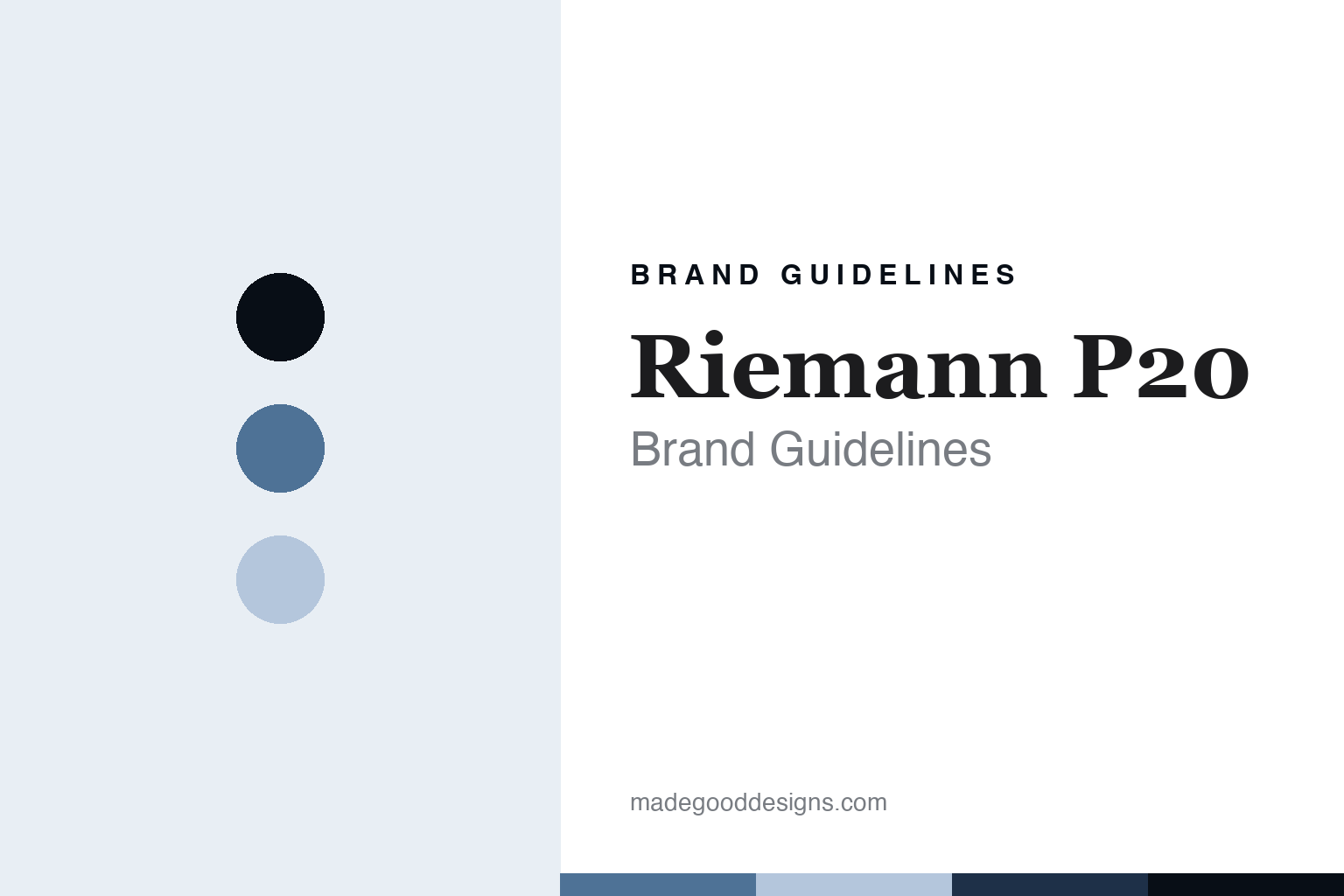
Riemann P20 Brand Guidelines
The Danish once-a-day sunscreen since 1979.
Aa
Two constants: a Scandi-slate palette and an once-a-day-serif register. Abstract homage — not a Riemann P20 product or mark.
The Danish once-a-day sunscreen since 1979
Riemann P20 is the long-lasting once-a-day sunscreen of Danish origin, owned by Orkla.
Riemann P20 brings the round a promise — the long-lasting sunscreen of Danish origin, created by Claus Riemann in 1979, built on a single idea: one application in the morning, protection through the day. Riemann P20 makes sunscreen, and its answer to a round about sun care is duration: a once-a-day, high-water-resistance formula that competes on how long it lasts rather than how it feels. A brand, long-lasting.
Its identity is the Danish once-a-day sunscreen since 1979. Riemann P20’s once-a-day promise, its 1979 origin and its Orkla ownership are the story here. A brand, long-lasting. The Danish once-a-day sunscreen since 1979.
(Honest notes, so the story stays precise, and the claims stay the brand’s own. Riemann P20, at its P20 sites, makes long-lasting sunscreen — original sprays, face, sensitive, kids and higher-protection lines — positioned on a once-a-day, up-to-ten-hours, high-water-resistance idea, and because sunscreen is a regulated product, we report every protection and duration claim strictly as the brand’s own marketing, never as established fact, and we give no sun-safety advice. It was created in 1979 by Claus Riemann, whose stated aim was to help a friend with sensitive skin, and while a pharmacist profession is often attached to him, we could not confirm it, so we do not state it; the Danish origin we present softly as heritage rather than a sourced prose fact. On where it is made, a theme of this round, a country of manufacture is not documented, so we do not assert one. On ownership, a star theme of this round, it is owned by Orkla, the Norwegian consumer-goods group, so it is not independent or family-owned, and a United Kingdom distributor is not its owner. We also note, neutrally, that a 2016 consumer-group test of once-a-day sunscreens raised questions about how protection holds over a day and advised reapplication, which an industry body disputed. Its name and packaging are IP we describe but do not reproduce; there is no official brand hex; these tones are an unofficial interpretation.)
Colour
Riemann P20 lives in a Scandi slate. Click a swatch to copy the hex.
Riemann P20’s identity is long-lasting, Scandinavian and plain — a Scandi slate, an ink, a sky, a deep slate, and a paper. The palette leans Scandi slate and sky: a cool, understated register that nods to a Danish origin and a functional, once-a-day promise rather than a loud palette. It signals long-lasting sun care. The honest caveat: with no published brand hex, these values are an original, unofficial interpretation, not first-party colours.
The lesson is a Scandi slate signals a long-lasting, plain identity. Riemann P20’s world is a functional, made object. For designers, it is a reminder that a Scandi slate and a soft sky can carry a sunscreen brand — the tone of duration. Because these tones can fail as small text, keep type dark and let the colour live in the accents, palette and band. The takeaways: promise duration; keep it functional; report claims as marketing; and treat any single hex as unofficial.
Typography
The register is an once-a-day serif — functional, plain, understated.
Riemann P20’s identity carries a functional, plain, understated spirit — a duration brand, not a fashion. An once-a-day serif captures the mood: clean, functional and confident, the register of a long-lasting sunscreen. Set in a Scandi-slate palette, the once-a-day serif feels functional and understated — exactly the personality Riemann P20 carries. It is a promise rather than a logo, mirroring a sunscreen and a spray. (Riemann P20’s real packaging is a thing we describe but do not reproduce, and the exact typeface is not ours to use.) Because it is not ours to use, the honest description is “an once-a-day-serif sunscreen,” shown here in a stand-in. The type behaves like the brand: functional, plain and understated.
Aa
An once-a-day-serif sunscreen — functional and understated. (Specimen set in Playfair Display, an once-a-day-serif STAND-IN; NOT the Riemann P20 logo.)
Who owns the sun
Riemann P20 stands for the Danish once-a-day sunscreen since 1979.
Riemann P20 brings the round a promise. A Scandi-slate palette, an once-a-day serif and a duration idea make one thing — the Danish once-a-day sunscreen since 1979 — the whole identity: long-lasting, Scandinavian and plain. The once-a-day promise is the concept, and the 1979 origin is the heritage. The point is a sunscreen that competes on how long it lasts, one morning application meant to carry the day.
Put to work, the identity is a promise told straight, as design. A maker in this spirit would promise duration, keep it functional, and report claims as marketing. A reader in this spirit would keep the facts right: Riemann P20 makes long-lasting sunscreen; it was created in 1979 by Claus Riemann, whose profession we do not assert, of Danish heritage framed softly; a country of manufacture is undocumented; and it is owned by the Norwegian group Orkla, so it is not independent or family-owned. Riemann P20 joins Piz Buin, from an earlier round, in the heritage-European-sun tradition, and it sits on the who-owns spine here. The honest editorial moves are to date it to 1979, to name Claus Riemann without a profession, to name Orkla, to note the once-a-day durability caution neutrally, and to report the duration claims as marketing. The lesson Riemann P20 teaches is that a single promise can be a whole identity, and reporting the claims as marketing keeps it credible.
For designers and brand-builders, Riemann P20 continues who owns the sun: promise duration — and keep it functional. The lessons: build a brand on one functional promise, like once-a-day; keep the design understated; report duration and protection language strictly as your own, and note independent scrutiny neutrally; be honest about group ownership; and never reproduce packaging. It is also a reminder to stay precise: Riemann P20 is the long-lasting once-a-day sunscreen of Danish origin, owned by Orkla — with the palette here an unofficial interpretation. Read that way, Riemann P20 is less a bottle than a promise: one application, all day. The lesson for a brand is that a promise and honest claims reinforce each other, and naming Orkla keeps the story earned. Riemann P20 made the-Danish-once-a-day-sunscreen-since-1979 the identity — proof that a promise can define a brand.
Explore & save
Keep Riemann P20’s identity on hand — save it to a board in the Made Good inspiration library.
Riemann P20 identity set
Pin the Scandi-slate palette and the once-a-day-serif register to your own board.