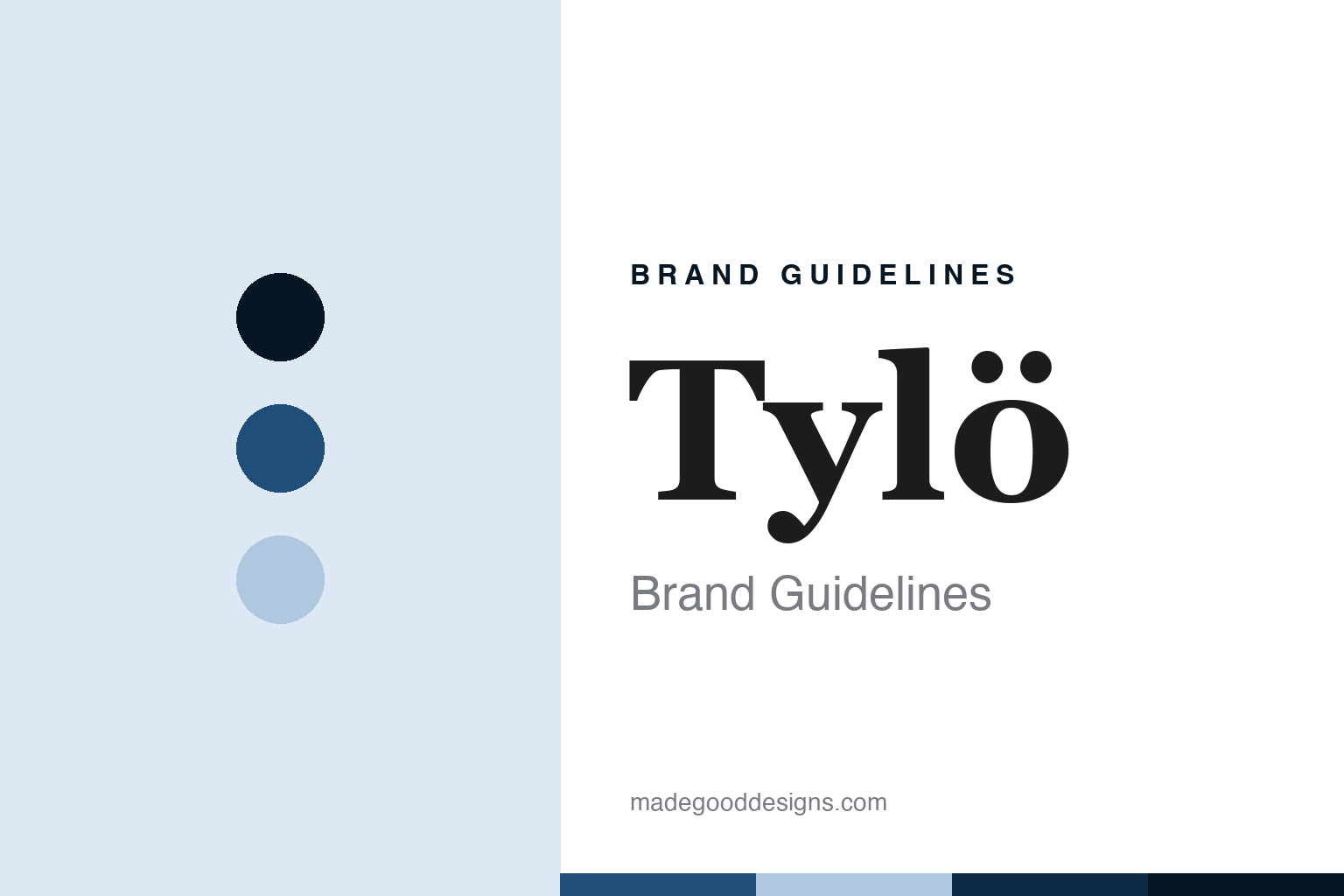
Tylö Brand Guidelines
The founder’s name is gone.
Aa
Two constants: a Tylö-steel-blue palette and a Halmstad-serif register. Abstract homage — not a Tylö product or mark; no cabin, heater, bench or logo is reproduced.
The founder’s name is gone
Tylö was founded by a named electrician in a woodshed. His surname now appears nowhere across 81 of the company’s own current files.
Tylö opens the round with a deletion. The business was started in 1949 by an electrician working out of a woodshed on the edge of Halmstad, trading under a company name that meant, literally, the electric-spiral company. He died in 2013. His surname now appears in none of the company’s live pages, none of its 2026 catalogue, none of its four current brochures and none of its forty-five product manuals — eighty-one files, zero occurrences. Six of its own history pages return errors. What remains is the phrase the Swedish founder of Tylö. Its answer to a round about who makes and who brands the product is a brand that kept the name and lost the man: the founder’s name is gone.
Its identity is the founder’s name is gone. The 1949 woodshed, the Halmstad works and a selectively applied badge are the story here. The wordmark. The founder’s name is gone.
(Honest notes, so the founding, the ownership, the making and one careful omission are framed accurately. On founding: 1949 is the date the catalogue brands on, and the trademark registers corroborate the original corporate name independently, because all four of the brand’s European marks were filed under it. But the company’s own group site says the founder built his first heater in 1951, and its homepage runs over seventy-five years and seventy-seven years of experience in the same breath, so the dates are its own to reconcile and we give both. On ownership, the fact that reframes everything: this brand no longer has a company of its own. The group renamed itself in 2022 and was bought in 2023 by an American listed conglomerate, and that group’s subsidiary schedule contains no entity bearing this brand’s name at all — only the renamed holding companies. The Swedish trademark register still prints the old corporate name against the same registration number, which is how you can tell they are one legal person. On the making: the Swedish claim is real and third-party certified today, because certificates issued from 2023 onward name the Swedish company as manufacturer of the heaters. It was not always so: across the whole international certification database, the brand’s own former Swedish entity never once appears as the manufacturer of a sauna heater, only of shower cabinets. On the omission: the badge is withheld from exactly one line, and that is worth reading carefully rather than cynically. Its marks are IP we describe but do not reproduce; there is no official brand hex.)
Colour
Tylö lives in a Tylö steel blue. Click a swatch to copy the hex.
Tylö’s identity is Swedish, deleted and precise — a Tylö steel blue, an ink, a pale slate, a deep navy, and a paper. The palette leans Tylö steel blue and deep navy: a northern register that stands in for a Halmstad works rather than a loud logo colour. It signals that the founder’s name is gone — Swedish, deleted and precise. The honest caveat, and it corrects an assumption we held: the brand’s actual 2026 accent is not blue or green at all but a burnt terracotta, carrying its links, buttons and eyebrows, against warm near-black neutrals. We describe that rather than restating it, and these values are an unofficial interpretation.
The lesson is withholding a claim is itself a claim, and this one is made typographically. The catalogue says all our heaters and sauna rooms are crafted with care right here in Sweden — and the scoping of that sentence is doing real work, because an infrared cabin is arguably neither a heater nor a sauna room. Checked page by page, the word Sweden appears not once on the infrared page and not once across the products index, while the sauna and steam pages both carry a made-in-Sweden block. Set that against the recall record and the reason becomes clear rather than sinister: the North American cabin and infrared lines are made in China, and the badge is simply not applied to them. This is not a firm hiding an origin. It is a firm declining to claim one where it does not hold, while its European heaters carry current third-party certificates naming a Swedish manufacturer. The wordmark itself is the other half of the identity, and it is genuinely well made: five flat shapes in a single warm near-black, with the T’s crossbar extended into a continuous rule across three letters so they hang beneath it, and the umlaut rendered as two rectangular bars sitting on that same line. Because a strong hue can fail as small text, keep type dark and let the colour live in the accents, palette and band. The takeaways: give both founding dates; say the brand has no company of its own; scope the Swedish claim to heaters and rooms; and never transfer the China finding to the European range.
Typography
The register is a Halmstad serif — Swedish, spare, deliberate.
Tylö’s identity carries a Swedish, deliberate spirit — a works that states what it makes and stops short of what it does not. A Halmstad serif captures the mood: spare, settled and quietly formal, the register of a certificate rather than an advertisement. Set in a Tylö-steel-blue palette, the Halmstad serif feels measured rather than styled — exactly the personality the record supports. It behaves like a steam curl rather than a loud logo, mirroring a bench slat and a grain line. (Tylö’s real products, its wordmark and its extended-crossbar device, its trademarked technology names and the name itself are things we describe but do not reproduce, and the exact typeface is not ours to use; its own mark is a geometric sans and our stand-in is a serif, so nothing here should be mistaken for its type.) Because it is not ours to use, the honest description is “a Halmstad-serif brand,” shown here in a stand-in. The type behaves like the brand: Swedish, spare and deliberate.
Aa
A Halmstad-serif brand — spare and formal. (Specimen set in Fraunces, a Halmstad-serif STAND-IN; NOT the Tylö logo, wordmark or products.)
The deleted-founder node
Tylö stands for the founder’s name being gone.
Tylö opens the round as its deleted-founder node. A Tylö-steel-blue palette, a Halmstad serif and a 1949 woodshed make one thing — the founder’s name is gone — the whole identity: Swedish, deleted and precise. The founding is the frame, the Halmstad works is the substance, and an absence across eighty-one files is the signature. The point is a brand that outlived both its founder and its company, and that now carries a Swedish story under American ownership.
Put to work, the identity is the name restored and the claim scoped. A brand in this spirit would name the electrician who started it and the woodshed he started it in, give 1949 and the 1951 first-heater date because its own two properties disagree, state that it has no legal entity of its own and that its group was bought by an American listed company in 2023, scope the Swedish claim to the heaters and rooms its own catalogue scopes it to, and decline to extend that claim to the North American lines the recalls place in China. A reader in this spirit would keep the facts right: Tylö makes heaters and sauna rooms, its European heaters are certified with a Swedish manufacturer named, its US cabins are Chinese-made, and it sells no wood-burning stove at all. Tylö opens the round, before Helo. The honest editorial moves are to restore the founder, to give both dates, to scope the badge, and to keep the two markets apart.
For designers and brand-builders, Tylö opens the deleted-founder node: a wordmark can outlast the person it was named after, and usually does. The lessons: a category can be opened by a firm whose most measurable brand act is a subtraction, since its founder’s surname is absent from eighty-one current files and six of its own history pages now fail; a founding is corroborated sideways, because the original corporate name survives as the filing applicant on all four of the brand’s European trademarks even though the company itself has been renamed twice since; an ownership is stated plainly as what it is, a brand with no entity of its own inside an American listed group, with the Swedish register still printing the old corporate name against the identical registration number so that the two can be shown to be one legal person; a manufacturing claim is verified rather than assumed, and it turns out to be both true and recent, since the brand’s own former Swedish entity never appears as a heater manufacturer in the international certification record while the renamed Swedish company has been named on heater certificates since 2023; and a badge is read for where it is withheld, because the word Sweden is absent from the infrared page and the products index while the sauna and steam pages carry it, which maps exactly onto the lines that are and are not made there. Three cautions close it. Its own deleted copy once quantified the factory in square metres and no longer does, and the later of the two figures was the smaller, so neither should be quoted. Its health claims hedge consistently with modals, and a full extraction of its ninety-two-thousand-character catalogue finds the words study, research, proven and clinical at zero occurrences each — so where it makes a wellness claim it cites nothing, and we attribute rather than repeat. And the same group’s recalls reached tens of thousands of units across two countries, which is a fact about the group and its Chinese-made cabins, not about a Swedish heater. The hook is that absence: Tylö is the founder’s name is gone. Read that way, Tylö is less a family story than a mark that survived everyone who made it: Swedish, spare, deliberate. The lesson for a brand is that a name is the most durable asset you own and the easiest history to mislay. Tylö made the-surviving-wordmark the identity — proof that a round can open on a deletion.
Explore & save
Keep Tylö’s identity on hand — save it to a board in the Made Good inspiration library.
Tylö identity set
Pin the Tylö-steel-blue palette and the Halmstad-serif register to your own board.