Kastor Brand Guidelines
A trade name, not a company.
Aa
Two constants: a Kastor-ember palette and a trade-name-sans register. Abstract homage — not a Kastor product or mark; no stove, heater, cauldron or logo is reproduced.
A trade name, not a company
Kastor Oy ceased on the last day of 2009. On that same day, Kastor became an auxiliary trade name of another company — now owned from Michigan.
Kastor is the round’s absorbed-name node, and the register tells it in two lines. The company called Kastor Oy — itself registered in 1991 under a name that is Kastor spelled backwards — ceased on the thirty-first of December 2009. On that exact date, Kastor was entered as an auxiliary trade name of a different company, the one that had bought it. That company has since been renamed twice and, since the third quarter of 2023, belongs to an American listed building-products group in Michigan, which booked twenty-two million dollars of the purchase price as the value of the trademarks it acquired. Meanwhile the catalogue runs the words the genuine Finnish sauna as a header on every spread. Its answer to a round about who makes and who brands the product is that here there is no maker left to ask: a trade name, not a company.
Its identity is a trade name, not a company. The 1908 founding, a vanished factory town and a strapline are the story here. The absorption. A trade name, not a company.
(Honest notes, because this entry needs more of them than any other. On the name: never write Kastor Oy in the present tense. The group’s own American page concedes the position — Kastor Oy, today called Kastor, a brand. On founding, five competing dates and we report all of them: an encyclopaedia dates the founder’s first heating businesses to 1908 in Vyborg and says they became Kastor in 1916; the company’s own 2004 press release said the firm was founded around 1910 and that it had been making heating equipment for almost a hundred years, which implies something closer to 1905 than 1916; the current owner says the winter of 1916 and calls itself the oldest sauna company in the world; and the register says 1991. Note the internal tension — almost a hundred years written in 2004 does not reconcile with 1916, and the 1916 date appears in the record only after the brand narrative passed to its acquirer. On the founder, whom the other research stream missed entirely: a Finnish building master, inventor and heater manufacturer, with a published-works list and a museum photograph, who bought a sauna-heater patent from a named engineer in 1932. All of that comes from an encyclopaedia and is rich but unverified at source. On the making, the finding that matters most: this brand makes no made-in claim anywhere. Its marks are IP we describe but do not reproduce; there is no official brand hex.)
Colour
Kastor lives in a Kastor ember. Click a swatch to copy the hex.
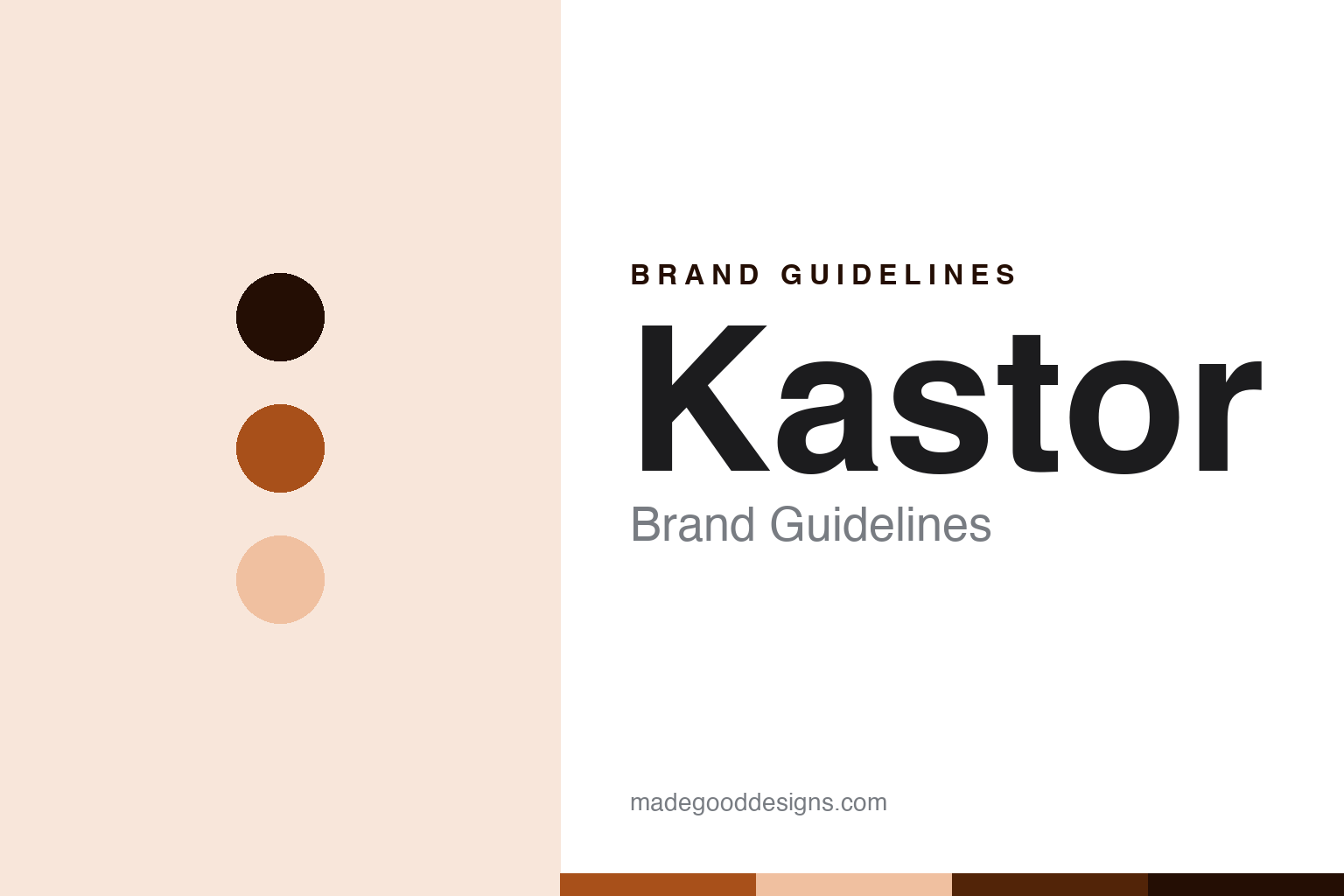
Kastor’s identity is Finnish by adjective, absorbed by structure — a Kastor ember, an ink, a pale flame, a deep char, and a paper. The palette leans Kastor ember and deep char: a firebox register that stands in for a wood-burning range rather than a loud logo colour. It signals a trade name, not a company — Finnish by adjective, absorbed by structure. The honest caveat is unusually strict: this brand no longer has a visual identity of its own in the wild. On its current host site it appears as a word above product photography, beneath another brand’s red wordmark, and the image file named after it is a photograph rather than a logo. We describe that and invent nothing.
The lesson is you can watch a brand be absorbed by reading its file names. Several of the product images on its current pages still carry the previous group’s name embedded in the filename — an identity absorbed twice over, legible in the URL. The range tells the same story: a decade ago this name covered wood-burning stoves, electric heaters, control units, fireplaces, modular chimneys and whole sauna rooms; today it covers wood-burning stoves and nothing else, everything else having migrated to the sibling brand or disappeared. Its own current manual even disclaims other makers’ flues, which is what a narrowed range sounds like in the small print. What survives is naming, and the naming is good: Finnish common nouns for bear and cauldron, one loanword, a size suffix in cubic metres, and letter suffixes for water-tank orientation. The tagline that survives with it — follow your fire — is better than most in this trade. Because a strong hue can fail as small text, keep type dark and let the colour live in the accents, palette and band. The takeaways: never use the company name in the present tense; report all five founding dates; say plainly that no made-in claim exists; and never transfer the group’s China findings to these stoves.
Typography
The register is a trade-name sans — plain, inherited, unhoused.
Kastor’s identity carries a plain, inherited spirit — a name that outlived its company and now sits inside someone else’s page template. A trade-name sans captures the mood: functional, unbranded and unhoused, the register of a product heading rather than a logotype. Set in a Kastor-ember palette, the trade-name sans feels borrowed rather than styled — exactly the personality the record supports. It behaves like an ember rather than a loud logo, mirroring a stone stack and a firebox line. (Kastor’s real products, its model names and the name itself are things we describe but do not reproduce; no current Kastor logo could be retrieved and none is invented here, and the exact typeface is not ours to use.) Because it is not ours to use, the honest description is “a trade-name-sans brand,” shown here in a stand-in. The type behaves like the brand: plain, inherited and unhoused.
Aa
A trade-name-sans brand — functional and unhoused. (Specimen set in Manrope, a trade-name-sans STAND-IN; NOT the Kastor mark or products — and no current Kastor logo could be retrieved.)
The absorbed-name node
Kastor stands for being a trade name, not a company.
Kastor holds the round’s absorbed-name node. A Kastor-ember palette, a trade-name sans and a contested 1908 make one thing — a trade name, not a company — the whole identity: Finnish by adjective, absorbed by structure. The founding is the frame, a vanished factory town is the substance, and two register lines are the signature. The point is a heritage name still selling heritage while the company behind it no longer exists, and the group that owns it valuing the name itself at twenty-two million dollars.
Put to work, the identity is the register quoted and the claim refused. A brand in this spirit would never use the company name in the present tense, would give all five founding dates and note that the current owner’s date appears only after it took over the narrative, would credit the founder while marking the source as unverified, would state that the manufacturer of record on the manuals is a Hanko address rather than a factory statement, and would say plainly that no made-in claim appears anywhere in its materials. A reader in this spirit would keep the facts right: Kastor is a wood-burning stove range sold by a Finnish company owned by an American group; its range has narrowed to that alone; and its historic plant town does not appear in any current document. Kastor follows Narvi, before Huum. The honest editorial moves are to fix the tense, to report all the dates, to refuse the origin claim, and to keep the group’s recalls separate.
For designers and brand-builders, Kastor holds the absorbed-name node: a trademark can be worth more than the company that earned it. The lessons: a category can include a name whose corporate existence ended on a dated line in a public register while its commercial existence continued unbroken, transferring to its acquirer as an auxiliary trade name on the very same day; a founding is reported as five competing dates rather than one, and the tension is named — almost a hundred years, written by the company itself in 2004, cannot be reconciled with the winter of 1916 that its current owner now prints; a founder is restored to a story that had lost him, with his own trade, his own inventions and a patent he bought in 1932 all credited to an encyclopaedia and marked unverified rather than dressed as fact; an origin claim is refused outright, because across nineteen live pages, three fully extracted PDFs and a second independent sweep of eighteen more pages, this brand makes no statement of where its stoves are made, and what stands in its place is heritage language and the words designed and skilled engineering; and a range contraction is read as brand history, since a name that once carried heaters, controls, fireplaces, chimneys and rooms now carries stoves alone. Three cautions close it. The manufacturer of record on the manuals is an address, not a factory statement, and the historic heater plant was in a different town whose address still appears in a trademark record — when or whether production moved is not established. The China findings in the group’s 2025 and 2026 recalls concern its sibling brand’s cabins and its infrared lines, and nothing supports transferring them to these stoves, but the two must be kept apart in the same paragraph or a reader will merge them. And the wellness material across this group is among the strongest in the round, including a page asserting that numerous medical studies prove the benefits with no study named — so all of it is attributed here and none of it repeated, though it is worth recording that the word detox appears nowhere on this brand’s pages at all. The hook is that structure: Kastor is a trade name, not a company. Read that way, Kastor is less a maker than an asset on a balance sheet doing a very good impression of a maker: plain, inherited, unhoused. The lesson for a brand is that the name is the part that gets bought, and the part that survives. Kastor made the-absorbed-name the identity — proof that heritage can outlive the firm that built it.
Explore & save
Keep Kastor’s identity on hand — save it to a board in the Made Good inspiration library.
Kastor identity set
Pin the Kastor-ember palette and the trade-name-sans register to your own board.