Klafs Brand Guidelines
Ninety-eight years old, three years named.
Aa
Two constants: a Klafs-bronze palette and a register-sans register. Abstract homage — not a Klafs product or mark; no cabin, heater, bench, glass front or logo is reproduced.
Ninety-eight years old, three years named
The company that sells “since 1928” was first registered in December 2014 under a different name, and became Klafs GmbH in July 2022 — nine days after the historic firm was dissolved.
Klafs closes the round with the cleanest register trail in it. The business is genuinely old: founded in 1928 in Stettin by a named engineer, restarted at Schwäbisch Hall in 1948 after he was expelled, selling its first sauna in 1952. The company that carries the name today is not that firm. It was first registered in December 2014 as an asset-management shell, renamed twice through 2015 and 2021, and took the name Klafs GmbH on the twenty-first of July 2022 — nine days after the global identifier registry records the historic partnership as dissolved. So the business is ninety-eight years old and the legal person carrying its name is three. Its answer to a round about who makes and who brands the product is a brand and a company that have come apart and been rejoined: ninety-eight years old, three years named.
Its identity is ninety-eight years old, three years named. The 1928 founding, the Schwäbisch Hall works and a renaming are the story here. The register. Ninety-eight years old, three years named.
(Honest notes, because this is the most layered entry in the round. On founding: four dates compete and we give them all — the company says 1928 and its designer collaborator corroborates it; its own timeline says the 1948 trade registration laid the foundation of today’s firm; its former private-equity owner said twice, in its own release, that the company was founded in 1952; and the register says December 2014. On family: only one generation of the founding family ever ran it, from 1928 to the founder’s sudden death in 1965, after which his widow held his share and two long-serving employees took control. No descendant appears in any management or shareholder record since, and the company itself uses the word family business only in the past tense. On ownership: bankruptcy proceedings opened in July 1991, two industrial firms took half each that November, a Dutch investment company acquired a majority announced in January 2021, and an American family-owned group completed its purchase in January 2024 — with the deal value undisclosed both times. On the making: two German plants and one Polish one, named by its former owner and never by the brand. And on one claim we are careful: its craftsmanship badge is a claim about joinery, not about the heater. Its marks are IP we describe but do not reproduce; there is no official brand hex.)
Colour
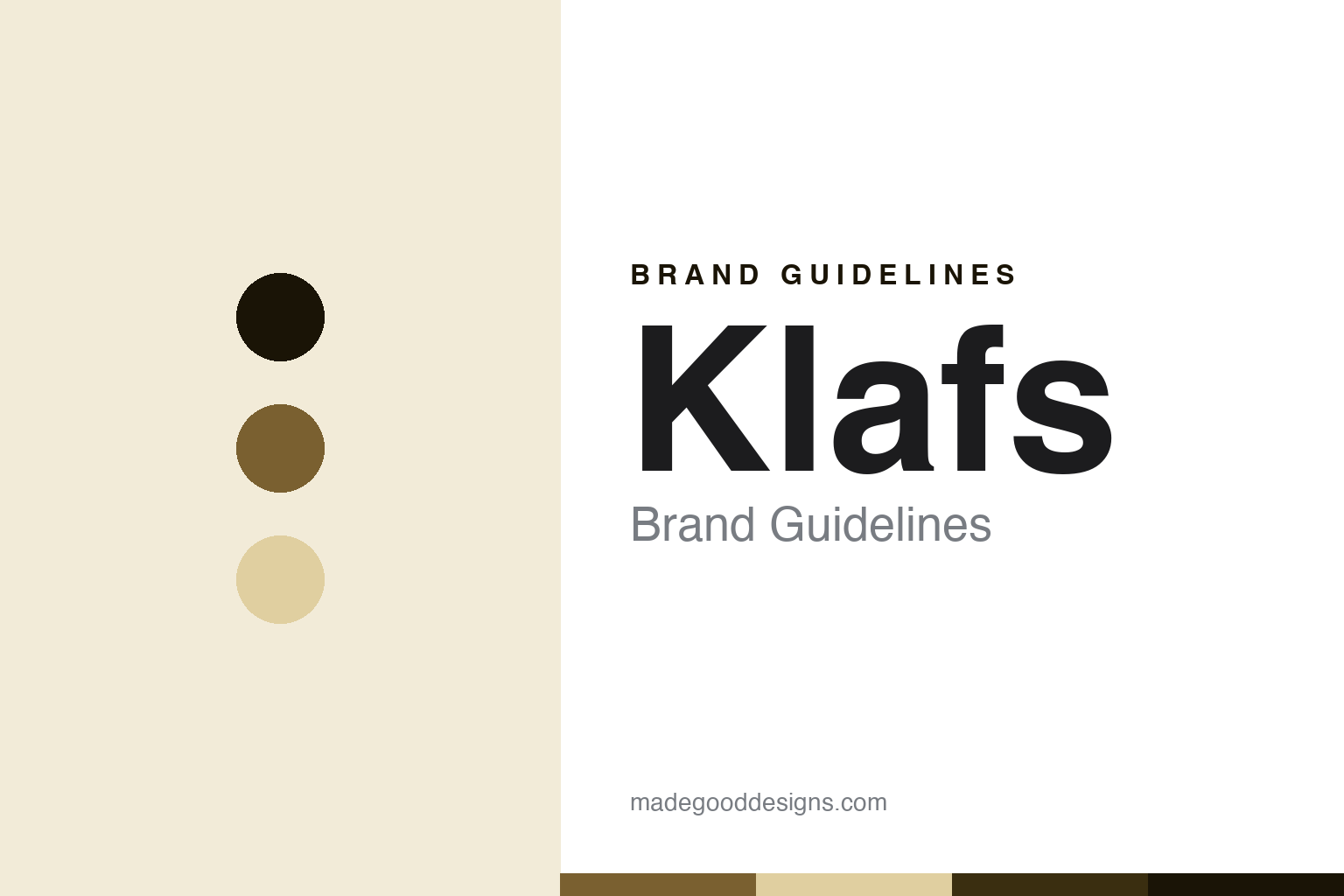
Klafs lives in a Klafs bronze. Click a swatch to copy the hex.
Klafs’ identity is German, layered and premium — a Klafs bronze, an ink, a pale brass, a deep umber, and a paper. The palette leans Klafs bronze and deep umber: a cabinetmaking register that stands in for hemlock, glass and engineered metalwork rather than a loud logo colour. It signals ninety-eight years old, three years named — German, layered and premium. The honest caveat: its own mark is a wide monochrome wordmark that inherits its colour rather than carrying one, so there is no house hex to restate, and these values are an unofficial interpretation.
The lesson is a naming system can run four registers at once, and this one does. Coined Latinate names for the heaters and the loungers. Letter-and-number codes for the cabins and steam rooms. Registered sub-brands for the bathing modes and the foam bath. Internal-capital technical names for the mechanisms. And plain German compounds or English words where a product needs to be understood immediately. Often three of those layers land on a single item, so one product line is described by a Latin coinage, a sub-brand with a registered symbol and an alphanumeric code in the same breath. Set that against the Estonian firm earlier in this round, which uses one bare English noun in capitals and nothing else, and you have the two poles of naming in one category: maximal and minimal, both coherent. The other half of the identity is collaboration — an industrial design studio attached to a famous automotive name, an interior designer, a furniture designer — and those are real, dated and independently corroborated on the collaborators’ own pages, which is far better evidence than a self-description. Because a strong hue can fail as small text, keep type dark and let the colour live in the accents, palette and band. The takeaways: give all four founding dates; say family business in the past tense as the company does; name the Polish plant its former owner named; and never write the bare word patented.
Typography
The register is a register sans — German, layered, exact.
Klafs’ identity carries a German, documentary spirit — a firm whose truest history is in a commercial register rather than a timeline. A register sans captures the mood: formal, neutral and dense, the register of a filing rather than a brochure. Set in a Klafs-bronze palette, the register sans feels recorded rather than styled — exactly the personality the record supports. It behaves like a bench slat rather than a loud logo, mirroring a glass edge and a grain line. (Klafs’ real products, its wordmark, its coined line names and registered sub-brands and the name itself are things we describe but do not reproduce, and the exact typeface is not ours to use; its own mark carries no fill attribute and inherits its colour, which we describe and do not restate.) Because it is not ours to use, the honest description is “a register-sans brand,” shown here in a stand-in. The type behaves like the brand: German, layered and exact.
Aa
A register-sans brand — formal and dense. (Specimen set in Manrope, a register-sans STAND-IN; NOT the Klafs logo or products.)
The renamed node
Klafs stands for being ninety-eight years old and three years named.
Klafs closes the round as its renamed node. A Klafs-bronze palette, a register sans and a contested 1928 make one thing — ninety-eight years old, three years named — the whole identity: German, layered and premium. The founding is the frame, the Schwäbisch Hall works is the substance, and a nine-day gap in a register is the signature. The point is that a heritage brand and the legal person carrying it can have entirely different ages, and that the register is where you find out.
Put to work, the identity is the trail followed to the end. A brand in this spirit would give 1928, 1948, 1952 and the 2014 registration and name which source says which, credit the founder and note that only one generation of his family ever ran the firm, use family business in the past tense exactly as the company does, state the 1991 bankruptcy and the two industrial firms that rescued it, name the private-equity majority and the American group that bought it in 2024 with both deal values undisclosed, name the Polish plant its former owner named, and scope the craftsmanship badge to the joinery it actually describes. A reader in this spirit would keep the facts right: Klafs makes cabins, benches, steam rooms and control systems in Germany and Poland, buys its stones from Finland and its timber from Canada and the Nordics, does not state where its heaters or glass are made, and has been American-owned since January 2024. Klafs closes the round, after Huum. The honest editorial moves are to give every date, to follow the register, to name the plant, and to scope the badge.
For designers and brand-builders, Klafs closes the renamed node: a heritage date describes a business, and a register describes a company, and they are rarely the same age. The lessons: a round can be closed by a firm whose own paperwork is the most eloquent thing about it, since the company selling since 1928 was a 2014 shell that took the name nine days after the historic partnership was recorded as dissolved; a founding is reported as four competing dates with the source of each named, and the most striking disagreement comes from its own former owner, which twice dated the company to 1952 rather than 1928; a family story is told accurately, because one generation ran it for thirty-seven years and none since, and the company is honest enough to use the phrase family business only historically, and honest enough to say of its founder that he did not invent the sauna but helped it break through; a manufacturing claim is scoped to what it actually says, since a badge about craftsmanship appears on three of forty-eight pages and is absent from every heater product page, and the sentence where a manufacturing claim would sit uses the verb further developed instead; and a disclosure gap is named rather than filled, because a Polish production site appears in its former owner’s press release and in an encyclopaedia and nowhere on the company’s own site, while where its heaters, control units and glass are physically built is simply not stated anywhere. Four cautions close it, and the round. Its retractable sauna claim is substantiated by filings in its own name with titles and dates, which is why the bare word patented is never needed here. Two of its design honours are special mentions rather than wins, verified at the awarding body on a page headed the winners — and the company itself labels them correctly, which deserves saying. Another prize it holds in quantity is not a design jury of comparable standing and some of its categories are satisfaction surveys, so it is cited separately. And its health material is the most assertive in this round: it states a natural detox effect as fact, and where its German page hedges that regular sauna use may extend life by up to five years and footnotes a named doctor, its English page drops the hedge entirely and promises the reader will gain at least five years. That is the same pattern this series has now recorded across three rounds — a claim softened in one language and not another — and every one of those statements is attributed here and none repeated. The hook is that gap: Klafs is ninety-eight years old, three years named. Read that way, Klafs is less a continuous house than a name carefully carried across three ownerships and one bankruptcy: German, layered, exact. The lesson for a brand is that continuity is a thing you assert and a thing the register can check. Klafs made the-carried-name the identity — proof that a round can close on nine days.
Explore & save
Keep Klafs’s identity on hand — save it to a board in the Made Good inspiration library.
Klafs identity set
Pin the Klafs-bronze palette and the register-sans register to your own board.