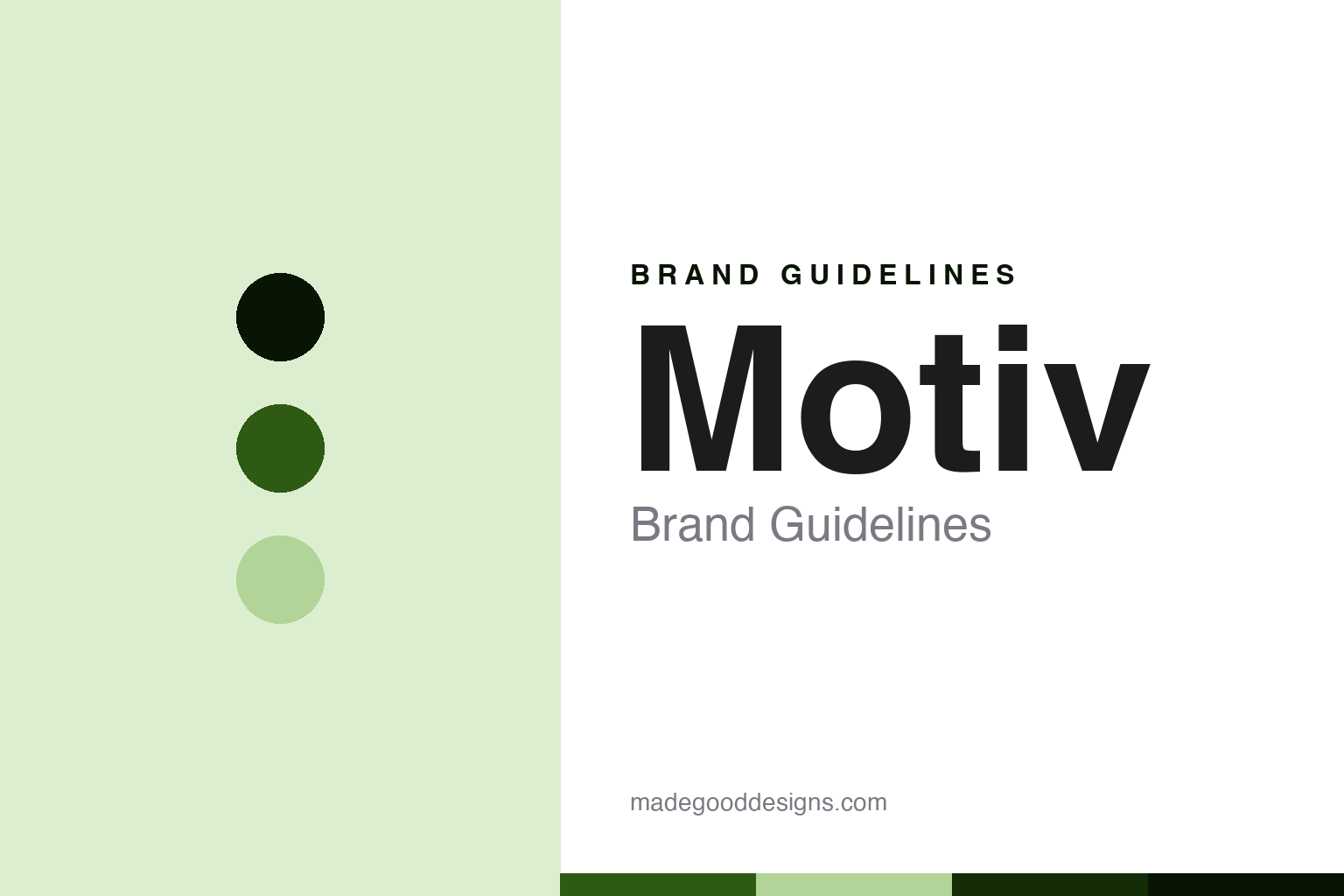
Motiv Brand Guidelines
The supplier that put its name on the ball.
Aa
Two constants: a Motiv-moss palette and a condensed-sans register. Abstract homage — not a Motiv product or mark; no ball, core, monogram or logo is reproduced.
The supplier that put its name on the ball
Most brands in this trade are a name applied to someone else’s pour. Motiv is the inverse: it was the someone else first.
Read Motiv’s own account of itself and the unusual thing is what it leaves out. “From the beginning of this revolution,” its about page says, “we manufactured high performance cores for one of the industry leaders.” It describes “the production of millions of bowling ball cores.” Then: “In 2006, our customer for these high performance cores decided to move bowling ball production outside the United States. This decision forced us to utilize our skill and knowledge in a different capacity.”
The customer is not named on that page. Two independent sources name it as Brunswick, and the company’s president has described the moment in his own words to a trade publication — “when our primary customer for bowling products left for Mexico in 2006.” Brunswick moved ball production to Reynosa and closed its Muskegon plant across 2005 and 2006; the dates in the published accounts differ by a year, so the honest version is that span rather than a single date.
What makes this worth telling is the position it describes. For roughly fifteen years a Michigan firm called Wilbur Products made the weight blocks that went inside balls sold under another company’s name. The cores were its work and the brand on the outside was not. When the customer offshored, the supplier had two options: follow the work out of the country, or stop being invisible. It chose the second, and the company that had been making the inside of the ball started making the outside too.
The legal entity is still Wilbur Products, trading as Motiv Bowling; the president is W. Scott Wilbur, and the business is eponymous and privately held. No acquisition, investor or private-equity involvement appears in any source we reached — though we should be precise about the limits of that: the Michigan corporate register could not be queried during this research, so independence here rests on named secondary reporting rather than on a filed record. Its own warranty refers to “any of its parent, subsidiary, and affiliate entities,” which confirms a group structure sits above the trading name.
It is a small company by the standards of the names around it: roughly forty-three to forty-five people, depending on which account you take. In February 2026 it announced it would acquire and renovate a 96,000-square-foot facility in Roosevelt Park for ball production and export logistics, with around ninety new jobs; the figure reported for the investment is about $8.9 million. That announcement is carried by trade press rather than by a primary state release, which we could not locate, so it is reported here on that basis.
Colour
Its origin claim is strong, specific and scoped — and the place it promises to appear is the one place it does not.
Motiv makes an origin claim and commits to it in plain verbs. Its claim page reads: “MOTIV® high performance bowling balls are proudly made in the United States of America. In fact, we’ve been manufacturing high performance bowling ball products at our factory in Muskegon, Michigan for over 30 years.” The page’s own metadata repeats it — “manufactured in the United States of America.”
Note which words do which work. Made in, manufacturing, manufactured in and American made all appear where origin is the subject. Engineered, designed and built appear only where the subject is how a ball behaves — “engineered for a specific purpose,” “designed to neutralize the imbalance created after drilling.” The two softest verbs in this whole series, assembled and crafted, appear nowhere on the site at all. After several rounds of watching brands reach for a weaker verb exactly when a factory is at stake, it is worth recording a company that does the opposite.
Two qualifications belong next to the praise. The first is scope: the claim is written as “MOTIV® high performance bowling balls” and “all high performance MOTIV balls.” The polyester spare balls are not inside that wording, and nothing on their pages asserts US origin. The second is geography. “Our factory in Muskegon, Michigan” does not match the company’s address. The headquarters and research operation are at Trimble Court in Spring Lake, in Ottawa County; the plant is in Roosevelt Park, in Muskegon County. Both sit in the Muskegon metropolitan area and neither is the city of Muskegon. That is marketing geography rather than a false statement, and it is worth flagging as the former.
Then there is the absence, which we state carefully because we tested it carefully. The claim page says the company puts “the Made In U.S.A. logo on each product page where appropriate.” Across all fifty-six of its current ball product pages, no Made-in-USA wording or logo reference appears in the HTML — while, in the same files and with the same scanner, “Weight Block” appears on all fifty-six, “Cover Stock” on all fifty-six and “Radius of Gyration” on fifty-five. The same search returns eight hits on the claim page itself, so the method demonstrably fires when the text is present, and the result was re-checked under a browser user agent in case the content was gated. A badge delivered purely as an image would carry no text to find, so the finding is bounded: no such wording or reference appears in the markup, though the company says it places the logo there.
Typography
A monogram built from four blades, and a stylesheet with exactly one letter-spacing value.
The mark is a monogram rather than a wordmark. An M is built from four separate blade-like strokes, each tapering to a point instead of terminating square, set on a pronounced oblique axis leaning right. Around and behind it runs a sweeping elliptical arc that enters at the upper left and exits right, with a second, shorter arc nested inside at the lower left. The two arcs read as a revolving path — for a bowling brand, the ball’s rotation; generically, speed. Five vector paths, no enclosing container, no baseline, no descender. In the header it is a single flat orange; in the footer the identical five paths carry vertical gradients that lighten toward the top.
The palette is narrow to the point of discipline: one orange carries the brand, supported by two near-blacks and a hotter red-orange, with neutral greys doing everything else. Orange on near-black is effectively the whole system.
Two typefaces divide the work — a tall, narrow, flat-sided condensed sans for display, used on headings and product titles, and a wide geometric sans for body and interface. But the detail that actually sets the voice is smaller than either. Headings are uppercase, enforced by twenty-three separate rules. And the letter-spacing is 0.05em — a value used ninety-five times, and the only letter-spacing value in the entire stylesheet. One tracking figure, applied everywhere, is a tighter piece of brand governance than most published guidelines manage.
The model names are the most systematic scheme in this round. A family noun takes a modifier, and the modifier can sit on either side of the family name, with its position distinguishing models within the line — Jackal Onyx and Venom Shock against Black Jackal, Mythic Jackal, Lethal Venom and Nuclear Forge. The families run a single semantic field throughout: predator and ordnance. Jackal, Raptor, Venom, Sniper, Tank, Trident, alongside Ambush, Carnage, Havoc, Mayhem, Covert and Recon. And tier is signalled by naming mode rather than stated — performance balls get a family and a modifier, while spare and entry balls are named by colourway instead, so a reader can place a ball in the range from its name alone.
Aa
A condensed-sans brand — tall, narrow, uppercase. (Specimen set in Oswald, a condensed-sans STAND-IN; NOT the Motiv logo, monogram or products.)
The in-house node
Motiv stands for the one name in this round with one factory, one brand and no sub-brands.
Motiv holds the round’s in-house node. In a trade where a shelf of rival names resolves to very few buildings, it is the control case — and the evidence for that is quantitative rather than rhetorical. In the governing body’s published list of approved balls, the group of brands owned by the largest consolidator accounts for roughly 3,400 approvals across seven names, and the Utah house for roughly 1,800 across three. Motiv has around 218, under one name, with no sub-brands at all. Those counts come from parsing the list directly and should be treated as approximate to within a couple of per cent.
Four things, taken together, make the in-house claim credible rather than merely asserted. It mass-produced components for someone else before it was a brand, which is not a history a badge-engineer can invent. It runs trademarked coverstock and core families with internal formulation codes, and at least one ball changes core between weights — a tooling detail that implies its own moulds. It makes a formulation-level commitment that is also a pointed accusation about its competitors, publishing a guarantee that it will never use the cost-reducing diluents that increase urethane volume. And it operates its own serial scheme encoding the month and year of manufacture. It also claims a patented printing process that integrates graphics into the coverstock itself; we report the patent numbers as the company’s claim, because every patent database we tried refused the request and we verified nothing.
Being the independent does not mean being unblemished, and the record should say so. On 15 March 2016 the governing body revoked approval of two Motiv balls, the Jackal and the Jackal Carnage, after field spot-checks found them exceeding the maximum differential radius of gyration. Motiv publicly acknowledged the measured averages — 0.0604 and 0.0616 against a 0.060 limit — but the decisive datum was the proportion of non-conforming balls, which exceeded the 0.6% threshold. The company was fined $16,000 and placed on a year’s probation, and its appeal was affirmed against it that August. The regulator’s director put the reasoning bluntly: “our decision here was driven by data, not dialogue.” Both models remain on the non-conforming list today. A single-plant manufacturer is not a better-behaved one by definition; it is simply one whose plant you can name.
There is a last detail that belongs to the whole round rather than to this entry, and Motiv states it more candidly than anyone. Its warranty excludes drilling fees and “parts incorporated into the ball such as slugs, grips, interchangeable inserts,” and then goes further: approval, certification, compliance and “competition eligibility or legality are not guaranteed or warrantied after drilling.” The maker disclaims the finished object’s legality once a third party has finished it. A bowling ball leaves its factory undrilled, and the last manufacturing operation is performed by a retailer — which is why the company publishes the exact grit sequences needed to recreate its own factory surface. A maker that tells you how to reproduce its box finish is not shipping a sealed product.
Explore & save
Keep Motiv’s identity on hand — save it to a board in the Made Good inspiration library.
Motiv identity set
Pin the Motiv-moss palette and the condensed-sans register to your own board.