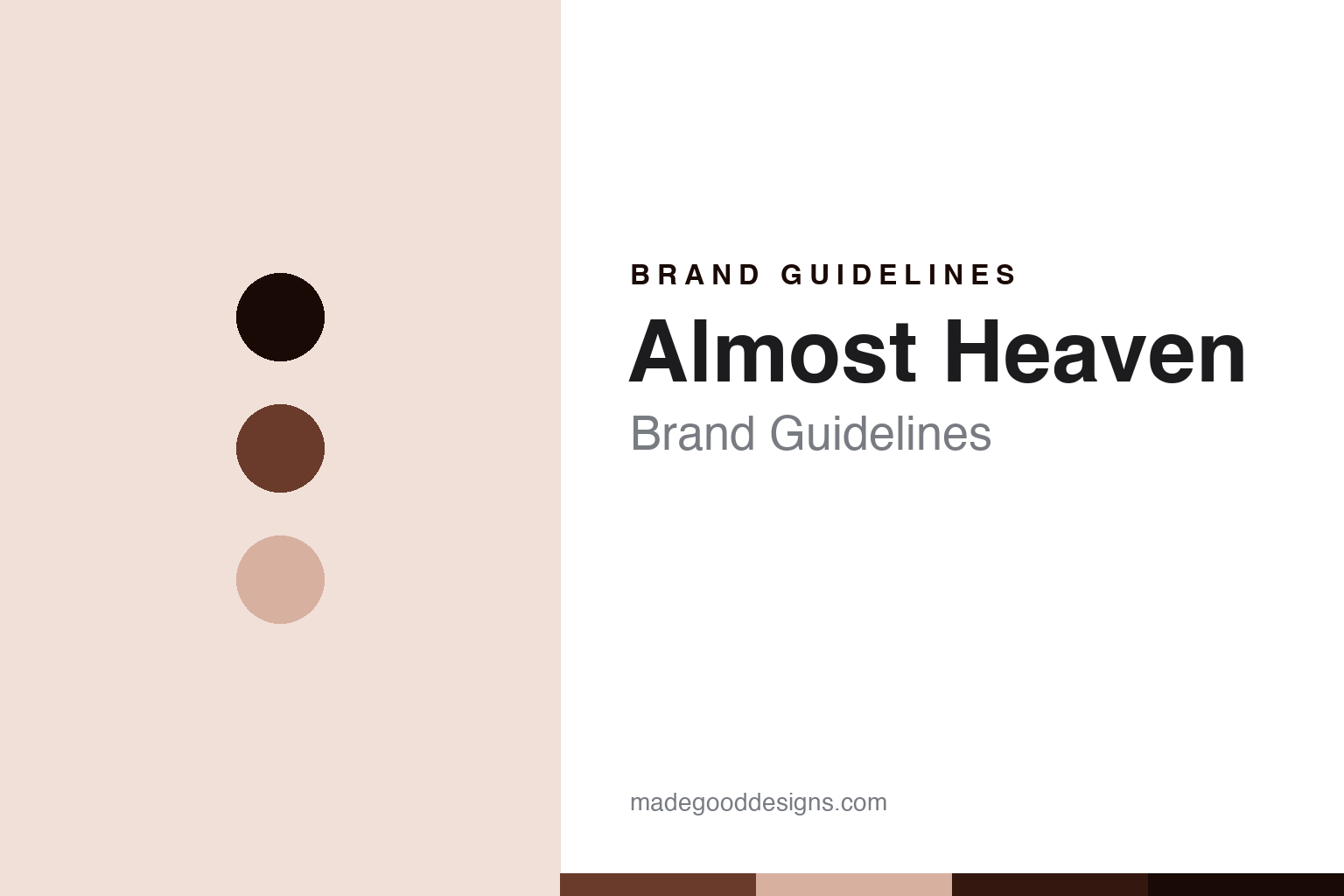
Almost Heaven Brand Guidelines
One manual says Europe.
Aa
Two constants: an Almost-Heaven-cedar palette and a cooperage-sans register. Abstract homage — not an Almost Heaven product or mark; no barrel, cabin, heater, monogram or logo is reproduced.
One manual says Europe
The homepage says proudly manufactured in the USA. One of the company’s own cabin manuals says that sauna was manufactured in Europe — and gives its Finnish name.
Almost Heaven closes the round with the plainest origin catch in it, and the company published it itself. Its homepage says the saunas are proudly manufactured in the USA and its about page offers superior American-made wellness solutions. But the installation manual for one of its cabin models, hosted on its own site, opens by telling the owner that this sauna — and it gives the model’s Finnish name in parentheses — was manufactured in Europe, with a parts list headed by that Finnish name. Of a hundred and thirty manuals on that download page, it is the only one that says so; the sister cabin and the whole newer collection are Nordic spruce and linden rather than the cedar the brand is known for. Its answer to a round about who makes and who brands the product is a blanket claim with one honest exception buried in the paperwork: one manual says Europe.
Its identity is one manual says Europe. The 1977 founding, two West Virginia plants and a Finnish parent are the story here. The exception. One manual says Europe.
(Honest notes, so the founding, the ownership, the making and one absence are framed accurately. On founding: the brand dates itself to 1977; its parent’s regulated stock-exchange release says the company was established in 1978, and both are given. The founder is not named anywhere — not on any current page, not in any archived page, not in the parent’s filings — so we name nobody, and the earliest corporate traces are two predecessor trading names. On ownership, a chain worth following: a Michigan pool-and-spa group bought it in 1999; a member of that group’s founding family bought it out personally in 2007 and ran it for eleven years; and the Finnish listed manufacturer acquired the business and assets in December 2018 for about four million euros, against a prior year of eight and a half million dollars of revenue and a small operating loss. The closing and the consolidation fall either side of new year, which is why the parent says 2018 and the brand says 2019 — both are right. On the making: the cabins are built at two plants in one West Virginia county, and the heater is Finnish and named as such on the product pages. And one detail turns the acquisition into a bill of materials: before 2018 the archived heaters page offered heaters from the rival Swedish group and another brand entirely. Its marks are IP we describe but do not reproduce; there is no official brand hex.)
Colour
Almost Heaven lives in an Almost Heaven cedar. Click a swatch to copy the hex.
Almost Heaven’s identity is American, place-named and endorsed — an Almost Heaven cedar, an ink, a pale stave, a deep russet, and a paper. The palette leans Almost Heaven cedar and deep russet: a cooperage register that stands in for staves and hoops rather than a loud logo colour. It signals that one manual says Europe — American, place-named and endorsed. The honest caveat: the brand offers finishes rather than a house colour, and its mark runs on a black band and fine serif hairlines, which we describe rather than restate.
The lesson is the parent can be endorsed inside the lockup, and here it is. The mark is a monogram of two overlapping peaked strokes that read as mountains or a doubled initial, the name beneath in wide-letterspaced high-contrast serif capitals with fine hairlines, the word saunas smaller below that — and then a solid black band carrying the parent’s wordmark in bold italic sans. The endorsement is not a line of small print at the foot of the page; it is a component of the logo, in its own bar, and the company’s own messaging terms give the legal name as the brand followed by the words by the parent. Read against the naming system, the effect is a brand doing two jobs at once. The barrels and rooms are named almost entirely for West Virginia towns and state parks — twenty-two of them — which is about as locally rooted as product naming gets, and one of those towns is where the second factory opened in 2021. The newer line, by contrast, takes the parent’s name and nature words, and one of its product addresses still carries the old collection name while the page title carries the new one: a rename caught mid-flight. Because a strong hue can fail as small text, keep type dark and let the colour live in the accents, palette and band. The takeaways: give both founding years; name no founder; qualify the made-in-the-USA claim; and never write registered trademark, because no register could be reached.
Typography
The register is a cooperage sans — American, plain, place-named.
Almost Heaven’s identity carries an American, cooperage spirit — staves, hoops and a barrel rolled out of a mountain county. A cooperage sans captures the mood: plain, sturdy and unfussy, the register of a kit list rather than a luxury brochure. Set in an Almost-Heaven-cedar palette, the cooperage sans feels assembled rather than styled — exactly the personality the record supports. It behaves like a stave rather than a loud logo, mirroring a hoop line and a grain edge. (Almost Heaven’s real products, its peaked monogram, the endorsement band, its place-name model names and the name itself are things we describe but do not reproduce, and the exact typeface is not ours to use; its own wordmark is a high-contrast serif and our stand-in is a sans, so nothing here should be mistaken for its type.) Because it is not ours to use, the honest description is “a cooperage-sans brand,” shown here in a stand-in. The type behaves like the brand: American, plain and place-named.
Aa
A cooperage-sans brand — plain and sturdy. (Specimen set in Manrope, a cooperage-sans STAND-IN; NOT the Almost Heaven logo, monogram or products.)
The qualified-origin node
Almost Heaven stands for one manual saying Europe.
Almost Heaven closes the round as its second qualified-origin node, and the counterpart to the Estonian brand earlier in it. An Almost-Heaven-cedar palette, a cooperage sans and a 1977 founding make one thing — one manual says Europe — the whole identity: American, place-named and endorsed. The founding is the frame, two West Virginia plants are the substance, and one paragraph in one manual is the signature. The point is a genuinely American manufacturer whose blanket claim overreaches by exactly the width of the products its Finnish parent supplies.
Put to work, the identity is the claim qualified and the chain followed. A brand in this spirit would give 1977 and its parent’s 1978, name no founder because none is named anywhere, set out the three ownerships with their dates, say that the cabins are made in West Virginia and that the heater is Finnish and named on the page, and scope the American claim so it does not cover the cabin lines whose own manual and whose timber species say otherwise. A reader in this spirit would keep the facts right: Almost Heaven builds barrel and cabin saunas at two plants in Greenbrier County, fits Finnish heaters it does not make, has been owned by the Finnish manufacturer since the end of 2018, and names its products after the towns around it. Almost Heaven closes the round, after Klafs. The honest editorial moves are to give both years, to name nobody, to scope the badge, and to attribute every health claim.
For designers and brand-builders, Almost Heaven closes the qualified-origin node: the acquisition shows up in the bill of materials before it shows up in the branding. The lessons: a round can be closed by a firm whose own installation manual contradicts its own homepage, because a hundred and twenty-nine manuals say nothing about origin and the hundred-and-thirtieth says Europe and supplies the model’s Finnish name; an ownership change is made visible through the parts, since the archived heaters page from before the takeover offered heaters branded by the rival Swedish group, and every heater in the catalogue today is the new parent’s — a supplier swap that is more informative than any press release; a parent is endorsed inside the lockup rather than in the footer, in its own black band, with the legal name in the messaging terms reading brand-by-parent; a naming system is rooted in one county, twenty-two towns and parks deep, with the second factory sharing a model’s name; and a claim is scoped rather than repeated, because proudly manufactured in the USA is true of the cedar barrels rolled out of Renick and Lewisburg and not true of the spruce-and-linden cabins the manual places in Europe. Then the round’s two halves close together, and this is where the category hook finally lands. The rating plate reproduced in the heater manual on this company’s own website carries the Finnish manufacturer, a testing-house file number and three standard numbers: an American dry-bath heater standard, a Canadian adoption of the international sauna-heater standard, and a listing mark. That heater has had a standard of its own since June 1988. The room around it did not get a European construction standard until the twenty-eighth of February 2026 — and that one covers public facilities only and expressly excludes electrical matters. Across all hundred and thirty manuals, not one claims any listing for the cedar barrel itself; the only certification attached to a cabin anywhere in this round is a forest certification, which is about the tree and not the room. So the product is certified to the clause and its enclosure very largely is not. Two cautions close it. No trademark register could be reached at all, so the name is described as presented with a registered symbol since at least 2003 and never as a registered mark. And its health page is headed with the language of studies while naming none, its blog asserts that heavy-metal detoxification has been proven without a citation, and its own page carries a disclaimer making no claims for individual users — so every one of those is attributed here and none repeated, detox least of all. The hook is that exception: Almost Heaven is one manual says Europe. Read that way, Almost Heaven is less a claim than a kit with an honest page in it: American, plain, place-named. The lesson for a brand is that the truest sentence you publish is usually the one nobody was supposed to read. Almost Heaven made the-exception-in-the-manual the identity — proof that a round can close on a single paragraph.
Explore & save
Keep Almost Heaven’s identity on hand — save it to a board in the Made Good inspiration library.
Almost Heaven identity set
Pin the Almost-Heaven-cedar palette and the cooperage-sans register to your own board.