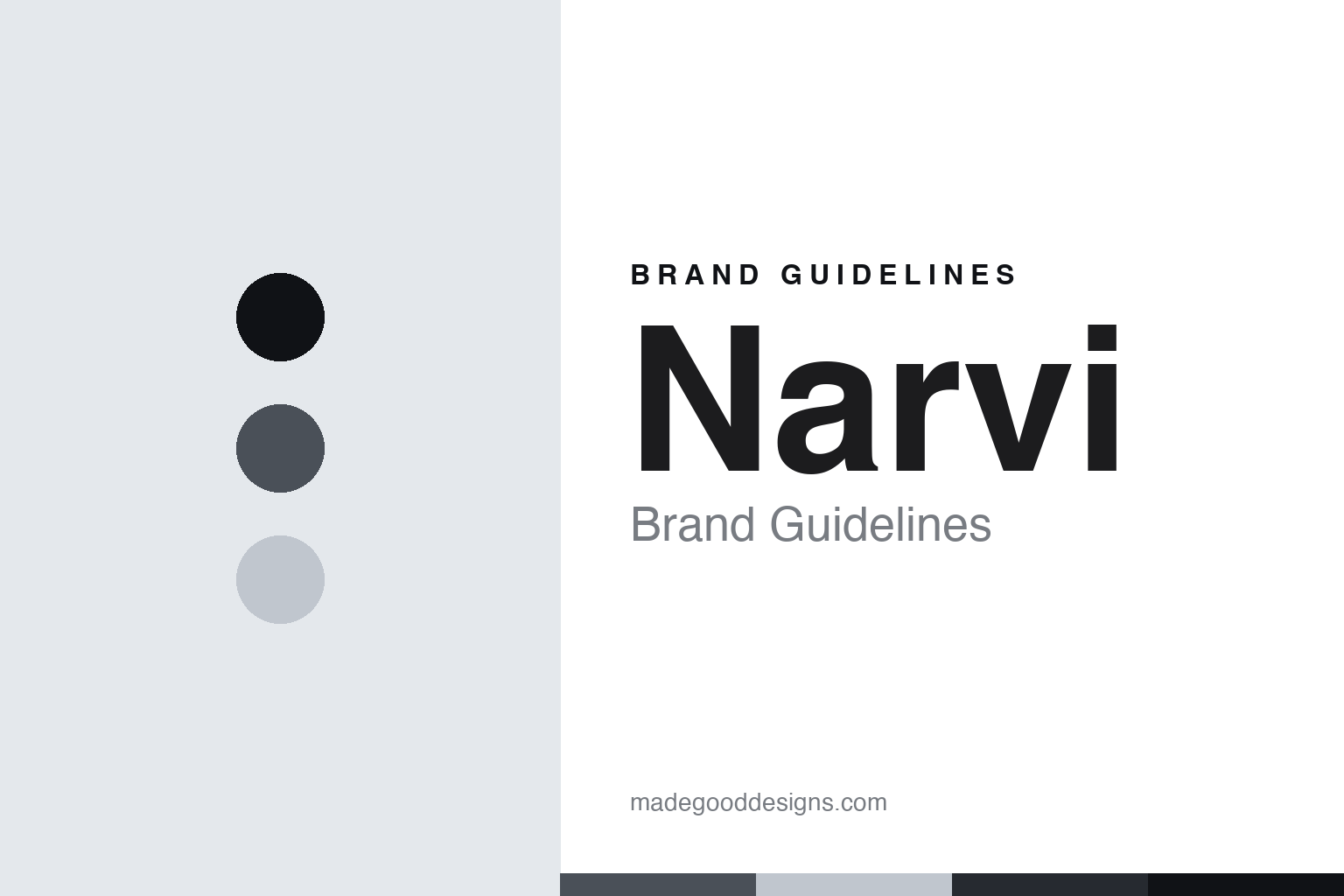
Narvi Brand Guidelines
The maker that claims nothing.
Aa
Two constants: a Narvi-soapstone palette and a declaration-sans register. Abstract homage — not a Narvi product or mark; no heater, stove, stone basket or logo is reproduced.
The maker that claims nothing
Narvi publishes 23 Declarations of Performance naming itself as manufacturer — and, across 44 pages in four languages, asserts not one health claim.
Narvi is the round’s evidence node, and it earns that place twice. On manufacture, it publishes twenty-three Declarations of Performance, product by product, each naming the company itself as manufacturer of record, each citing an assessment system, a notified body with its identifying number, a harmonised standard, and a numbered test report with measured carbon-monoxide and efficiency figures — one of them signed in the village, on a given date, by a named design director. On health, in a category saturated with claims, it makes none: a keyword sweep of all forty-four of its captured pages in four languages found no medical or physiological assertion anywhere, and the word detox at zero occurrences. Its answer to a round about who makes and who brands the product is a paper trail rather than an adjective: the maker that claims nothing.
Its identity is the maker that claims nothing. The 1937 founding, the Lapinkylä works and a folder of certificates are the story here. The declaration. The maker that claims nothing.
(Honest notes, so the founding, the ownership, the making and one correction are framed accurately. On founding: the business dates to 1937 and three brothers who began by making weighing scales in a village metal workshop east of Rauma, and the register corroborates the surname independently because the old company carried their name as a registered auxiliary trade name. The firm took the name of the lake next door in 1955, when it sold its first stove. But there are three entities in this story and only one business: an original company registered in 1986 that ceased in 2014, and the company trading today, which was registered as a vehicle in 2007 under a different name and adopted this one on the very day the old company ceased. On ownership, a correction to the obvious assumption: this is not a family firm and must not be called one. A Finnish investment house took the business over in 2009, its funds have since been wound up, and the 2026 shareholding sits behind a paid register extract — so the right phrase is that ownership is not disclosed in freely available sources, which is different from secret. On the making: the Finnish homepage says the heaters are made by hand in the village, from this country’s stone and hand-formed metal, and the per-product pages repeat it for both the wood-burning and the electric ranges. It sells no cabins at all. And one claim needs its own language checked, because the superlative it uses in English is narrowed in Swedish and absent from the Finnish. Its marks are IP we describe but do not reproduce; there is no official brand hex.)
Colour
Narvi lives in a Narvi soapstone. Click a swatch to copy the hex.
Narvi’s identity is Finnish, evidential and plain — a Narvi soapstone, an ink, a pale ash, a deep slate, and a paper. The palette leans Narvi soapstone and deep slate: a mineral register that stands in for stone mass and formed steel rather than a loud logo colour. It signals the maker that claims nothing — Finnish, evidential and plain. The honest caveat: the brand’s own 2026 palette runs warm off-whites, stone greys, a muted sage and a deep teal against a near-black charcoal, and its wordmark is a single flat ink in that charcoal; we describe that rather than restating it, and these values are an unofficial interpretation.
The lesson is a superlative hedged in one language and not another is the most legible thing a brand does. This company calls one stove the cleanest burning in the world on its English and German pages. The Swedish page narrows it to the world’s cleanest wood-fired stove. The Finnish page makes no such claim at all. Its own declarations do show that stove measuring materially lower on carbon monoxide than the rest of its range — which supports a claim about its own range, not a world record — so the Swedish formulation is the one to prefer and the divergence is worth naming rather than smoothing. This series has now seen the same pattern six times in three rounds, in a maker’s origin wording, in a fencing house’s made-in claim, and here in a performance superlative: the hedge exists in one language and vanishes in another. Set against that, the restraint elsewhere is striking. The naming runs on Finnish nature and place words alongside inherited alphanumerics, with sizes appended as sauna volume; the wordmark is pure letterform with no pictorial symbol; and the company publishes downloadable design files in four formats per product, which is a specifier-facing courtesy almost nobody in this trade offers. Because a strong hue can fail as small text, keep type dark and let the colour live in the accents, palette and band. The takeaways: never write family-owned; separate 1937 from 1986 and 2007; prefer the Swedish superlative; and report the absence of health claims, because it is the finding.
Typography
The register is a declaration sans — Finnish, documentary, exact.
Narvi’s identity carries a Finnish, documentary spirit — a works that answers questions with certificates. A declaration sans captures the mood: plain, technical and unpersuasive, the register of a performance declaration rather than a brochure. Set in a Narvi-soapstone palette, the declaration sans feels filed rather than styled — exactly the personality the record supports. It behaves like a stacked stone basket rather than a loud logo, mirroring a flue line and a formed edge. (Narvi’s real products, its wordmark, its model and engraving names and the name itself are things we describe but do not reproduce, and the exact typeface is not ours to use.) Because it is not ours to use, the honest description is “a declaration-sans brand,” shown here in a stand-in. The type behaves like the brand: Finnish, documentary and exact.
Aa
A declaration-sans brand — plain and technical. (Specimen set in Manrope, a declaration-sans STAND-IN; NOT the Narvi logo or products.)
The evidence node
Narvi stands for the maker that claims nothing.
Narvi holds the round’s evidence node. A Narvi-soapstone palette, a declaration sans and a 1937 founding make one thing — the maker that claims nothing — the whole identity: Finnish, evidential and plain. The founding is the frame, the Lapinkylä works is the substance, and a folder of numbered certificates is the signature. The point is a company that substantiates what it makes and declines to assert what it cannot, in a category where almost everyone does the reverse.
Put to work, the identity is the paperwork foregrounded and the adjectives left out. A brand in this spirit would date the business to 1937 and credit the three brothers by surname, keep the 1986 and 2007 entities separate from the business, describe its ownership as not disclosed in free sources rather than family-owned, quote its performance declarations with the notified body and report numbers attached, prefer the narrower Swedish version of its own superlative, and say plainly that it sells no cabins. A reader in this spirit would keep the facts right: Narvi turns and forms heaters, stoves, flues and cauldrons in one Finnish village, publishes certificates in its own name, exports through builders’ merchants and distributors, and makes no health claim. Narvi follows Helo, before Kastor. The honest editorial moves are to split the entities, to correct the ownership, to prefer the Swedish wording, and to report the silence.
For designers and brand-builders, Narvi holds the evidence node: the strongest thing a maker can publish is a document with a number on it. The lessons: a category can contain a firm whose brand asset is a certificate folder, since a performance declaration naming the company as manufacturer, citing a notified body and a numbered test report, settles the question this entire round is about in a way no amount of copy can; a founding is separated cleanly into a business and two successive legal vehicles, with the current one adopting the name on the same day the previous company ceased — a detail that looks like trivia and is in fact how the continuity was engineered; an ownership claim is corrected rather than inherited, because a private-equity takeover in 2009 ended whatever family character the firm had, and the honest present-tense description is undisclosed in free sources; a superlative is read across all four of its languages, and the English and German versions turn out to claim more than the Swedish while the Finnish claims nothing — the same hedge-in-one-language pattern this series has now recorded six times; and a silence is reported as a finding, because across forty-four pages in four languages this company asserts no health benefit at all, and in a wellness category that is the rarest thing in the file. Three cautions close it. Its claim to be the only large-scale maker with production and development wholly in Finland sits on a stale English page and is better replaced by a trade publication’s dated formulation that it is the country’s second largest and the largest of those concentrated there. A fire destroyed roughly half its plant in 2020, and the replacement premises came into use in 2021, which belongs in any account of its capacity. And the mesh-cased heater is not its invention: another Finnish maker was first, sued this company and two others over registered design rights in 2008, and the court dismissed the claims in 2009 — so the sequence is sued and dismissed, never infringement. The hook is that restraint: Narvi is the maker that claims nothing. Read that way, Narvi is less a brand than a bench with its paperwork in order: Finnish, documentary, exact. The lesson for a brand is that in a category full of assertion, the firm that only states what it can evidence ends up the most credible voice in it. Narvi made the-published-declaration the identity — proof that restraint is a positioning.
Explore & save
Keep Narvi’s identity on hand — save it to a board in the Made Good inspiration library.
Narvi identity set
Pin the Narvi-soapstone palette and the declaration-sans register to your own board.