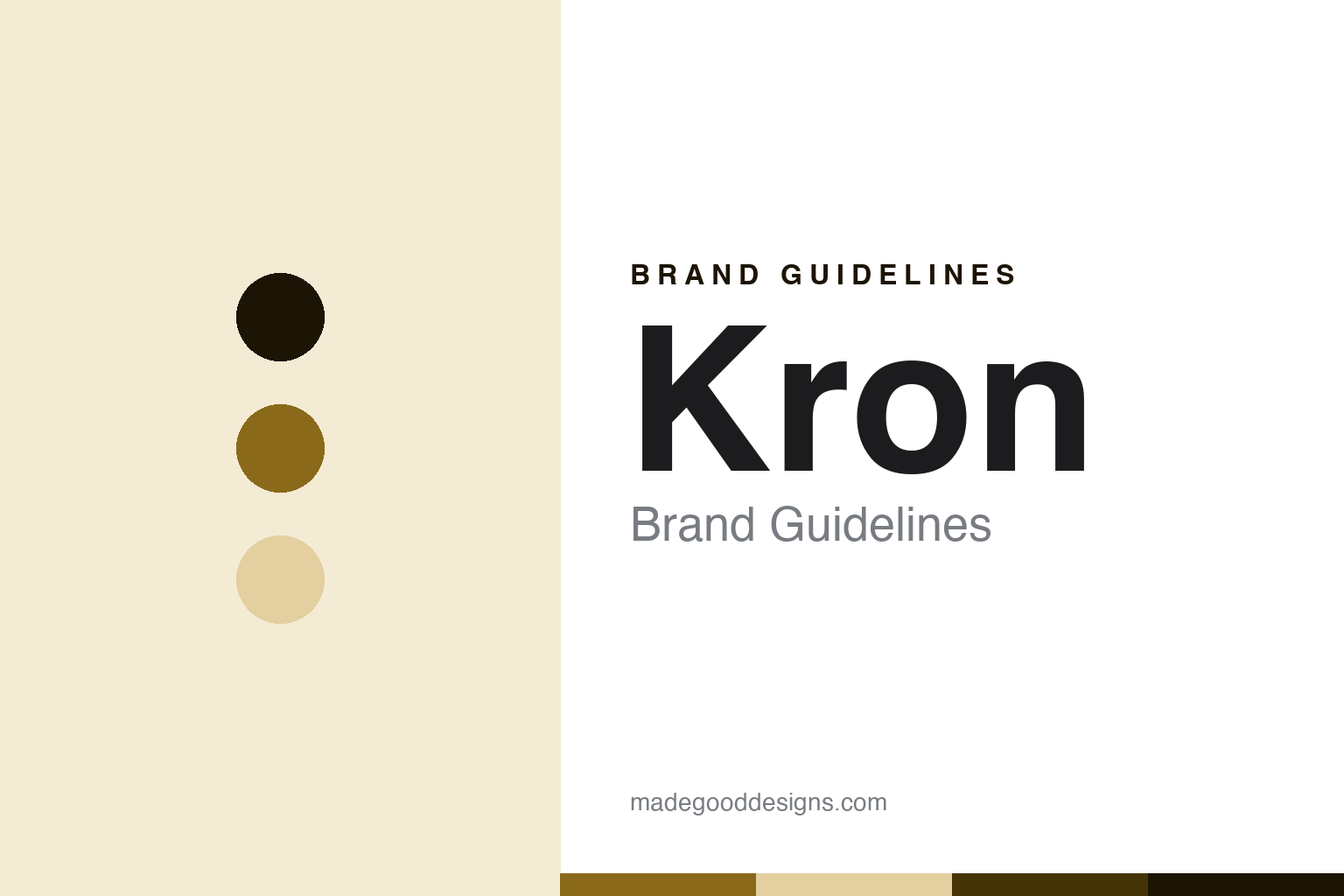
Kron Brand Guidelines
The name is the guarantee.
Aa
Two constants: a Kron-brass palette and a stamp-sans register. Abstract homage — not a Kron product or mark; no pipe, stamp, tartan or logo is reproduced.
The name is the guarantee
Kron hand-punched his own name and his state into every tenor top — and said explicitly that a maker’s name on the pipes is his personal guarantee of quality.
Kron closes the round with the only fully documented maker’s stamp in it, and with the clearest statement of why such a stamp exists. His own photograph of a tenor top shows two lines of hand-punched serif capitals on the collar between the bead and the combing: his initials and surname above, and below them the state, not the town. And he explained the reasoning himself — that his name going on last keeps him focused on quality, and that it is important for a pipe maker to have his own name stamped on the pipes, attesting to his personal belief and guarantee in them. Four other makers in this round sign their work four different ways. This is the one who says what the signature is for: the name is the guarantee.
Its identity is the name is the guarantee. The 1987 founding, the Hudson-side workshop and a punched two-line mark are the story here. The signature. The name is the guarantee.
(Honest notes, because this entry needs more of them than any other. On the name: there is no company called Kron Bagpipes. The firm is C. E. Kron and Company, and an earlier partnership traded under a joint name with the Edinburgh maker who co-founded it. On status, stated carefully and not resolved: the company’s website is a fossil. The page served today is byte-for-byte identical to an archived copy from October 2010, every file carries a 2019 timestamp from a bulk host migration rather than any edit, and its bagpipes page has read that there are none in stock in every capture since 2012. No dealer anywhere lists new stock. Against that, a dated first-person account from 2022 reports him still making pipes on a much smaller scale, from a different town. So this entry says neither closed nor trading, because neither is supported. On the founder: whether he is living could not be established, because every obituary database refused the connection — that is a blocked search, not an absence, and this article asserts nothing about it. On ownership: a newspaper profile called him sole proprietor, a New York corporation under a different name was filed in 1987 and is now inactive, and its dissolution date is unretrievable. On the making: he claimed everything on the pipe was made in his shop, and that claim needs the qualification his own site supplies — it kept two lists, one of products made by us and one of products not made by us, and the reeds, the cords and the bag were bought in. His marks are IP we describe but do not reproduce; there is no official brand hex, and no designed logo exists to describe.)
Colour
Kron lives in a Kron brass. Click a swatch to copy the hex.
Kron’s identity is American, proprietorial and unmodernised — a Kron brass, an ink, a pale brass, a deep bronze, and a paper. The palette leans Kron brass and deep bronze: a workshop register that stands in for a punch and a silver bench rather than a loud logo colour. It signals that the name is the guarantee — American, proprietorial and unmodernised. The honest caveat is unusually strict: not only is there no official brand hex, there is no designed logo or wordmark at all. The site’s identity is purely typographic, the name set in small caps in its navigation, and we describe that rather than inventing a mark that never existed.
The lesson is an identity can live entirely in the product and not at all in the graphics. This is a brand with no logotype, no monogram, no device and no colour system — and a stamp, a numbering convention and a naming convention that are all completely coherent. Sets were year-stamped; chanters carried serial numbers; models took the definite article and a noun, so the range read as a short list of named things rather than a parts ladder. The silver patterns had names. There was even a slogan, pairing his pipes with a reed brand he manufactured under licence and ending in a rocket-launch cue. Read against the Scottish firms earlier in this round, all of which have wordmarks and two of which put a claim or a country into the lockup, this is the opposite approach: nothing on the page, everything on the instrument. And the stated rationale is the strongest version of the argument this whole round has been circling — that a maker who buys in his parts cannot answer for them, and that the name punched into the wood is the mechanism by which he does. Because a strong hue can fail as small text, keep type dark and let the colour live in the accents, palette and band. The takeaways: name the company correctly; say neither closed nor trading; never assert a trademark or a patent; and never state anything about the founder’s health.
Typography
The register is a stamp sans — American, proprietorial, unmodernised.
Kron’s identity carries an American, proprietorial spirit — one man, a punch, a silver bench and a converted riverside factory. A stamp sans captures the mood: plain, struck and unglamorous, the register of hand-punched capitals rather than a designed logotype. Set in a Kron-brass palette, the stamp sans feels punched rather than styled — exactly the personality the record supports. It behaves like a struck letter rather than a loud logo, mirroring a punch mark and a combed groove. (Kron’s real products, his stamped mark, his model names, his silver-pattern names and the name itself are things we describe but do not reproduce; no designed logo or wordmark exists, and none is invented here.) Because it is not ours to use, the honest description is “a stamp-sans brand,” shown here in a stand-in. The type behaves like the brand: American, proprietorial and unmodernised.
Aa
A stamp-sans brand — struck and plain. (Specimen set in Manrope, a stamp-sans STAND-IN; NOT the Kron stamp, mark or products — and no designed Kron logo exists.)
The signature node
Kron stands for the name being the guarantee.
Kron closes the round as its signature node. A Kron-brass palette, a stamp sans and a 1987 founding make one thing — the name is the guarantee — the whole identity: American, proprietorial and unmodernised. The founding is the frame, the New York bench is the substance, and two lines of punched capitals are the signature. The point is a maker with no graphic identity whatsoever and a completely explicit theory of why the mark in the wood matters.
Put to work, the identity is the stamp taken at its word and the status left open. A brand in this spirit would use the company’s actual name, date the business to 1987 and the pipe-making to the year after, credit the Edinburgh co-founder who trained in a named Edinburgh shop and left in 1995, describe the ownership as a sole proprietorship behind an inactive corporation whose dissolution date cannot be retrieved, quote the everything-made-here claim as a claim and set it against the company’s own list of things it did not make, and say plainly that the website has been frozen since 2010 and the stock page empty since 2012 without declaring the business dead. A reader in this spirit would keep the facts right: Kron turned drones, stocks, chanters and silver in New York, bought in reeds, cords and bags, stamped his name and the year on what he made, and trained a successor who went on to win a world championship with his own pipes. Kron closes the round, after Dunbar. The honest editorial moves are to fix the name, to leave the status open, to attribute the making claim, and to assert nothing about the man.
For designers and brand-builders, Kron closes the signature node: the mark that matters may not be a mark you can design. The lessons: a round about who makes and who brands an instrument can be closed by a firm with no logo, no wordmark, no device and no palette, whose entire identity is a hand-punched name, a year, a serial number and a handful of definite-article model names; a claim is tested against its own author, because the assertion that everything on the pipe was made in this shop sits on a site that separately published a list headed other products not made by us, naming the cords and tassels outright; a competitive swipe is attributed rather than repeated, since his line that most if not all other makers buy in at least some of their parts is a self-serving claim that this round has now checked against six other makers and found broadly true of the reeds and bags but not of the turning; a trading status is left genuinely open, because a fossilised website and an empty stock page are evidence of neglect rather than closure, and a dated eyewitness report of continued small-scale work from another town is evidence against closure; and a person’s health is not speculated about at all, because every source that would answer it refused the request, and a blocked search is not a finding. Then the round’s two halves meet here. The instrument has no regulator: no body anywhere certifies, type-approves or dimensionally specifies a bagpipe, and the governing association that runs the world championships gives the drums a tonal specification while giving the pipe only a name and an exemption. The timber does. The current international appendices list the whole genus that African blackwood belongs to, and on a single page exempt finished musical instruments and their parts and accessories outright — an exemption that did not exist before late 2019, and which sits two annotations away from the wood of the violin bow, whose equivalent exemption covers non-commercial trade only. So the material is governed to the clause while the instrument is governed not at all, and across every page of all seven makers’ own websites in this round the word for that regime appears exactly nowhere. Kron put it better in 1995 than this article can: people in competitions keep trying to make it standard, trying to gentrify it, but it is too wild an instrument. The hook is that stamp: Kron is the name is the guarantee. Read that way, Kron is less a brand than a signature on a thing: American, proprietorial, unmodernised. The lesson for a brand is that if you answer for your work, say so where it cannot be edited. Kron made the-punched-name the identity — proof that a round can close on two lines of capitals.
Explore & save
Keep Kron’s identity on hand — save it to a board in the Made Good inspiration library.
Kron identity set
Pin the Kron-brass palette and the stamp-sans register to your own board.