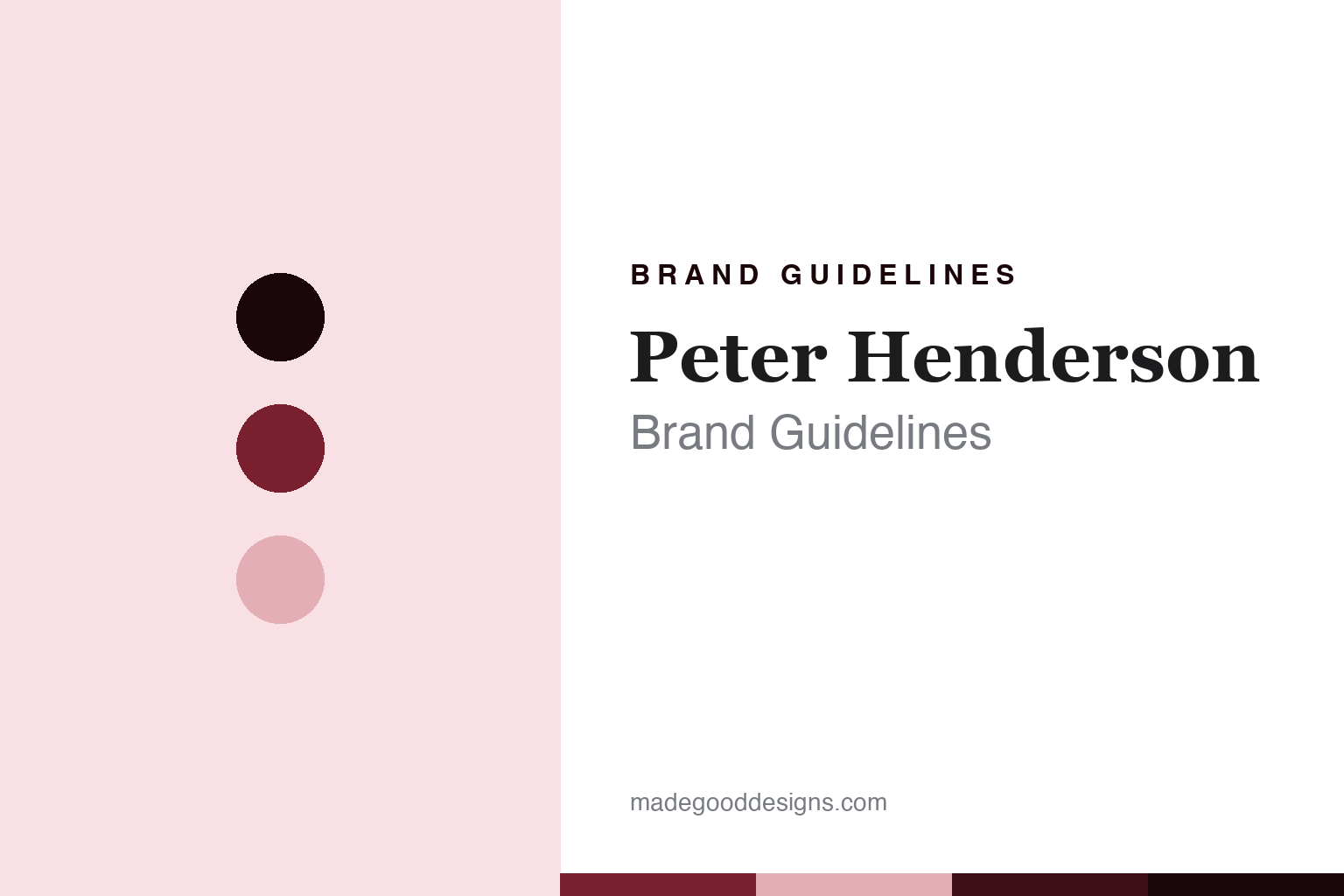
Peter Henderson Brand Guidelines
The founding date its owner hedges.
Aa
Two constants: a Henderson-claret palette and a heritage-serif register. Abstract homage — not a Peter Henderson product or mark; no pipe, hallmark, tartan or logo is reproduced.
The founding date its owner hedges
The shop says established 1868. The history page, on the same corporate estate, says the date “was claimed” and that business properly started in 1880.
Peter Henderson opens the round with the rarest thing in heritage branding: an owner arguing against its own founding date, in public, on its own website. The store page states the name was established in 1868 and calls the instruments the gold standard of the craft. The history page on the sister site says the 1868 date was claimed, suggests it probably marks the point at which a seventeen-year-old began learning to make pipes, and states that business properly started in 1880, when Henderson took over another maker’s workshop. A third account elsewhere in the trade press says 1868 is when he finished an apprenticeship under an Edinburgh firm. Three versions, one of them the owner’s own scepticism. Its answer to a round about who makes and who brands the instrument is a prior question about whether the date on the brand is even true: the founding date its owner hedges.
Its identity is the founding date its owner hedges. The 1880 workshop, the Glasgow bench and a name older than the company are the story here. The heritage. The founding date its owner hedges.
(Honest notes, so the founding, the ownership, the continuity and one correction are framed accurately. On founding: we give all three accounts and assert none, because the sources genuinely disagree and one of the dissenters is the rights holder. Peter Henderson himself is a documented individual — his own firm’s catalogue from the 1920s calls him the late Mr Peter Henderson and credits him with founding the firm in 1868 — but no birth or death date could be found anywhere, so we give none. What is solid is 1880, the workshop he took over, a collection of music published in 1888, the Renfrew Street shop, and a succession of managers running the business into the 1920s. On ownership: this is not a company. It is a brand belonging to a Glasgow manufacturer that merged with the Henderson firm in 1973 — its own word is merged, while the trade press says acquired, and we give both. That manufacturer is itself owned by a holding company, and more than half of that holding company’s shareholding has been undisclosed on the public register since December 2019. On continuity, a correction that matters because the brand invites the opposite reading: these pipes have not been made continuously since 1868. The trade press describes the current managing director re-introducing Peter Henderson instruments, so the line lapsed and was brought back, and the name itself was only registered as a trade mark in 2005 — thirty-two years after the merger. Nobody should write continuously made since 1868. Its marks are IP we describe but do not reproduce; there is no official brand hex.)
Colour
Peter Henderson lives in a Henderson claret. Click a swatch to copy the hex.
Peter Henderson’s identity is Scottish, premium and historic — a Henderson claret, an ink, a pale claret, a deep garnet, and a paper. The palette leans Henderson claret and deep garnet: a heritage register that stands in for a nineteenth-century Glasgow name rather than a loud logo colour. It signals the founding date its owner hedges — Scottish, premium and historic. The honest caveat: with no official brand hex these values are an unofficial interpretation, and the brand’s real visual grading is metallic rather than chromatic, which we describe rather than restate.
The lesson is two brands under one roof can be told apart by how they are marked. The owner runs this name as its premium tier and its own surname as the value and institutional tier, and the split is not merely a price list — it reaches the hardware. A set under the founder’s name carries the maker’s name and the year of manufacture cut into the bass stock. A set under this name carries a serial number instead, low on the bass drone stock above the bag collar, and in silver it carries a hallmark on every piece. One brand is marked with words, the other with a number. That is a deliberate and rather elegant piece of brand architecture: the working marque signs its work, while the heritage marque is catalogued, as though each instrument were an entry in a ledger rather than a product off a bench. The model codes follow the same logic, a two-letter prefix and an ascending number, with suffix letters for the decorated Heritage tier. And the grade ladder is metal, not colour, running from nickel through half-silver to hallmarked sterling. Because a strong hue can fail as small text, keep type dark and let the colour live in the accents, palette and band. The takeaways: give all three founding accounts; never write continuously since 1868; say the marks belong to the parent; and treat the historic catalogue’s market-share boasts as period advertising.
Typography
The register is a heritage serif — Scottish, premium, historic.
Peter Henderson’s identity carries a Scottish, historic spirit — a nineteenth-century name kept in production by a twentieth-century firm. A heritage serif captures the mood: settled, engraved and unhurried, the register of a hallmark and a catalogue entry rather than a price sticker. Set in a Henderson-claret palette, the heritage serif feels cut rather than styled — exactly the personality the record supports. It behaves like a turned bead rather than a loud logo, mirroring a drone line and a combed groove. (Peter Henderson’s real products, its hallmark, its model codes, its engraving-pattern names and the name itself are things we describe but do not reproduce, and the exact typeface is not ours to use.) Because it is not ours to use, the honest description is “a heritage-serif brand,” shown here in a stand-in. The type behaves like the brand: Scottish, premium and historic.
Aa
A heritage-serif brand — engraved and settled. (Specimen set in Fraunces, a heritage-serif STAND-IN; NOT the Peter Henderson logo, hallmark or products.)
The hedged-heritage node
Peter Henderson stands for the founding date its owner hedges.
Peter Henderson opens the round as its hedged-heritage node. A Henderson-claret palette, a heritage serif and a contested 1868 make one thing — the founding date its owner hedges — the whole identity: Scottish, premium and historic. The date is the frame, the 1880 workshop is the substance, and a serial number on the bass stock is the signature. The point is a heritage name whose current owner declines to oversell its own age, which is both unusual and, commercially, slightly against interest.
Put to work, the identity is the date given three ways and the continuity corrected. A brand in this spirit would present 1868 as claimed rather than established, alongside the owner’s own suggestion that it marks a boy beginning to learn and the trade press’s version that it marks an apprenticeship completed, and would date the real start of business to 1880 and the workshop he took over. It would name the founder without inventing his dates, describe itself as a brand within a manufacturer rather than a company, say that its trade marks are registered to a holding company rather than to the maker, and decline to claim unbroken production. A reader in this spirit would keep the facts right: Peter Henderson is a premium bagpipe line made in Glasgow by the firm it merged with in 1973, re-introduced by that firm’s present management, and sold alongside that firm’s own marque. Peter Henderson opens the round, before R.G. Hardie. The honest editorial moves are to hedge the date, to correct the continuity, to attribute the marks, and to leave the founder undated.
For designers and brand-builders, Peter Henderson opens the hedged-heritage node: a heritage date you are willing to qualify is worth more than one you are not. The lessons: a category can be opened by a name whose owner publicly softens the very date the name trades on, which costs it a little romance and buys it a great deal of credibility; a founding is presented as three competing accounts rather than one confident sentence, and the most sceptical of the three belongs to the rights holder; a founder is named but left undated, because his own firm’s 1920s catalogue calls him the late Mr Peter Henderson without giving a year, and no source located supplies one; a continuity claim is refused outright, since the line was re-introduced rather than continuously produced and the name was first registered as a trade mark only in 2005; and an ownership is described as it actually is, a brand inside a manufacturer inside a holding company, with more than half of the holding company’s shareholding undisclosed on the register since 2019. Three cautions close it. Its own historic catalogue claims that ninety-five per cent of professional pipers worldwide used its pipes, which is period advertising and belongs in quotation marks and nowhere near a factual sentence. Its championship associations run through a sponsored band, and the sponsor’s own page carries two different totals for that band’s world titles within a few lines of each other, so those numbers need dating or dropping and must never be read as a federation endorsing a maker. And the name is genuinely hard to search, because a register search returns sixteen unrelated Henderson marks and not one of them is the bagpipe brand, while the most prominent holder makes sliding-door gear and has done since 1929. The hook is that candour about age: Peter Henderson is the founding date its owner hedges. Read that way, Peter Henderson is less a firm than a name carefully kept honest by the people who own it: Scottish, premium, historic. The lesson for a brand is that heritage survives qualification better than it survives contradiction. Peter Henderson made the-qualified-date the identity — proof that a round can open on a hedge.
Explore & save
Keep Peter Henderson’s identity on hand — save it to a board in the Made Good inspiration library.
Peter Henderson identity set
Pin the Henderson-claret palette and the heritage-serif register to your own board.