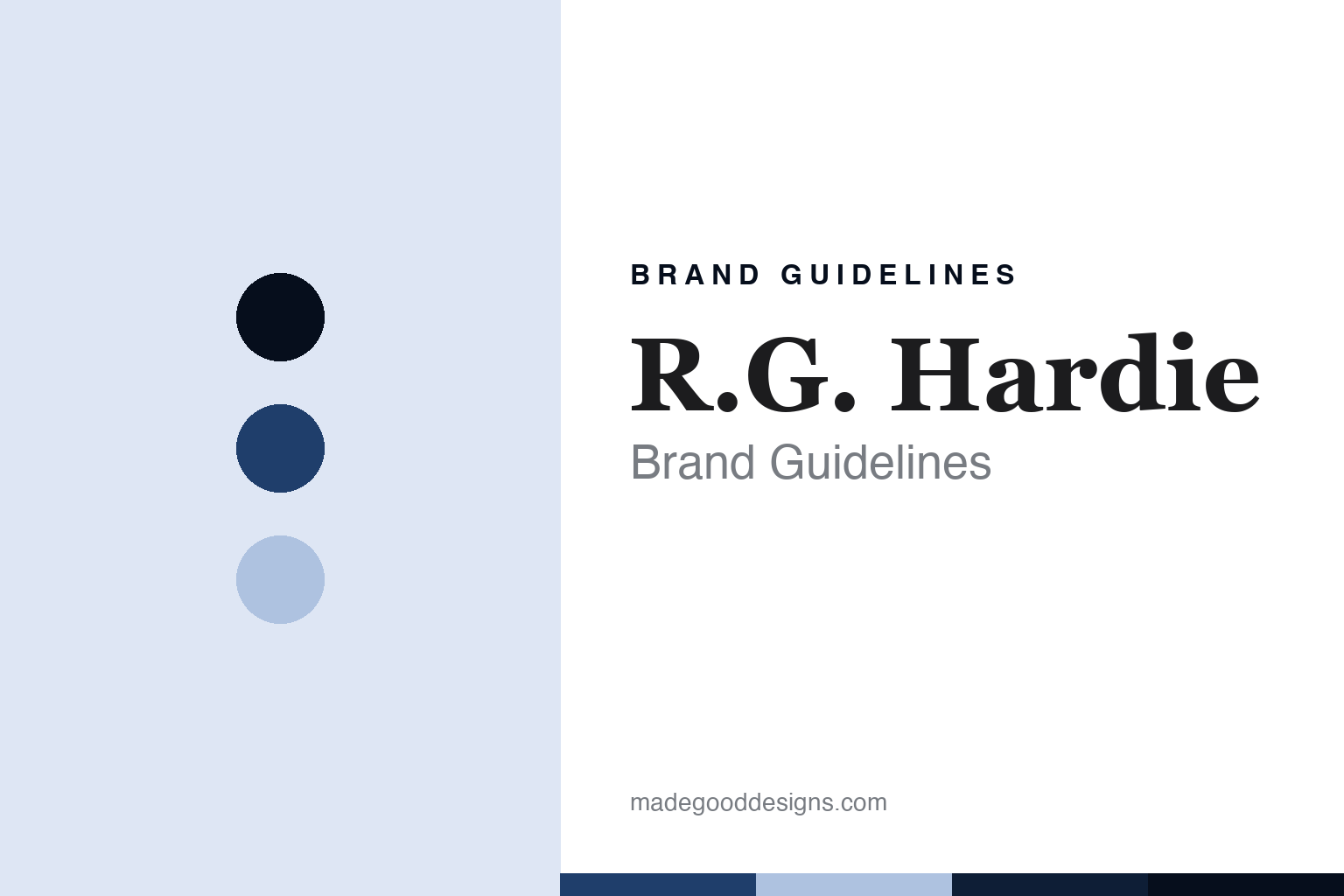
R.G. Hardie Brand Guidelines
Two firms fused at the bore.
Aa
Two constants: a Hardie-ink-blue palette and a workshop-serif register. Abstract homage — not an R.G. Hardie product or mark; no pipe, stamp, tartan or logo is reproduced.
Two firms fused at the bore
A 1973 merger is usually a line in a history page. Here it is measurable: the current range combines a 1924 Henderson set with the vintage Hardie drone bores.
R.G. Hardie follows the brand it merged with, and it is the round’s most literal demonstration of what a merger can mean. Most acquired heritage sits in the copy. This one sits in the geometry. The company states that its range is based on a 1924 vintage set of Peter Henderson bagpipes combined with the bass and tenor bottom joint bores from the vintage R.G. Hardie instrument — and since 2025 both marques ship a projecting mount profile it calls a hybrid inspired by vintage Hardie and Henderson styles. Two firms that merged in 1973 are now fused at the level of internal bore and mount profile. Its answer to a round about who makes and who brands the instrument is that here they are the same company twice: two firms fused at the bore.
Its identity is two firms fused at the bore. The 1950 garden shed, the Grovepark Street bench and a measurable hybrid are the story here. The workshop. Two firms fused at the bore.
(Honest notes, so the founding, the ownership, the making and one removed claim are framed accurately. On founding: 1950, in a garden shed at Bishopbriggs, by Robert Gavin Hardie with two named associates — and the founder is the most vivid figure in this round. He won a gold medal at Oban in 1947, was pipe-major of a band that took five consecutive world titles in the late 1960s, and had learnt pipe-making at two Glasgow firms. He died in 1990, when the business employed six people and made around a thousand sets a year. One detail is worth the whole biography: the pipes he played himself were, in his own description, bits and pieces gathered from his own workshop floor. On ownership: the present company dates only from 2003 and is three-quarters-plus owned by a holding company, which is in turn only partly accounted for — its sole recorded controller holds between a quarter and a half, and the larger holding that once sat alongside ceased in 2019 with no replacement filed. So more than half of the ultimate parent is undisclosed, and there is a striking silence to go with it: the family name that appears throughout the register appears nowhere at all across the company’s public pages, where the story is told entirely through its managing director. On the making: the clearest statement is the parent’s, which places bagpipe making at the Glasgow headquarters alongside leather, casting and engraving workshops, and says production is kept in-house. The brand’s own pages say Glasgow and our factory but never quite say the drones are turned here, so we attribute that to the parent. Bags, reeds, cords and covers are bought in, and its own guarantee says so by excluding them. On one removed claim: a sentence asserting a 1966 Royal Warrant was on the history page until mid-2021 and gone by that December. We report the deletion and the dates, and we do not republish the claim. Its marks are IP we describe but do not reproduce; there is no official brand hex.)
Colour
R.G. Hardie lives in a Hardie ink blue. Click a swatch to copy the hex.
R.G. Hardie’s identity is Scottish, institutional and technical — a Hardie ink blue, an ink, a pale slate, a deep navy, and a paper. The palette leans Hardie ink blue and deep navy: a band-uniform register that stands in for a Glasgow workshop rather than a loud logo colour. It signals two firms fused at the bore — Scottish, institutional and technical. The honest caveat: with no official brand hex these values are an unofficial interpretation, and the brand’s own grading is metallic rather than chromatic, which we describe and do not restate.
The lesson is how you sign the work is a brand decision, and running two marques lets you sign them differently. A set under this name carries the maker’s name and the year of manufacture cut into the bass stock. A set under the heritage name carries a serial number instead, and in silver a hallmark on every piece. The working marque signs; the heritage marque is catalogued. That one difference does more positioning work than either brand’s adjectives, and it maps exactly onto the two-tier split the company runs — this name for military and pipe-band and beginner buyers, the other for the premium tier. From 2025 the distinction softened slightly, because sets under this name began carrying serial numbers too, which is worth noting as drift rather than reversal. The rest of the system is consistent: prefix-plus-number model codes with suffix letters for mounts and decoration, named engraving patterns, and a grade ladder expressed in metal — nickel, then half-silver, then hallmarked sterling. Because a strong hue can fail as small text, keep type dark and let the colour live in the accents, palette and band. The takeaways: date the founding to 1950 and the company to 2003; say the marks belong to the parent; never republish the warrant; and never write patented or no patents exist, because the registers refused every query.
Typography
The register is a workshop serif — Scottish, institutional, technical.
R.G. Hardie’s identity carries a Scottish, technical spirit — a working Glasgow shop that turns, combs, beads and engraves, and publishes bore specifications. A workshop serif captures the mood: sober, engraved and unshowy, the register of a stamped bass stock rather than a headline. Set in a Hardie-ink-blue palette, the workshop serif feels cut rather than styled — exactly the personality the record supports. It behaves like a bore profile rather than a loud logo, mirroring a drone line and a turned bead. (R.G. Hardie’s real products, its gold wordmark, its stamped mark, its model codes and the name itself are things we describe but do not reproduce, and the exact typeface is not ours to use.) Because it is not ours to use, the honest description is “a workshop-serif brand,” shown here in a stand-in. The type behaves like the brand: Scottish, institutional and technical.
Aa
A workshop-serif brand — sober and engraved. (Specimen set in Cormorant Garamond, a workshop-serif STAND-IN; NOT the R.G. Hardie logo, stamp or products.)
The fused-lineage node
R.G. Hardie stands for two firms fused at the bore.
R.G. Hardie holds the round’s fused-lineage node. A Hardie-ink-blue palette, a workshop serif and a 1950 founding make one thing — two firms fused at the bore — the whole identity: Scottish, institutional and technical. The founding is the frame, the Glasgow workshop is the substance, and a published bore specification is the signature. The point is a merger made measurable, and a company that owns both halves of its own history and sells them as separate tiers.
Put to work, the identity is the lineage stated in dimensions. A brand in this spirit would date the founding to 1950 and the present company to 2003, name the founder and his two associates, describe the ownership as a holding company with more than half its shareholding undisclosed, place the making at Glasgow while noting that the clearest statement of it is the parent’s rather than the brand’s, say plainly that bags and reeds are bought in because its own guarantee excludes them, and report the removed warrant sentence as a dated deletion rather than a fact. A reader in this spirit would keep the facts right: R.G. Hardie turns bagpipes in Glasgow, sells two marques from one bench, supplies pipe bands and agencies other makers’ drums, and publishes the bore lineage of its own range. R.G. Hardie follows Peter Henderson, before McCallum. The honest editorial moves are to split the dates, to attribute the making, to disclose the bought-in parts, and to report the deletion without the claim.
For designers and brand-builders, R.G. Hardie holds the fused-lineage node: the most durable way to own acquired heritage is to build it into the product. The lessons: a category can include a firm whose 1973 merger is verifiable in the hardware, since its range is published as a 1924 Henderson exterior over its own vintage drone bores, and since 2025 both marques share a mount profile it describes as a hybrid of the two houses; a founding is dated to a garden shed in 1950 and kept separate from the 2003 incorporation of the present company, with a founder whose own playing set was assembled from offcuts swept off his workshop floor — a detail worth more than any craftsmanship paragraph; an ownership is reported as it stands on the register, three-quarters-plus held by a holding company of which more than half is undisclosed since 2019, and the absence is doubled by the fact that the controlling family’s name appears nowhere in the company’s public copy while the managing director is named eighteen times; a making claim is attributed to the party that actually makes it, because the sentence placing bagpipe making at the Glasgow headquarters is the parent’s and the brand’s own pages stop short of it; and a bought-in boundary is read out of the warranty, which excludes bags, drone reeds, chanter reeds, covers and cords — so the guarantee is the disclosure, and the bag fitted to its own practice pipes is another company’s product under its own name. Four cautions close it. The removed warrant claim must be reported only as former copy with its dates, because the obvious explanation fails on chronology and the underlying claim was never checked in either direction. The patent question is open rather than answered: every database refused the connection, so no patent may be asserted and equally no absence of patents. Its championship material runs through a band it has sponsored since 2006, and its own page carries two irreconcilable totals for that band within a few lines, so the honest version is the sponsor’s own limited claim that half the band’s pipers play its instruments. And the trade’s silence on timber is worth recording precisely, because it is a silence in one place only: across every page of this company’s three websites there is not one mention of the regulatory status of the wood its instruments are made from — yet its own managing director gave the trade press detailed comment when the permit regime arrived in 2017, and welcomed its removal for finished instruments in 2019. The company has discussed it at length. The brand has never mentioned it. The hook is that fusion: R.G. Hardie is two firms fused at the bore. Read that way, R.G. Hardie is less a brand than a lineage expressed in millimetres: Scottish, institutional, technical. The lesson for a brand is that heritage you can measure cannot be argued with. R.G. Hardie made the-fused-bore the identity — proof that a merger can become a specification.
Explore & save
Keep R.G. Hardie’s identity on hand — save it to a board in the Made Good inspiration library.
R.G. Hardie identity set
Pin the Hardie-ink-blue palette and the workshop-serif register to your own board.