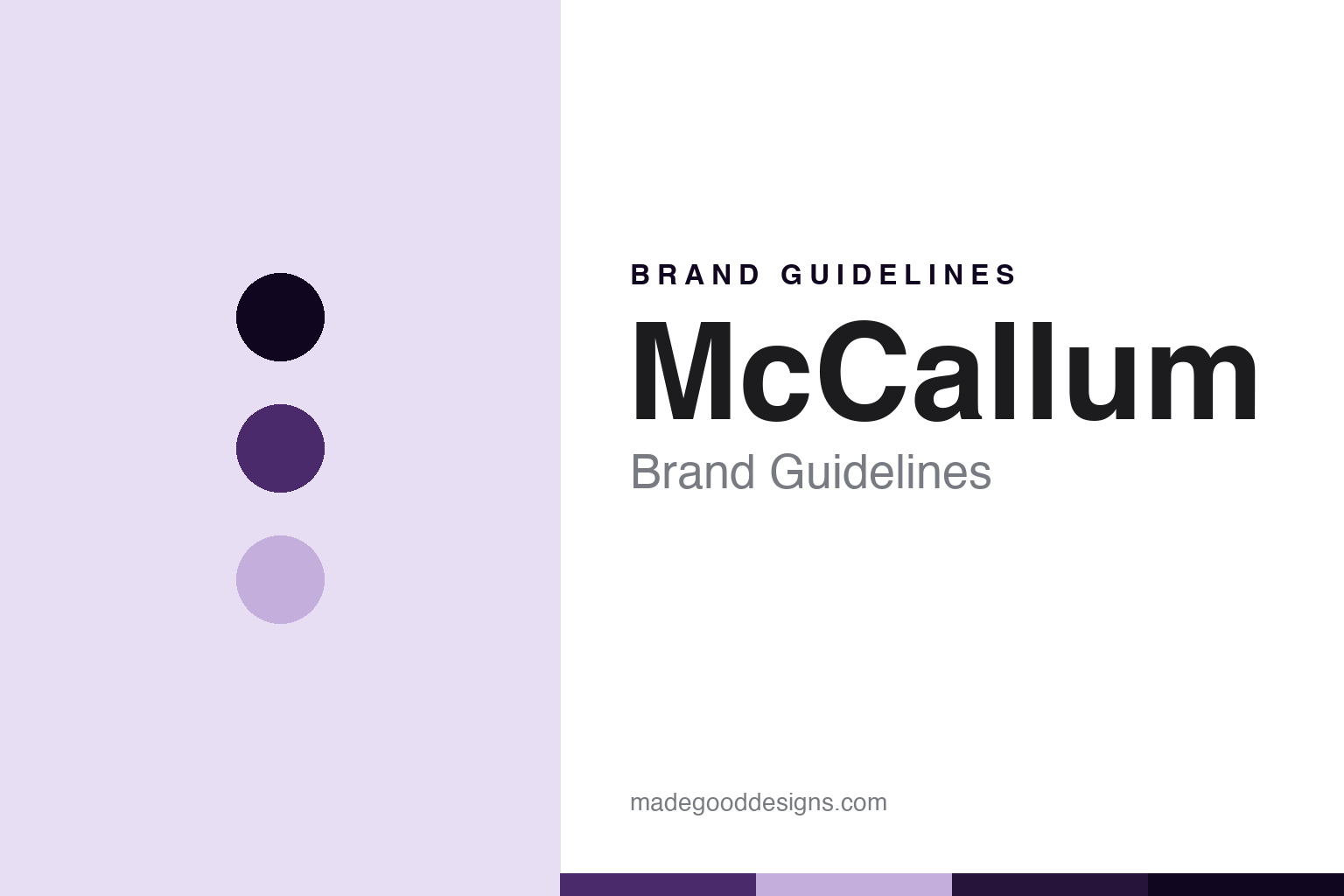
McCallum Brand Guidelines
The mark in the wood is a date.
Aa
Two constants: a McCallum-thistle palette and an engineering-sans register. Abstract homage — not a McCallum product or mark; no pipe, target device, tartan or logo is reproduced.
The mark in the wood is a date
Most makers stamp a name. McCallum strikes a manufacturing date inside the bass mid-joint pin, where nobody sees it — and makes a ten-year guarantee run from it.
McCallum is the round’s precision node, and its identity is settled by one line in its own guarantee: the warranty runs for ten years from the date of purchase or, alternatively, ten years from the date of manufacture stamped on the bass mid-joint pin. That is not a flourish. It is a traceable production date, struck inside a joint where no player will ever see it, and it is legally load-bearing. Set that against the rest of this round, where one maker cuts its name and the year into the bass stock and another gives every instrument a serial number, and the position is clear. Its answer to a round about who makes and who brands the instrument is a manufacturer’s answer: the mark in the wood is a date.
Its identity is the mark in the wood is a date. The 1998 founding, the Kilmarnock factory and a toolmaker’s training are the story here. The precision. The mark in the wood is a date.
(Honest notes, so the founding, the ownership, the making and one false claim are framed accurately. On founding: 1998, by two men who had known each other through piping and both played in the same Glasgow band — one a precision engineer, the other a supplier who had spent three years in Los Angeles and came home unable to get stock. The business began in a shed in a timber yard on the industrial estate it still occupies. The limited company came four years later in 2002, and the two dates should not be merged. One internal wrinkle we flag rather than smooth: the same page calls them both founders and then calls one of them the founder. On ownership, refreshingly: nothing is hidden. Two named people have each held between a quarter and a half of the shares since the register began recording it, neither holding has ever ceased, and there is no parent, no investor and no private equity anywhere in the filings. The bank charges are lending secured on its own units, which is not investment and must not be written as such. On the making, a claim that cannot stand: the site says the company buys no component parts from anywhere else. That sentence is unchanged since 2011 and its own catalogue, guarantee and product pages contradict it — bags, several reed brands, cases and moisture systems are bought in, the guarantee explicitly excludes pipe bags, and it is openly a dealer for two drum makers. What is genuinely in-house is the wood turning and the metal engraving. And a detail worth noticing: neither this company nor its site ever actually says made in Scotland. Its marks are IP we describe but do not reproduce; there is no official brand hex.)
Colour
McCallum lives in a McCallum thistle. Click a swatch to copy the hex.
McCallum’s identity is Scottish, engineered and systematic — a McCallum thistle, an ink, a pale thistle, a deep heather, and a paper. The palette leans McCallum thistle and deep heather: a workshop register that stands in for a Kilmarnock machine shop rather than a loud logo colour. It signals that the mark in the wood is a date — Scottish, engineered and systematic. The honest caveat: with no official brand hex these values are an unofficial interpretation. The company’s own mark is monochrome in a single deep blue, with a concentric-ring target device beside the wordmark, and we describe that rather than restating it as ours.
The lesson is a founder’s previous trade can be the whole brand. This company’s own pages explain that its managing director was a time-served toolmaker who programmed CNC milling and turning machinery for a Kilmarnock engineering firm that made engine parts for the aero industry, and that he applies the same tolerances to bagpipes. Everything downstream follows from that sentence: specifications typed into computer programs to guarantee a consistent finish, forty sets a week, two shifts starting at six in the morning, a ten-year no-quibble guarantee, and a model ladder that reads like a parts list — a two-letter timber code, an ascending number tracking metal content, and suffix letters for finish. Even the collaborations are coded rather than named, carrying the initials of the piper who specified them. This is a brand built on repeatability, and its identity is honest about that in a trade that usually sells the opposite. Which is also why the date stamp is the right mark: a workshop signs its work, but a manufacturer records when it was produced. Because a strong hue can fail as small text, keep type dark and let the colour live in the accents, palette and band. The takeaways: separate 1998 from 2002; drop the no-bought-in-parts claim; never quote the frozen headcount; and treat the trade-press profile as the advertising feature it is labelled.
Typography
The register is an engineering sans — Scottish, engineered, systematic.
McCallum’s identity carries a Scottish, engineering spirit — a factory that turns, bores and engraves to typed tolerances. An engineering sans captures the mood: plain, measured and unromantic, the register of a specification sheet rather than a heritage paragraph. Set in a McCallum-thistle palette, the engineering sans feels machined rather than styled — exactly the personality the record supports. It behaves like a concentric ring rather than a loud logo, mirroring a target device and a turned groove. (McCallum’s real products, its target mark, its model codes, its collaboration lines and the name itself are things we describe but do not reproduce, and the exact typeface is not ours to use; its own wordmark is a rounded hand-drawn humanist sans and our stand-in is not, so nothing here should be mistaken for its type.) Because it is not ours to use, the honest description is “an engineering-sans brand,” shown here in a stand-in. The type behaves like the brand: Scottish, engineered and systematic.
Aa
An engineering-sans brand — plain and measured. (Specimen set in Manrope, an engineering-sans STAND-IN; NOT the McCallum logo, target device or products.)
The precision node
McCallum stands for the mark in the wood being a date.
McCallum holds the round’s precision node. A McCallum-thistle palette, an engineering sans and a 1998 founding make one thing — the mark in the wood is a date — the whole identity: Scottish, engineered and systematic. The founding is the frame, the Kilmarnock factory is the substance, and a stamp inside a joint is the signature. The point is a maker that marks its instruments the way a manufacturer marks a production run, and that built a guarantee on top of the mark.
Put to work, the identity is the engineering claimed and the overclaim dropped. A brand in this spirit would date the business to 1998 and the company to 2002, credit both founders while noting its own page wavers between two and one, describe the ownership as fully disclosed and founder-held because that is exactly what the register shows, state that the bank charges are secured lending rather than investment, name what it turns and engraves itself and admit what it buys, and delete the sentence claiming it buys no components. A reader in this spirit would keep the facts right: McCallum turns blackwood and engraves metal in Kilmarnock, buys in bags, cases, moisture systems and some reeds, sells its own reed brand, deals other makers’ drums, and employs around thirty people. McCallum follows R.G. Hardie, before Naill. The honest editorial moves are to split the dates, to drop the claim, to disclose the bought-in parts, and to date every number.
For designers and brand-builders, McCallum holds the precision node: mark your work the way you actually make it. The lessons: a category can include a firm whose identity is settled by its guarantee rather than its history, because the ten-year warranty runs from a manufacturing date struck inside the bass mid-joint pin, which is the most manufacturer-like mark in this round; a founder’s prior career does the positioning, since a toolmaker who programmed machinery for aero-industry work brings tolerances rather than lore, and the company says so in its own words; a founding is split between the 1998 business and the 2002 company and the shed in a timber yard is worth naming, because a specific origin beats a vague one; an ownership is reported as disclosed, which after two entries in this round of holding companies and undisclosed shareholdings is worth stating plainly rather than passing over; and an overclaim is cut, because the line about buying no component parts is fifteen-year-old copy that its own catalogue, its own guarantee and its own smallpipes page each contradict. Four cautions close it. Every figure on its site — headcount, floor area, output — comes from a text block frozen since 2011, and the filed accounts give a different and current number, so nothing from that block should be quoted as present-tense fact. The most detailed recent trade-press profile is explicitly headed as an advertising feature, so its robots, its staff count and its reassurance about timber supply are the company’s promotional voice and not independent reporting. Its championship material belongs to bands and players rather than to the firm, one such claim in its own catalogue has no year attached at all, and none of it should read as a federation endorsing a maker. And a name it sells an instrument line under is held as a registered mark in the same class by an unrelated company, which is a fact worth knowing and emphatically not a legal characterisation. The hook is that stamp: McCallum is the mark in the wood is a date. Read that way, McCallum is less a heritage house than a precision shop that happens to make an ancient instrument: Scottish, engineered, systematic. The lesson for a brand is that the honest signature is the one that matches the process. McCallum made the-dated-stamp the identity — proof that a manufacturer need not borrow a craftsman’s voice.
Explore & save
Keep McCallum’s identity on hand — save it to a board in the Made Good inspiration library.
McCallum identity set
Pin the McCallum-thistle palette and the engineering-sans register to your own board.