August Förster Brand Guidelines
One family, one factory, one name.
Aa
Two constants: a Lusatian-green palette and a workshop-sans register. Abstract homage — not an August Förster product or mark; no piano or wordmark is reproduced.
The same street since 1862
Every other house in this round has moved, been sold or split its name. This one has done none of those things.
Friedrich August Förster, born on 30 July 1829, set up his workshop in Löbau, in Saxon Upper Lusatia, on 1 April 1859. The factory on Jahnstraße dates from 1862, and by the company’s account it is still the only place where an August Förster piano is made. The legal entity is August Förster GmbH Kunsthandwerklicher Flügel- und Pianobau — “artisanal grand and upright piano building” — registered at the Dresden court, at Jahnstraße 8.
The family line is unbroken in name if not in law. The founder’s son Cäsar took over on his death in 1897. In 1900 the firm opened a second factory across the border in Georgswalde, in Bohemia — today Jiříkov, in the Czech Republic — which was seized in 1945. In 2008 Annekatrin Förster took over as the fifth generation.
That Bohemian factory is worth a pause. More than a century before Bechstein bought its plant at Hradec Králové, August Förster was already building across the Czech border — and lost that factory when it was seized in 1945. In this trade, Bohemia has been both the place a German house expands into and the place it can lose.
The company does not hide its age; it counts it. Its current home page announces “167 years of captivating sound, crafted by hand” — arithmetic that lands exactly on 2026 from the 1859 founding.
Colour
The East German state took the company in 1972. Four years later it put the family name back on the gate.
In 1972 the company was nationalised as “VEB Flügel- und Pianobau Löbau” — a people’s enterprise with no family name at all. In 1976 it was renamed “VEB Förster Pianos Löbau.” The state owned the factory; it nevertheless wanted the name. Our reading — and it is only an inference — is that a piano called Förster was worth more abroad than one called “grand and upright piano building, Löbau,” to an economy that needed hard currency.
The documents record only the change of name, not the reason. What the company’s own history records is that Wolfgang Förster stayed on as manager throughout the nationalised years. In 1987 the factory began fitting German Renner actions. In 1991, after reunification, Wolfgang Förster re-privatised the business, taking the family’s name back into private hands after the state that had nationalised it had ceased to exist.
Compare that with the other houses here. Feurich left Leipzig in 1959 and has since built in Franconia, in China and in Vienna. Seiler lost Silesia and rebuilt twice. August Förster stayed where it was, under a regime that took the company, and came out the other side with the same street, the same building and the same family in charge.
Typography
No second line, no Asian partner, no tiered nameplate — in every source we checked.
This round is about the gap between a piano’s name and its factory. August Förster is the house where we could not find a gap. In the sources we checked — the company’s own site, the German register and the buyer’s guide PianoBuyer — there is no second line, no sub-brand made elsewhere and no partner factory abroad. A 2016 industry report described the company as one that “rejects Chinese production.” We bound that carefully: it is an absence in the sources named, not a guarantee about every part inside the instrument. The actions, for example, come from Renner, another German maker.
The scale is small, and the company states it. Its home page gives a staff of 39, building about 60 grands and 120 uprights a year. (An older trade figure of 120 grands a year is out of date; we use the company’s current one.) The range is short: grands of 170, 190 and 215 centimetres, the new “Model 275 Sovereign – the new concert grand piano,” and uprights of 116, 125 and 134.
The same 2016 survey of the German industry recorded the deals on the other side of the line: Pearl River of Guangzhou taking about 90 percent of Schimmel, and Parsons of Hong Kong taking two-thirds of Grotrian. Förster appeared in that report as a house that had chosen not to follow. A decade later, the difference between those choices is the subject of this whole round.
Its origin language is accordingly plain: “Pianos from the Heart of Germany” and “craftsmanship made in Germany.” Geographically, Löbau sits close to Germany’s eastern edge, not far from both the Polish and the Czech borders; “heart” is a claim about character, not a map reference. Germany’s courts read “Made in Germany” as requiring the essential manufacturing steps to happen in Germany; a company with one factory in Saxony has the simplest possible case. Whether it carries the piano trade association’s voluntary seal is a separate question that we did not settle, and we make no claim either way.
The control case matters to the round. Without it, every split nameplate here might look like the only way to survive. Förster is evidence that a small house can stay whole — at the price of staying small.
Aa
A plain, sturdy workshop sans — honest proportions, no flourish. (Specimen set in Karla, a sans STAND-IN; NOT the August Förster wordmark or products.)
Quarter-tones and an electric chord
The most conservative house in the round has the most experimental history.
By its own account, August Förster built a quarter-tone grand in 1923 with the Czech composer Alois Hába, and in 1928 showed a quarter-tone upright, built for the composer Ivan Wyschnegradsky, at the Leipzig fair. The company says the last two quarter-tone grands are in Prague’s Museum of Czech Music and in Cairo’s National Arab Music Institute. In 1932 came the Förster Elektrochord, an electro-acoustic piano developed with Oskar Vierling and Franklin Miessner; the company says an Elektrochord built in 1938 went on display at the Deutsches Museum in Munich in December 1985. (English Wikipedia dates and names the instrument slightly differently.)
The modern equivalent is stretto 6.0, a narrow-key option offered on every model, with an octave of 15.2 centimetres instead of the standard 16.5 — a piano for smaller hands. Richard Strauss and Prokofiev are reported to have owned Förster pianos, and Puccini to have composed at one.
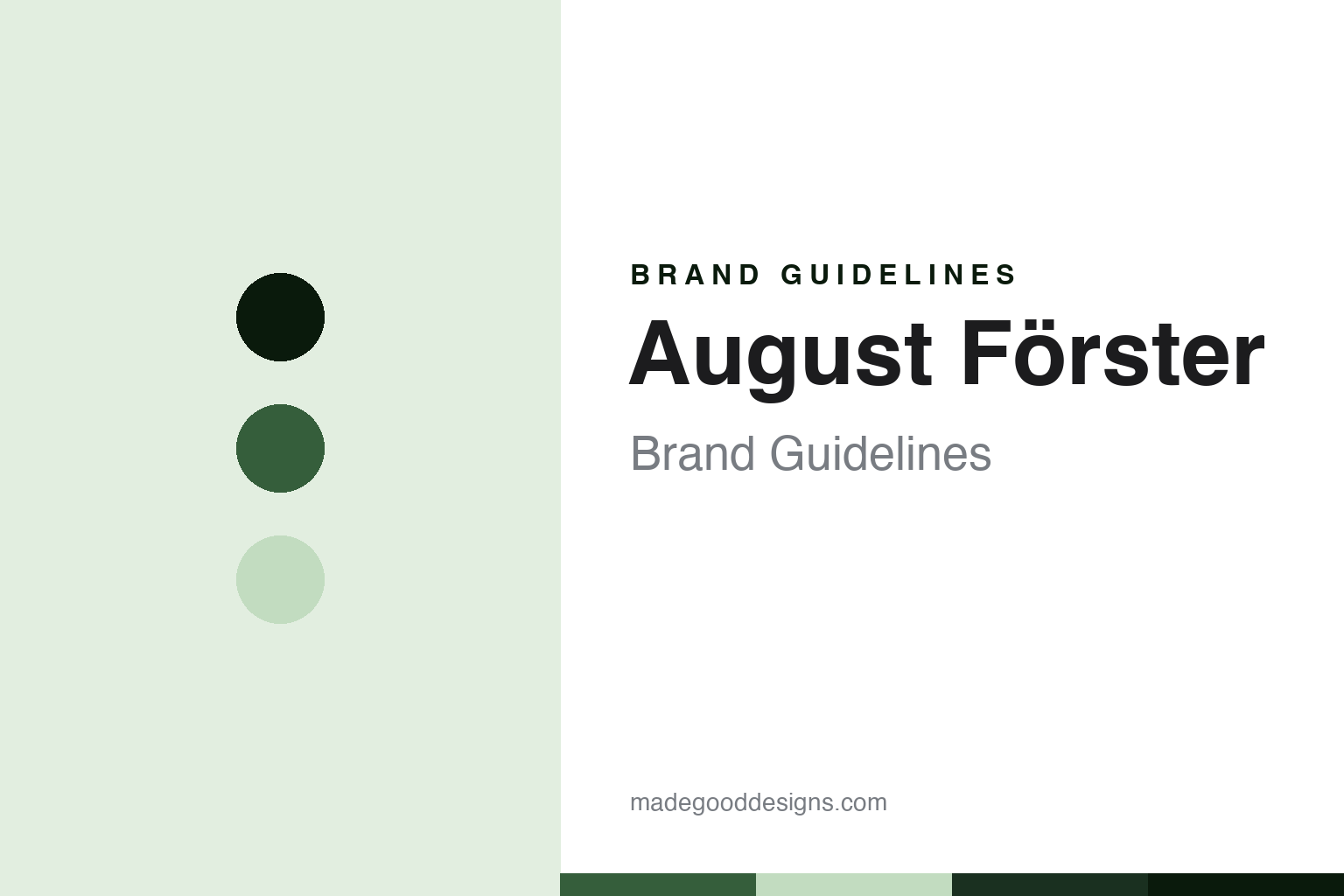
For this guide we use a Lusatian green and a pale sage with a plain workshop sans. These are an unofficial interpretation, not August Förster’s own colour values, and nothing of its mark is reproduced.
Explore & save
Keep August Förster’s identity on hand — save it to a board in the Made Good inspiration library.
August Förster identity set
Pin the Lusatian-green palette and the workshop-sans register to your own board.