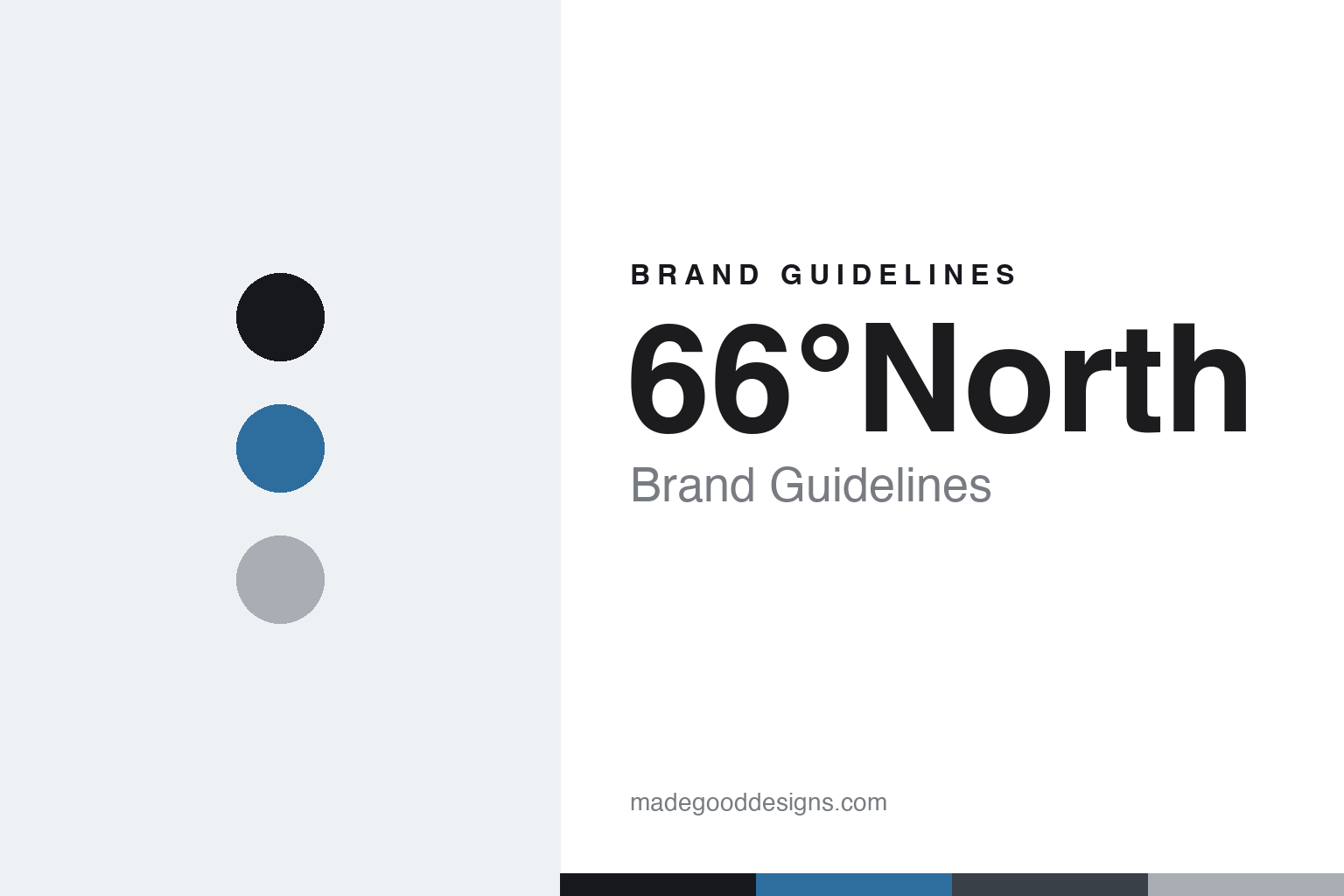
66°North Brand Guidelines
Keeping Iceland warm since 1926.
Aa
Two constants: a glacier-blue palette and a Nordic geometric register. Abstract homage — not the 66°North wordmark or logo.
Keeping Iceland warm since 1926
66°North began as protective workwear for Icelandic fishermen.
66°North is a lesson in heritage forged by weather. Founded in 1926 by Hans Kristjánsson in Suðureyri, in Iceland’s remote Westfjords, the brand began by making protective workwear for Icelandic fishermen and rescue workers facing brutal North Atlantic conditions. Its name refers to the Arctic Circle latitude near Iceland.
Its brand identity is Arctic, minimalist and function-first — heritage weather protection evolving into an outdoor and urban-lifestyle crossover, “keeping Iceland warm since 1926.” Product lines are named after Icelandic glaciers and peaks, and the wordmark builds the degree symbol (°) into its signature.
(Honest notes: 66°North is independent but not run by the founder’s family — it has been owned since 2011 by Helgi Rúnar Óskarsson and Bjarney Harðardóttir. It’s a certified B Corp, but its gear is mostly made in company-owned European factories, not “in Iceland” (that’s design and testing). And there’s no official brand hex, so the tones here are an unofficial interpretation.)
Colour
66°North lives in a glacier-blue palette. Click a swatch to copy the hex.
66°North’s identity is Arctic, cool and minimalist — an ink, a glacier blue, a basalt, an ash grey, and a snow. The palette pairs a glacier blue with cool greys — the register of Icelandic ice, basalt and North Atlantic weather. It signals the Arctic, protection and Nordic restraint rather than warmth or fashion. The honest caveat: with no published brand hex, these tones are an original, unofficial interpretation, not first-party values.
The lesson is glacier blue plus cool greys signals Arctic heritage. 66°North’s world is a storm off Iceland. For designers, it is a reminder that a glacier blue with basalt greys reads as Arctic and protective — right for a brand born on the Westfjords. The takeaways: use a glacier blue; ground it in cool greys; and treat any single hex as unofficial — using ink for small text so the palette stays cold.
Typography
The register is a Nordic geometric — clean and minimal.
66°North’s identity carries a clean, minimal, Arctic spirit — a century of weather protection. A Nordic geometric sans captures the mood: it is clean and minimal, the register of a restrained Icelandic brand. Set in a glacier-blue palette, the Nordic geometric feels clean and minimal — exactly the personality 66°North carries. It is restrained rather than loud, mirroring function-first design. (66°North’s real wordmark — with the degree symbol built in — is a trademark we describe but do not reproduce, and the exact brand typeface is not ours to use.) Because the mark is not ours to use, the honest description is “a Nordic geometric spirit,” shown here in a stand-in. The type behaves like the brand: clean, minimal and Arctic.
Aa
A Nordic geometric spirit — clean and minimal. (Specimen set in Jost, a Nordic geometric STAND-IN; NOT the 66°North wordmark, which is a trademark.)
Weather as identity
66°North stands for Arctic weather protection.
66°North is a lesson in making weather the identity. A glacier-blue palette, a fisherman-workwear origin and a B Corp ethos make Arctic weather protection the whole brand — Arctic, minimal, protective. The weather is the differentiator. The differentiator is an Arctic, minimalist, heritage identity.
For designers and brand-builders, 66°North offers a clear takeaway: a place and its weather can be a brand. The lessons: own a real origin (Westfjords workwear); ground the name in geography (the Arctic Circle); and back longevity (free repairs, B Corp). It is also a reminder to stay accurate: it’s independent but not the founder’s family, made mostly in European factories (not Iceland), and the palette here is an unofficial interpretation. 66°North made the weather the brand — proof that place can be the difference.
Explore & save
Keep 66°North’s identity on hand — save it to a board in the Made Good inspiration library.
66°North identity set
Pin the glacier-blue palette and the Nordic-geometric register to your own board.