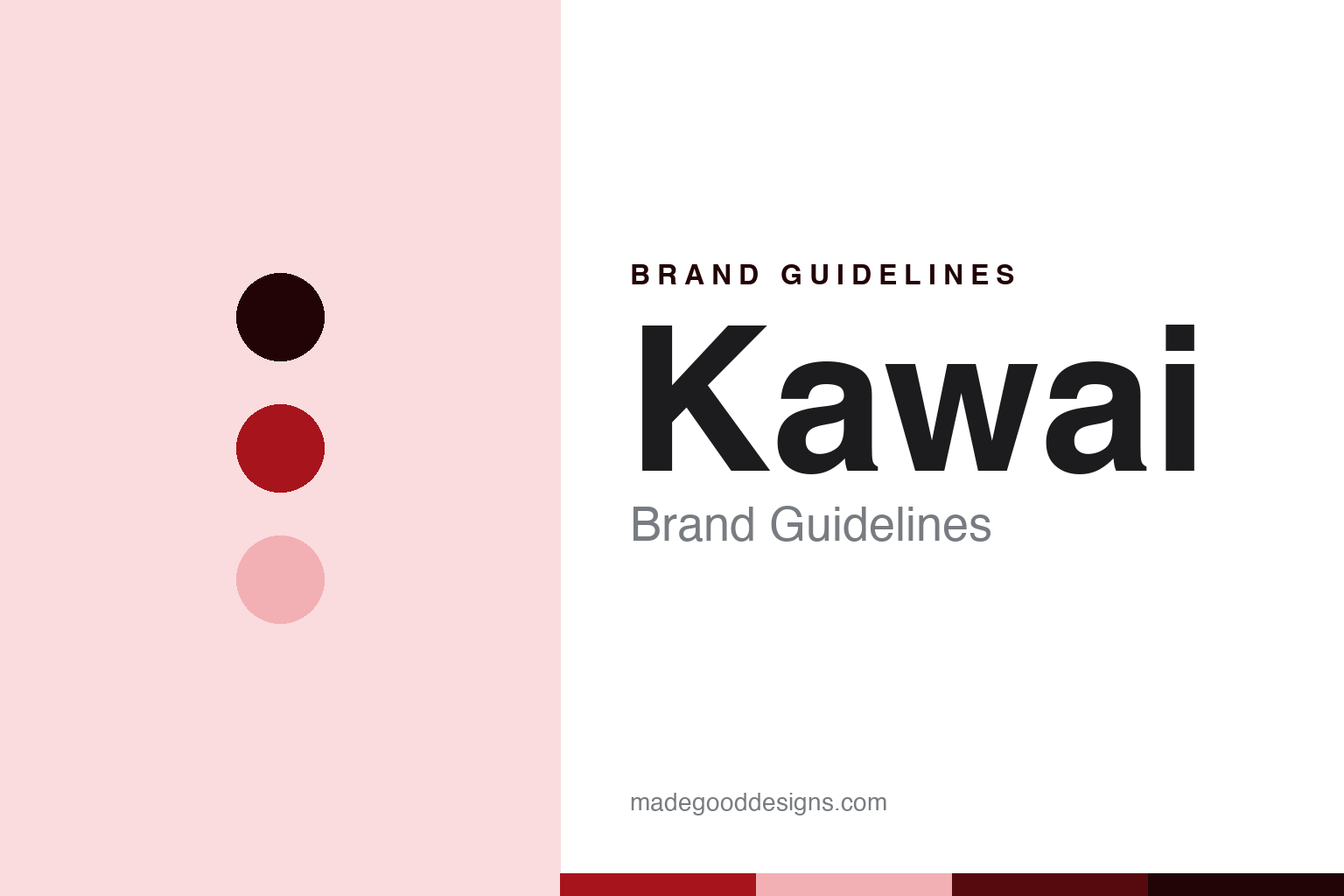
Kawai Brand Guidelines
A family name, said plainly.
Aa
Two constants: a Kawai-red palette and a precise-gothic register. Abstract homage — not a Kawai product or mark; no piano or wordmark is reproduced.
An apprentice who left
Kawai was founded by a man who had learned from the founder of the company it would compete with for a century.
Kawai’s corporate history is exact: “1927 Koichi Kawai established the Kawai Musical Instruments Research Laboratory,” on 9 August 1927, in Hamamatsu. Its American arm adds the detail the Japanese record leaves out. Koichi Kawai, it says, was “a gifted inventor and former apprentice to Torakusu Yamaha,” and he started the company with “seven like-minded craftsmen.” The first Kawai grand followed in 1928, the company took its manufacturing name in 1929, and it became a joint-stock company in 1951.
That makes Hamamatsu the home of both of Japan’s great piano names, and Kawai — by its own account — the one founded by a former apprentice of the other’s founder. The series already has a Yamaha guide; read side by side, the two are a family story told by two families.
The Kawai family has kept the name in front. After Koichi Kawai’s death, Shigeru Kawai became president in 1955; Hirotaka Kawai followed in 1989; Kentaro Kawai is president today. The company is listed on the Prime Market of the Tokyo Stock Exchange, with about 2,900 employees across the group, and among its significant shareholders is an association bearing the Kawai name. Its centenary falls in 2027, which makes it, by nearly three decades, the oldest of the Asian makers in this round — Pearl River dates itself to 1956, Samick to 1958.
Colour
Kawai says, model by model, which factory builds which piano. Few makers in this round are as specific.
Kawai’s American site states its origins line by line. “Most Kawai grand pianos — the entire GX series and the GL-30, GL-40, and GL-50 — are built at the Ryuyo Piano Factory near Hamamatsu, Japan.” Then: “The compact GL-10 and GL-20 (US market) are built at Kawai’s Karawang, Indonesia facility.” And: “Every Shigeru Kawai concert instrument is hand-built in Japan by Master Piano Artisans.” We did not find an equivalent statement for its K-series uprights, so we make none.
The factory list is just as plain. The Ryuyo grand-piano factory and research laboratory opened in 1980; upright finishing moved there from Maisaka in 2009. Overseas, Kawai lists four plants at Karawang in Indonesia, the first opened in 2001; a factory in Ningbo, China, from 2004; and an electronics company in Shanghai. Its investor materials say a new Indonesian factory for digital pianos was due to start in July 2026. One small precision: the company’s premium site says Shigeru Kawai pianos are built “at the Ryuyo Grand Piano Factory in Hamamatsu, Japan,” while the factory’s registered address is in neighbouring Iwata. “Near Hamamatsu,” as the American site says, is the exact version.
The numbers are public too, though not in units. For the year to March 2026 Kawai reported net sales of ¥72.0 billion, of which acoustic pianos were ¥19.2 billion — down 5.5 percent, with about three-quarters sold outside Japan — and an operating profit of just ¥113 million. It is a large, careful company in a contracting market. At home it claims more: its presentation says Kawai’s share of Japan’s acoustic-piano market passed 50 percent for the first time — a figure from the company’s own survey, which we report as its claim.
Typography
Kawai keeps its family name for its finest instruments. A rival’s second line is widely said to come from its factories.
The top line carries the family name. Shigeru Kawai pianos, launched in 1999, are built at Ryuyo, and the company says fewer than 20 of its SK-EX concert grands are produced each year. Kawai’s results presentation for the year to March 2026 claims that at the 2025 International Chopin Piano Competition, 21 of the 84 first-round pianists chose a Shigeru Kawai, as did three of the eight prizewinners. Its EX concert grand was an official instrument of the competition as long ago as 1985.
The other story is told by other people. American Steinway dealers say openly that Boston, Steinway’s second line, is built by Kawai, and a 2016 industry report said the same. Steinway’s own filings say only that Boston pianos are “produced in Hamamatsu, Japan and near Jakarta, Indonesia by third-party manufacturers”; in them, Kawai appears only as a competitor. Kawai’s own corporate history, which we searched, mentions neither Boston nor Steinway. We report the dealers’ account as the dealers’, and note only that the cities match Kawai’s.
There is a longer history behind that. In 1974 the US Tariff Commission, reviewing the safeguard tariff the President had imposed on imported upright pianos in 1970, reported that Japan supplied about 90 percent of the upright pianos imported into the United States, and that “Two importers probably accounted for all the U.S. imports of Japanese-made uprights—Yamaha International Corp. … and Kawai Piano (America) Corp.” Half a century ago, in other words, Kawai was one of the two importers behind the trade America’s piano makers had asked Washington to restrain.
The original 1969 finding is blunter still. Two of the commissioners who backed the tariff wrote that imports, “negligible prior to 1962,” now accounted for 13 percent of sales, and that they came “largely from Japanese companies which not only appear to be highly efficient producers, but excellent merchandisers as well.” That sentence describes Kawai’s position then; its precise factory statements describe its habits now. A company that was once the import the American industry feared now publishes, model by model, where its pianos come from.
Aa
A precise, even gothic — engineered, calm, clear at every size. (Specimen set in Zen Kaku Gothic New, a sans STAND-IN; NOT the Kawai wordmark or products.)
Red, and three taglines
The logo file on Kawai’s American site is red. The taglines change with the audience.
Kawai speaks in three registers. Its corporate mission is “Let your life resound.” Its American site’s title carries “Instrumental to Life.” And the premium line calls itself “The Premier Piano of Japan.” The logo file the American site serves is red, which is why this guide’s palette starts from red — though our values are our own interpretation, not Kawai’s specification.
The company has also been broader than pianos. It bought the American organ maker Lowrey in 1988, the electric-guitar maker Teisco joined it in 1966, and it has sold sporting goods since 1969 and runs gymnastics schools in Japan. Those are the habits of a Hamamatsu industrial company, not a boutique — which is the right context for its plainness about factories.
For this guide we use a Kawai red and a pale blush with a precise gothic. These are an unofficial interpretation, not Kawai’s own colour values, and nothing of its mark is reproduced.
Explore & save
Keep Kawai’s identity on hand — save it to a board in the Made Good inspiration library.
Kawai identity set
Pin the Kawai-red palette and the precise-gothic register to your own board.