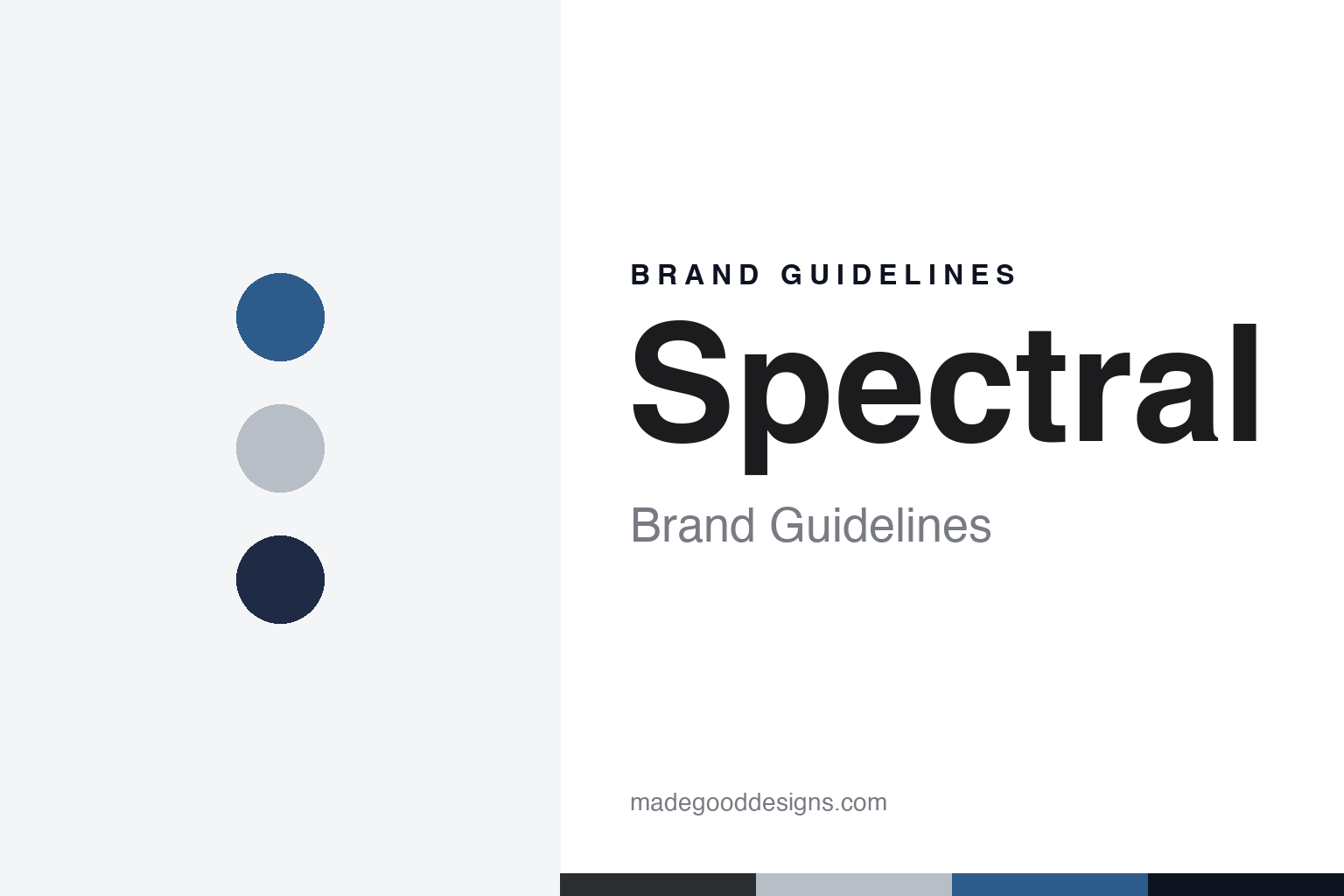
Spectral Brand Guidelines
The Silicon Valley amplifier maker that specifies its cables.
Aa
Two constants: a Spectral graphite, silver and blue palette and an Instrument sans register. Abstract homage — not a Spectral product or mark; no component, cable, logo or nameplate is reproduced.
The reference instrument
A preamplifier built to judge other products.
Spectral Audio is one of the oldest names in American high-end electronics, and one of the quietest. The company gives its founding year as 1977, and marked its 40th anniversary in 2017 with a limited monoblock amplifier, the DMA-500 Anniversary Reference, the trade site Mono and Stereo reported. Independent dating is looser: Stereophile called Spectral “nearly 20 years old” in May 1995, and The Absolute Sound called it a “33-year-old company” in February 2009, which would place its start a year or so earlier. We give the company’s date and note the difference.
Its founder is Richard Fryer, known in the trade as Rick. In a 2009 interview with The Absolute Sound’s Robert Harley, Fryer said his training was in psychology, that he had worked for high-end audio companies while at college, and that he eventually had to choose between a career as a psychologist and the music systems that came instinctively to him. “I’m not an engineer, but that’s part of my strength,” he said, describing his role as bringing talented people together. In 1999 the same magazine called him “Spectral’s sole owner and driving force”; we found no record of a later sale.
The company’s own history says Spectral grew out of an instrument rather than a business plan. Its founders, it says, “were active as audio reviewers and engineers in the early days of the High End,” and built the MS-ONE preamplifier as a reference against which products under review could be compared. Demand from listeners, the company says, “led to the formation of Spectral as a company,” and the MS-ONE was followed by the DMC-10 preamplifier, which Stereophile reviewed in February 1984.
Colour
A recording engineer, megahertz circuits and a cable rule.
Spectral’s engineering has long been led by Keith O. Johnson, who signs the company’s technical bulletins as Director of Engineering. Johnson is better known outside the hi-fi trade as the recording engineer of the classical label Reference Recordings, which English Wikipedia says he co-founded in 1976, and as co-developer, with Michael Pflaumer, of HDCD, a coding system for compact discs later acquired by Microsoft. Spectral says its custom electronics are “the backbone” of Reference’s recording system and that its design team often attends the label’s sessions; we give that as the company’s account.
The house style is very wide-bandwidth solid-state circuitry. The company quotes a description of it as “always discrete, fully complimentary, DC-coupled and ultra fast,” and its figures run into megahertz rather than kilohertz: The Absolute Sound noted in 1999 that the DMA-360 monoblock’s stated response reached 1.8MHz, and a 2019 bulletin claims the DMA-250 Series 3 delivers full power “with total load stability at an unprecedented 1 MHz.”
That bandwidth explains Spectral’s best-known rule. In the early 1980s, the company says, it worked with Bruce Brisson’s Music Interface Technologies on the MI-500 interconnect and MH-750 speaker cable, and its bulletins explain that ordinary “wire” cables were replaced by MIT “networks” that act as low-pass filters “to prevent oscillations” in its amplifiers. In 1999 The Absolute Sound reported that the DMA-360’s instruction book “mandates the use of MIT cables,” adding that the experts it consulted outside Spectral “were in sharp disagreement” over how risky other cables would be. A 2013 bulletin introduced a third generation of Spectral-branded cables “designed by Bruce Brisson for Spectral systems.” Our MIT Cables guide covers the cable maker itself.
Typography
An American cable industry.
High-end cables became a product category of their own in the United States at the end of the 1970s. English Wikipedia dates Monster Cable, founded by Noel Lee, to 1979, and says it grew by demonstrating to the trade that cables made a difference to sound. AudioQuest says its founder, Bill Low, began making custom cables in 1978 and founded the company in 1980.
The cable trade grew up alongside the amplifier makers. In the early 1980s Spectral, the Silicon Valley amplifier maker, worked with Bruce Brisson’s Music Interface Technologies on cables for its amplifiers, Spectral says, and in 1999 The Absolute Sound reported that a Spectral instruction book “mandates the use of MIT cables” to keep its wide-bandwidth circuits stable.
Whether cables sound different has long been argued. English Wikipedia calls the effect of speaker wire on the signal “a much-debated topic,” notes that engineers stress electrical resistance as the property that matters most, and records that tests by Stereo Review in 1983 found Monster’s cable “indistinguishable” from 16-gauge lamp cord. Magazines such as Stereophile and The Absolute Sound still review cables by listening. This guide does not settle the question; it records what each company says.
The seven companies here are spread across the country: Nordost in Holliston, Massachusetts; Transparent Audio in Saco, Maine; AudioQuest in Irvine, California; MIT Cables, long based in Rocklin and later Auburn, California, which said on its website in 2026 that it was no longer operating; Spectral in Santa Clara, California; Cardas Audio in Bandon, Oregon; and Shunyata Research in Poulsbo, Washington, according to their own websites and published listings.
This guide sets out what can be checked about each brand — who founded it, who owns it, and what it says about where its products are made — and marks clearly what rests only on the company’s own word.
Aa
An instrument sans — the register of test-and-measurement equipment. (Specimen set in IBM Plex Sans, a sans STAND-IN; NOT the Spectral logo.)
Spectral
A system sold as one piece of engineering.
Spectral has always kept its distance from the press. Stereophile’s Robert Harley wrote in May 1995 that it advertised very little and “almost never” sent products for review, because it held “that an entire Spectral system -including cables- is needed to hear the full musical capabilities of just one component”; until then the magazine had fully reviewed only the DMC-10 and the MCR-1 phono cartridge. Harley’s review of the SDR-2000 Professional D/A processor followed, and Stereophile named it its Digital Source of 1995. Fryer put the same idea to The Absolute Sound in 2009: “You don’t practice mix-and-match and get uniformly great results.”
Spectral’s technical bulletins gave an address on Oakmead Parkway in Sunnyvale as late as 2020; its website now lists Santa Clara, a few miles away in the same part of Silicon Valley, and tells American buyers to “call the factory” to find a dealer. The company says it “designs and builds” its products; we found no independent account of its workshop. Its current range, as listed online, includes the DMC-30SV preamplifier, DMA-series stereo and mono amplifiers, the SDR-4000SV CD processor and Ultralinear cables. A page dated 2024 promised “a number of exceptional new audio components during the 2024 season”; we found no announcement of them in the sources we checked.
The MIT link now raises a question for owners. In 2026 a letter on MIT’s own website, preserved by the Internet Archive, said Bruce Brisson had retired and that MIT was no longer operating; by October 2026 mitcables.com returned an error page. We could not read the letter ourselves, and found no statement from Spectral on what it means for its cable requirement.
Two further points for researchers. Spectral’s website is still built with 1990s frames — its home page warns that it “requires a browser with FRAMES support, such as Netscape 2.0.” And the name is shared: Spectral Audio Möbel GmbH, a German maker of audio-video furniture that stopped trading in 2024, is an unrelated company.
For a design guide, Spectral shows how a brand can be built on a closed system — electronics and cables presented as one engineering package — and on almost no marketing. Compare Mark Levinson and Audio Research, the two names Fryer recalled as already at work when Spectral began. For this guide we use graphite, instrument silver and a deep signal blue with a sans, an unofficial interpretation; no product or logo is reproduced.
Explore & save
Keep Spectral’s identity on hand — save it to a board in the Made Good inspiration library.
Spectral identity set
Pin the Spectral graphite, silver and blue palette and the Instrument sans register to your own board.