Sakae Brand Guidelines
The Osaka drum maker that built under another name, then made its own.
Aa
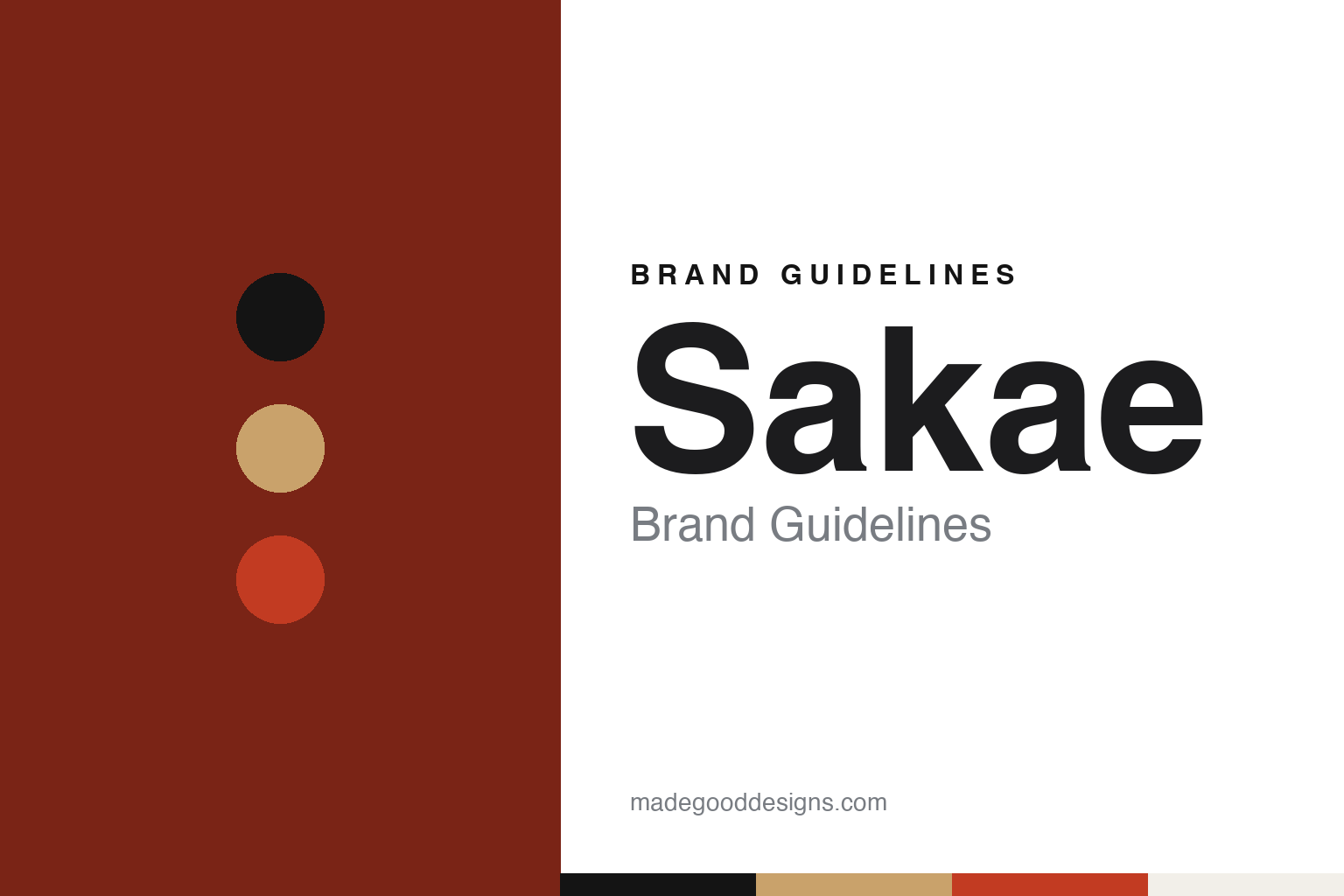
Two constants: a Sakae lacquer black, maple and vermilion palette and a Japanese gothic sans register. Abstract homage — not a Sakae product or mark; no instrument, logo or badge is reproduced.
Osaka, 1925
A drum maker that worked largely out of sight.
Sakae Rhythm was an Osaka drum maker established in 1925, according to a Kyodo report published by The Japan Times in May 2018, which cited the credit research firm Teikoku Databank. The brand’s present website also dates SAKAE to 1925. DRUM! Magazine described Eizo Nakata, the company’s president when it set out on its own, as the founder’s grandson.
For most of its history Sakae was little known by name outside Japan, because its best drums carried another badge. Starting in the late 1960s, DRUM! reported in 2018, Sakae produced Yamaha’s top-tier drums for 40 years; Phil Hood wrote in the same magazine in 2019 that it made most of Yamaha’s high-end drums, including the Recording Custom. Yamaha’s side of the story is different: DRUM! reported in 2015, after a visit to Yamaha’s factory, that key concepts, designs, finishes, hardware and many processes and patents came from Yamaha, though Sakae built the drums. Kyodo’s report says simply that the company “has also sold drums to Yamaha Corp.”
Sakae also made one of Osaka’s best-known drums: the instrument played by Kuidaore Taro, the mechanical drum-playing doll that serves as a landmark mascot in the city, Kyodo reported. The business peaked early. Sales reached ¥1.46 billion in the year to September 1988, according to Teikoku Databank.
Colour
Going it alone.
The Yamaha relationship unwound gradually. Hood wrote that Yamaha began making some drums at a factory in Hangzhou, China, in 1997, and that in 2013 Yamaha announced that many of its higher-end drums, including the Recording Custom, would no longer be available, ending its relations with Sakae. DRUM!’s 2015 report put the end of what it called an almost 50-year relationship two years earlier, when Yamaha moved production to its plant at Xiaoshan, China; the magazine’s 2018 report dated the break to 2009, so the sources differ.
Sakae, meanwhile, had begun selling drums under its own name. The current website’s timeline for its lead artisan, Shun Tsuji, who it says joined Sakae Rhythm in 1994, says he worked on product planning and development “for major drum manufacturers” from 1995, and lists the launch of “SAKAE” drums in 2009; the Almighty kit in 2011, sold mainly in Japan; the vintage-voiced Trilogy and the start of worldwide sales in 2013; and the flagship Celestial in 2015, which Tsuji said in a 2020 interview on the site combined maple and bubinga. Hood wrote that its finishes were “as beautiful as anything you’d find in the best furniture stores.”
The independent years were short. Korg USA distributed Sakae in the United States from 2014, DRUM! reported, and players included Jimmy Chamberlin of the Smashing Pumpkins and Greg Hutchinson, according to Kyodo. But orders from major customers fell and sales of its own-brand drums faltered, and sales dropped to ¥313 million in the year to September 2016. In May 2018, Kyodo reported, Sakae Rhythm suspended business with debts of ¥772 million, about $6.96 million, and lawyers began debt settlement procedures after banks stopped extending loans. Hood wrote that the company had stopped making drums in 2017.
Typography
Heritage names and boutique workshops.
These seven brands fall into two camps: old American names that have passed through several owners, and small workshops that build drums by hand. Rogers began in 1849 as a drumhead maker in New York state; DRUM! Magazine reported in 2018 that the name is owned by Reliance Musical, a Taiwanese manufacturer, with drums finished in California. Slingerland, founded by H. H. Slingerland in 1912, according to English Wikipedia, was bought from Gibson by Drum Workshop in 2019, and its website says DW is now part of Roland.
Leedy, started in Indianapolis in 1897 by Ulysses G. Leedy, passed to C. G. Conn and then Slingerland; English Wikipedia says Gretsch has held the trademark since 1986 and the brand has lain largely dormant. Noble & Cooley is the exception among the old names: founded in Granville, Massachusetts, in 1854, its team page now lists Nick Jones, a seventh-generation Cooley descendant, and John Keane as owners, its site says it is part of York Creative Collective, and it says its drums are handcrafted in the USA.
The boutique makers are younger. Craviotto, founded by the drummer Johnny Craviotto, says it has made one-ply solid-shell drums since 2004 and now handcrafts them in Nashville. C&C, founded by Bill Cardwell, builds drums at its shop in Gladstone, Missouri, and says it has made its own shells since 2010.
Sakae is the outlier: an Osaka maker established in 1925 that, DRUM! reported, built Yamaha’s top-tier drums for 40 years. It suspended business in 2018, Kyodo reported; DRUM! later reported that Korg had bought the trademark, and the name now appears on drums sold as Sakae Osaka Heritage.
This guide sets out what can be checked about each brand — who founded it, who owns it, and what it says about where its products are made — and marks clearly what rests only on the company’s own word.
Aa
A clean Japanese gothic sans for a maker that let its emblem speak. (Specimen set in Zen Kaku Gothic New, a sans STAND-IN; NOT the Sakae logo.)
Sakae Osaka Heritage
A name bought and rebuilt.
The name did not disappear with the company. Shortly afterwards, Hood reported in February 2019, Korg Inc. bought the Sakae trademark and engaged Sakae’s top designer to help rebuild the line; at the NAMM show that January, Korg USA showed a prototype maple kit called Evolved, a cajon and a new bass drum pedal. Hood wrote that the prototype drums were built in Taiwan. The brand now trades as SAKAE OSAKA HERITAGE, which its website calls “a rebirth in 2019,” and Korg USA’s website lists Sakae among its brands.
The website names Shun Tsuji as lead artisan, describing his work as “sonic sculpting,” and Michihiro Tsuchida, who it says led design and technology at the old company, as chief engineer. It describes the second-generation Evolved kit — North American maple, 29 shell colours and 10 powder-coated lug finishes — as “proudly designed and hand-finished in Osaka, Japan” and “hand-assembled with precision and artistry in Japan”; we give that as the company’s claim, beside DRUM!’s 2019 report of prototypes built in Taiwan. The site says only a limited number of kits are released each year, and sets out the recipe in detail: a seven-ply, 7.2mm maple bass drum whose innermost ply is set to run perpendicular to the head, six-ply toms and seven-ply floor toms with shallower-than-usual depths, and a “Cradle” mount that holds the toms from below. The range also includes Japan Custom snare drums in steel, brass, phosphor bronze, walnut and maple, cajons and Axelandor pedals. In a 2020 interview Tsuji said the bass drum head now carried only the emblem, not the word SAKAE, because a simple symbol would be easier to recognise from a distance.
For a design guide, Sakae shows how a maker that spent decades building under another company’s badge can turn its craft into a name of its own — and how that name can outlive the company. Compare Tama and Pearl, two other Japanese drum makers. For this guide we use lacquer black, maple and vermilion with a sans, an unofficial interpretation; no product or logo is reproduced.
Explore & save
Keep Sakae’s identity on hand — save it to a board in the Made Good inspiration library.
Sakae identity set
Pin the Sakae lacquer black, maple and vermilion palette and the Japanese gothic sans register to your own board.