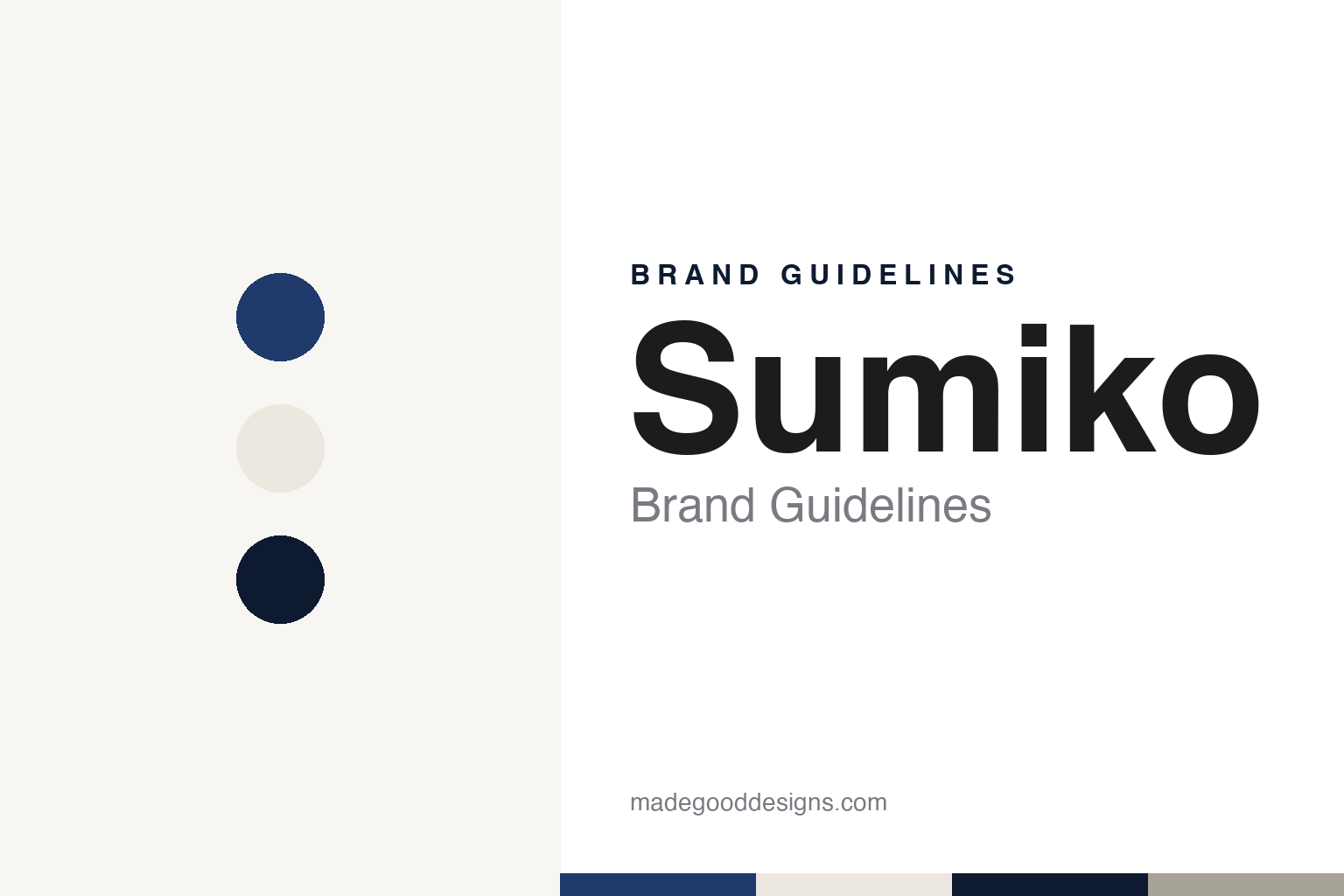
Sumiko Brand Guidelines
The Berkeley importer whose cartridges are built in Japan.
Aa
Two constants: a Sumiko Blue Point navy and pearl palette and a Clean sans register. Abstract homage — not a Sumiko product or mark; no cartridge, logo or nameplate is reproduced.
Fifth Street, Berkeley
An importer before it was a maker.
Sumiko is an American brand with Japanese-made products. For decades it was based at 2431 Fifth Street in Berkeley, California, and it built its reputation as an importer: its 2013 website called it “one of the largest importers and distributors of hi-end products in North America” and spoke of “over thirty years” in the business. By that account the company dates from the early 1980s or before, but we found no dated source naming its founders or its founding year, and we do not supply them. Sumiko is also a Japanese given name; the company does not explain its choice of name on any of the pages we read.
What Sumiko does date is its own cartridges. Its website says the first Sumiko cartridge was produced in 1982. What Hi-Fi?, reviewing the Rainier in 2022, wrote that “the company was founded in 1982,” which appears to treat the cartridge date as the company’s; we note the difference.
Before and alongside its own models, Sumiko imported other makers’ cartridges. Its 2013 website named Grace, Kiseki, Supex, Koetsu and Talisman among the models “made available via SUMIKO channels of distribution over the past three decades.” It also sold tonearms: English Wikipedia’s article on the Linn Sondek LP12 notes that a Sumiko tonearm was a popular partner for that Scottish turntable.
Colour
From Berkeley to Milan.
Distribution remained Sumiko’s larger business. In 2002 its website described it as “the North American home of Sonus faber, Vienna Acoustics, REL, Project, SME, Primare, and Oyster Phono-Cartridges” — Oyster being the name of its own cartridge range. In July 2011, Stereophile reported that Fine Sounds SpA of Milan, the owner of Sonus Faber, Audio Research and Wadia Digital, had acquired “100% of Sumiko manufacturing and distribution in Berkeley, CA.” Sumiko’s owners, Donald Brody and John Hunter, became partners in Fine Sounds while keeping REL and Wolf Cinema. English Wikipedia dates the purchase to 2010, but the article it cites is dated 11 July 2011.
Fine Sounds was controlled by the Italian private-equity firm Quadrivio. It bought McIntosh Laboratory in 2012, went through a management buyout in 2014 and was renamed McIntosh Group in 2016, according to English Wikipedia, which puts the group’s 2011 sales at €50 million and lists “Sumiko Phono Cartridges” among its brands. What Hi-Fi? reported that the American firm Highlander Partners bought the group in 2022 and that Bose announced its acquisition in November 2024. That report names McIntosh and Sonus Faber but not Sumiko, and we could not confirm who owns Sumiko today.
In 2020 the cartridges moved to a website of their own, sumikophonocartridges.com; Sumiko’s distribution site announced the move in May that year, alongside news that Rotel had appointed Sumiko its American distributor.
The logic of the 2011 deal, as Brody explained it to Stereophile, was that Quadrivio’s brands were strong in engineering and manufacturing, while Sumiko had “an enormous amount of talent, expertise, and background in the area of marketing, distribution, and sales,” and a long record of training dealers and exhibiting at trade shows. “Eventually, we decided to merge into one company,” he said.
Typography
Cartridges and documentation.
These seven makers belong to a small trade. A phono cartridge is a few grams of magnet, coil and diamond, largely assembled by hand, yet only a few of these brands say who does the work.
Goldring, which traces its roots to Berlin in 1906, belongs to Armour Home Electronics of Bishop’s Stortford, a subsidiary of Q Acoustics Limited, Companies House records show. It says its cartridges are “designed and handmade in the UK,” though its own history says it outsourced much component manufacturing in the 1990s. Soundsmith says every product is “hand-crafted” at its factory in Peekskill, New York.
Sumiko, the cartridge brand of a Berkeley, California, distributor bought by Fine Sounds of Milan in 2011, Stereophile reported, says all its cartridges are hand-built by Excel Sound in Yokohama.
Three are Japanese. Nagaoka, a family stylus maker based in Higashine, Yamagata, makes an MP-700 that is “still completely built by hand in Japan,” Hi-Fi News reported in 2025. ZYX works from Nagara in Chiba; its founder says he managed OEM cartridges for several makers at Namiki Precision Jewel before 1986. My Sonic Lab gives a Tokyo address; its US distributor, quoted by Stereophile in 2018, said founder Yoshio Matsudaira had earlier made cartridges for Air Tight.
Benz Micro, the Swiss name, is hardest to place: its website is a holding page, and the Swiss business-name index lists a Benz-Micro AG as deleted in 1997.
This guide sets out what can be checked about each brand — who founded it, who owns it, and what it says about where its products are made — and marks clearly what rests only on the company’s own word.
Aa
A clean sans — “True to the Record Groove.” (Specimen set in Manrope, a sans STAND-IN; NOT the Sumiko logo.)
Sumiko
American voice, Japanese hands.
Sumiko’s manufacturing claim is specific. It says “all Sumiko Phono Cartridges are hand-built in Japan by the skilled artisans at Excel Sound in Yokohama,” from its Oyster moving-magnet series to its Reference moving coils, with materials and components “all sourced within Japan.” Japanese Wikipedia lists Excel Sound among the country’s cartridge makers; the Yokohama detail and the claim that it builds every Sumiko model are the company’s. Its brand copy puts the two halves together: “Guided by the insights of American aficionados of analog fidelity, we draw on over half a century of Japanese expertise.” Its tagline is “True to the Record Groove.”
Its names tend toward gems and birds. In 2002 the Oyster line included the Pearl, the Black Pearl and the Blue Point, a high-output moving coil with a 2.5 mV output and an elliptical diamond stylus, then sold for $249. The current range includes the Amethyst, the Rainier — listed as a What Hi-Fi? Awards 2025 winner — the Starling, the Songbird and the Oriole, a reference moving coil the company says it launched in February 2026. Its website lists a Berkeley-area telephone number alongside an address in Maple Grove, Minnesota. The old distribution site, sumikoaudio.net, returned an error when we checked in October 2026, and sumikoaudio.com is an unrelated parked domain.
Its language has shifted with its role. In 2013 its cartridge pages promised “clear, accurate and balanced analog reproduction”; today it asks for cartridges that are “tonally balanced, refined, and fatigueless.” Its website lists distributors in more than 25 countries and territories, including Henley Audio in Britain and Fine Sounds Benelux in the Low Countries, and quotes reviews from Hi-Fi News, Stereophile and France’s Diapason.
For a design guide, Sumiko shows a brand that is openly American in voice and Japanese in manufacture. Compare Koetsu, a Japanese maker Sumiko once imported, and Grado, an American cartridge maker. For this guide we use a Blue Point navy and a pearl with a sans, an unofficial interpretation; no product or logo is reproduced.
Explore & save
Keep Sumiko’s identity on hand — save it to a board in the Made Good inspiration library.
Sumiko identity set
Pin the Sumiko Blue Point navy and pearl palette and the Clean sans register to your own board.