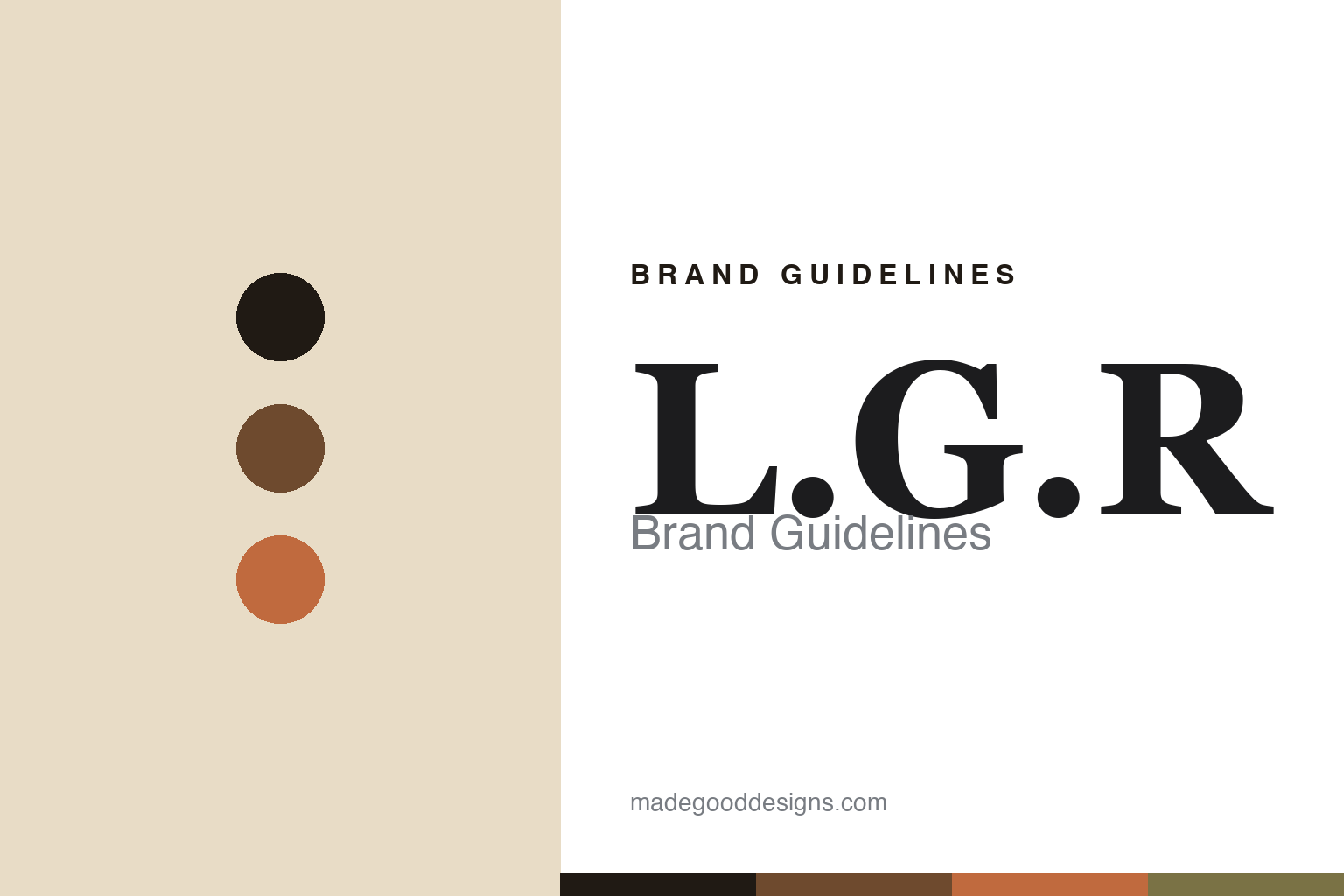
L.G.R Brand Guidelines
Africa, and the Riviera.
Aa
Two constants: a tortoise-and-terracotta palette and a Riviera serif register. Abstract homage — not the L.G.R identity.
Africa, and the Riviera
L.G.R reissues a family history from colonial-era Asmara.
L.G.R is a lesson in heritage as identity. Founded around 2005–2007 by Luca Gnecchi Ruscone — whose initials are the brand — it is an independent, founder-led Italian house whose frames are entirely handmade in Italy by three artisanal families, with boutiques from Milan to Paris.
Its identity fuses “the adventure of Africa and the glamour of the Italian Riviera.” The story is real: the founder’s grandfather, Raffaello Bini, ran “Foto Ottica Bini” in Asmara, Eritrea (then an Italian colony), a shop established in the 1930s that later imported Italian frames. L.G.R reissues those 1930s-to-1960s silhouettes, fits mineral-glass lenses, and — the signature system — names every model after an African city: Asmara (the first model, and the founder’s favourite), Massawa, Keren, Tripoli.
(Honest notes: “L.G.R” is Luca Gnecchi Ruscone. The Asmara shop was established around 1936 — not “1929.” The founding is best given as ~2005–2007 (2005 was the rediscovery of the old frames). The house is founder-led — no external design studio — and there’s no official brand hex, so these warm tones are a qualitative, unofficial interpretation.)
Colour
L.G.R lives in a tortoise-and-terracotta palette. Click a swatch to copy the hex.
L.G.R’s identity is warm, vintage and adventurous — an ink, a tortoise, a terracotta, a safari olive, and a sand. The palette reads like a 1950s safari on the Riviera — warm tortoise and terracotta over sand — the register of heritage reissue. It signals romance and provenance rather than trend. The honest caveat: with no published brand hex, these tones are an original, unofficial interpretation, not first-party values.
The lesson is warm tortoise and terracotta signal heritage and adventure. L.G.R’s world is a vintage frame with an African name. For designers, it is a reminder that warm, earthy colour reads as storied and romantic — right for a house built on a family history. The takeaways: source the palette from the story (safari, Riviera, tortoise acetate); name the range from the heritage (African cities); keep the lenses true (mineral glass); and treat any single hex as unofficial.
Typography
The register is a Riviera serif — warm, glamorous, storied.
L.G.R’s identity carries a warm, glamorous, storied spirit — a vintage reissue and a family history. A Riviera serif captures the mood: it is elegant and characterful, the register of Dolce Vita glamour. Set in a tortoise-and-terracotta palette, the Riviera serif feels warm and glamorous — exactly the personality L.G.R carries. It is storied rather than trend-driven, mirroring 1950s silhouettes with African names. (L.G.R’s real frames and initials wordmark are works we describe but do not reproduce, and the exact typeface is not ours to use.) Because it is not ours to use, the honest description is “a Riviera serif spirit,” shown here in a stand-in. The type behaves like the brand: warm, glamorous and storied.
Aa
A Riviera serif spirit — warm and glamorous. (Specimen set in Playfair Display, a Riviera serif STAND-IN; NOT the L.G.R identity.)
Heritage as identity
L.G.R stands for a family story worn on the face.
L.G.R is a lesson in making heritage the identity. A tortoise-and-terracotta palette, a Riviera serif and African-city names make a family history the whole brand — warm, storied, romantic. The heritage is the differentiator. The differentiator is an Asmara-to-Riviera, reissue identity.
For designers and brand-builders, L.G.R offers a clear takeaway: a true story can be the brand. The lessons: build on real provenance (the Asmara shop); reissue the archive faithfully; name the range from the heritage (African cities); and hold the craft (handmade in Italy, mineral glass). It is also a reminder to stay accurate: the shop dates to ~1936 (not 1929), the founding is ~2005–2007, and the palette here is an unofficial interpretation. L.G.R made heritage the brand — proof that a real story can be the difference.
Explore & save
Keep L.G.R’s identity on hand — save it to a board in the Made Good inspiration library.
L.G.R identity set
Pin the tortoise-and-terracotta palette and the Riviera-serif register to your own board.